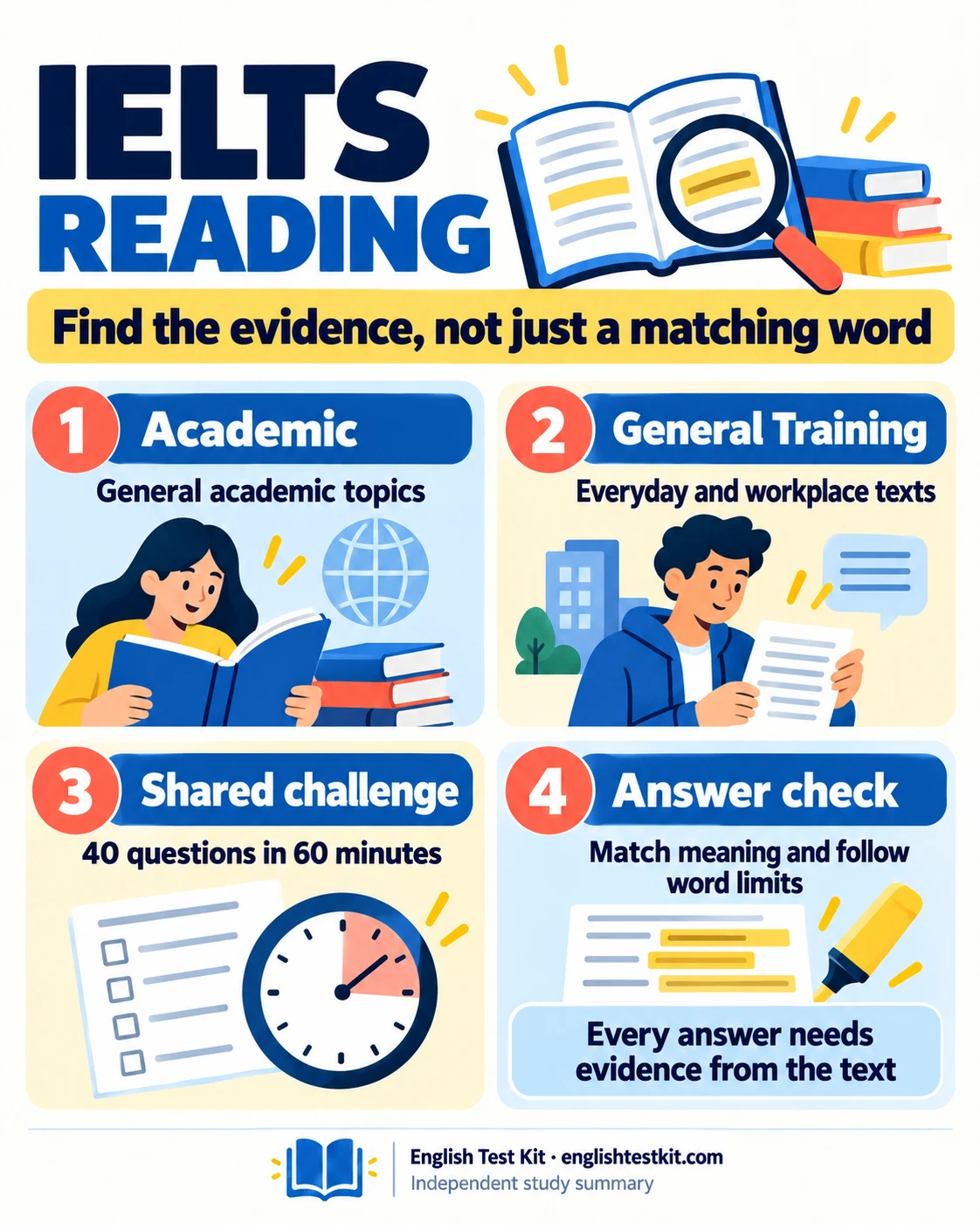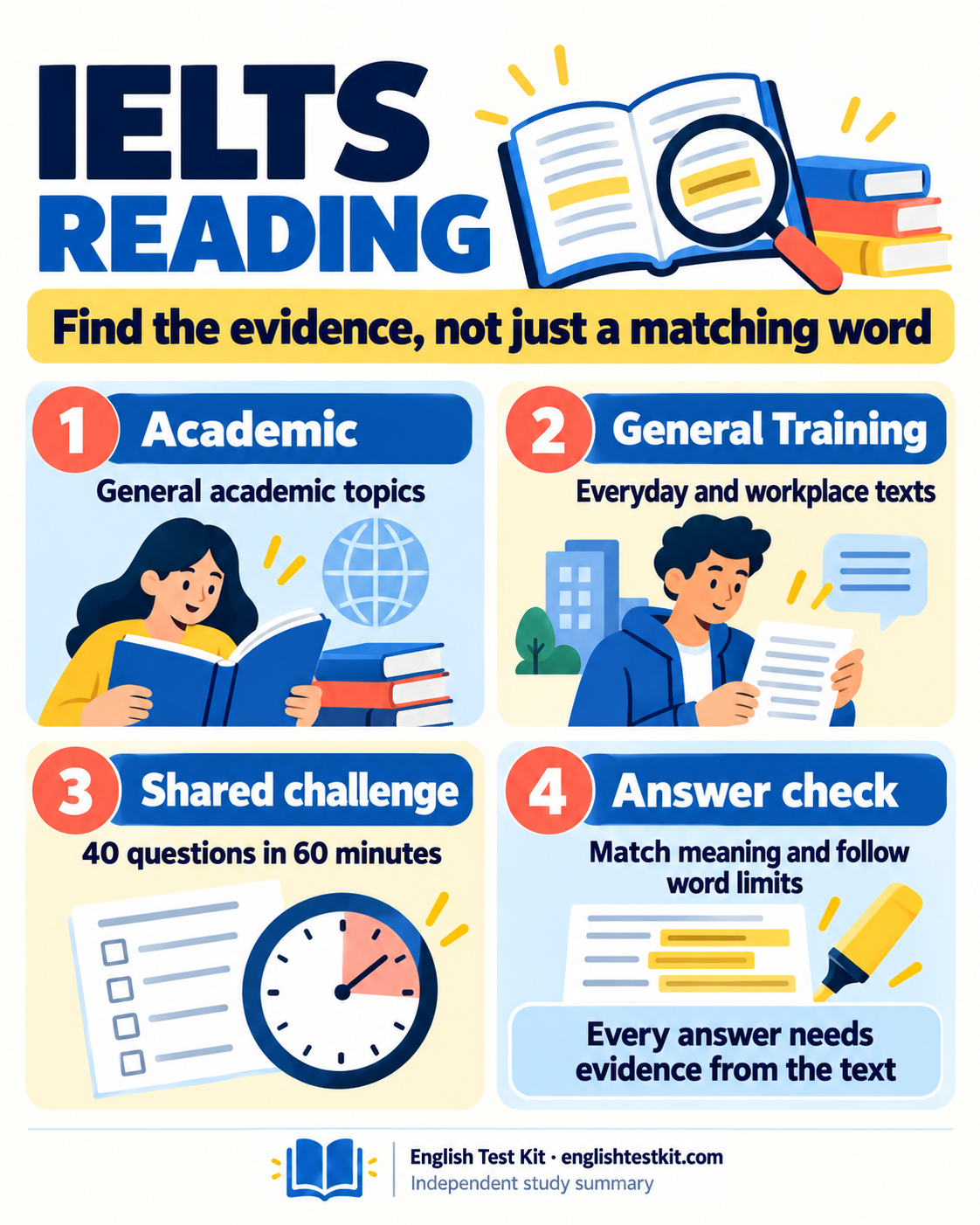
IELTS Reading tests what you can establish from a text under time pressure. Academic and General Training use different kinds of material, but both reward careful attention to meaning, instructions and evidence. A useful method separates understanding the passage from deciding exactly what a question asks you to prove.
A 60-minute reading test
Both main IELTS Reading tests last 60 minutes and contain 40 questions. You will work with several texts and answer questions that check skills such as finding detail, understanding the main idea, and following an argument.
Academic Reading
Academic Reading uses texts from sources such as books, journals, magazines, newspapers, and online publications. The subjects are intended for a general academic audience, not a specialist reader.
General Training Reading
General Training Reading starts with everyday material, moves into work-related texts, and includes a longer text on a general-interest topic. That makes it more closely connected with reading people may do in daily life or at work.
Use the right practice materials
The two versions do not use identical passages. Practise with materials for the test you plan to take, and follow the answer word limits shown in each task.
Choose a method that fits the question
For a main-idea question, ask what the paragraph is doing as a whole: introducing a problem, explaining a change, comparing approaches or supporting a claim. For a detail question, locate the relevant information and compare its meaning with the options. A repeated word is a search clue, not proof that an answer is correct.
Matching headings and matching information also require different attention. A heading should summarise a paragraph's central point; a matching-information item may ask for one specific example or detail. If you look only for a topic word, you can choose a heading that describes one sentence while missing the paragraph's purpose.
Worked example: false is different from not given
Read this original practice text: “The community library opened a new study room in May. Students may use it until 8 p.m. on weekdays. At weekends, the room closes at 5 p.m.” Assume the task asks whether each statement agrees with the information in the text.
“Students can use the study room until 8 p.m. on weekdays” is True, because the passage states the same meaning. “The room closes at 8 p.m. on Sundays” is False, because the weekend closing time is 5 p.m. “The study room has twenty desks” is Not Given, because the text says nothing about the number of desks.
Notice that your knowledge of libraries does not help with the final statement. Twenty desks might be plausible, but plausibility is not evidence. Likewise, the second statement is not merely unsupported: it conflicts with a stated time. During review, identify the exact relationship—agreement, contradiction or missing information—instead of memorising the letter of the answer.
Handle completion tasks precisely
Read the answer instruction before filling a gap. If you must use words from the passage, choose the required information without adding an unnecessary explanation. Then read the completed sentence for meaning and grammar. A correct idea expressed with too many words can fail the task's limit, so check the answer form separately from comprehension.
For an unfamiliar word, first ask whether you need its exact meaning to answer. The surrounding contrast, example or definition may provide enough information. Avoid spending several minutes translating a term that does not affect the question. When a word is important, record the phrase and context during review rather than keeping an isolated vocabulary list.
A pacing method to test in practice
Start by identifying the passage's topic and structure, then read the questions so you know what information to seek. Work through the relevant section carefully. If one item remains uncertain, mark it in your practice notes and continue before returning. Some tasks follow text order while others require searching across sections, so follow the pattern of the actual task rather than assuming one universal rule.
After a timed set, compare three groups: answers you knew, answers you guessed, and items you did not finish. Review guessed correct answers too; they can hide a weak method. Measure whether your next attempt improves evidence-finding and completion, not only speed.
Common mistakes to correct
Matching an option to a familiar word without checking the whole claim.
Using outside knowledge when the answer must come from the passage.
Confusing an unstated detail with a contradiction.
Selecting a heading for a striking example instead of the paragraph's main idea.
Ignoring the word limit or the required number of options.
Build accuracy on fresh passages, then add realistic time pressure. Repeatedly answering a passage you remember can feel fluent without showing that the method transfers to a new text.
Save your one-page study summary