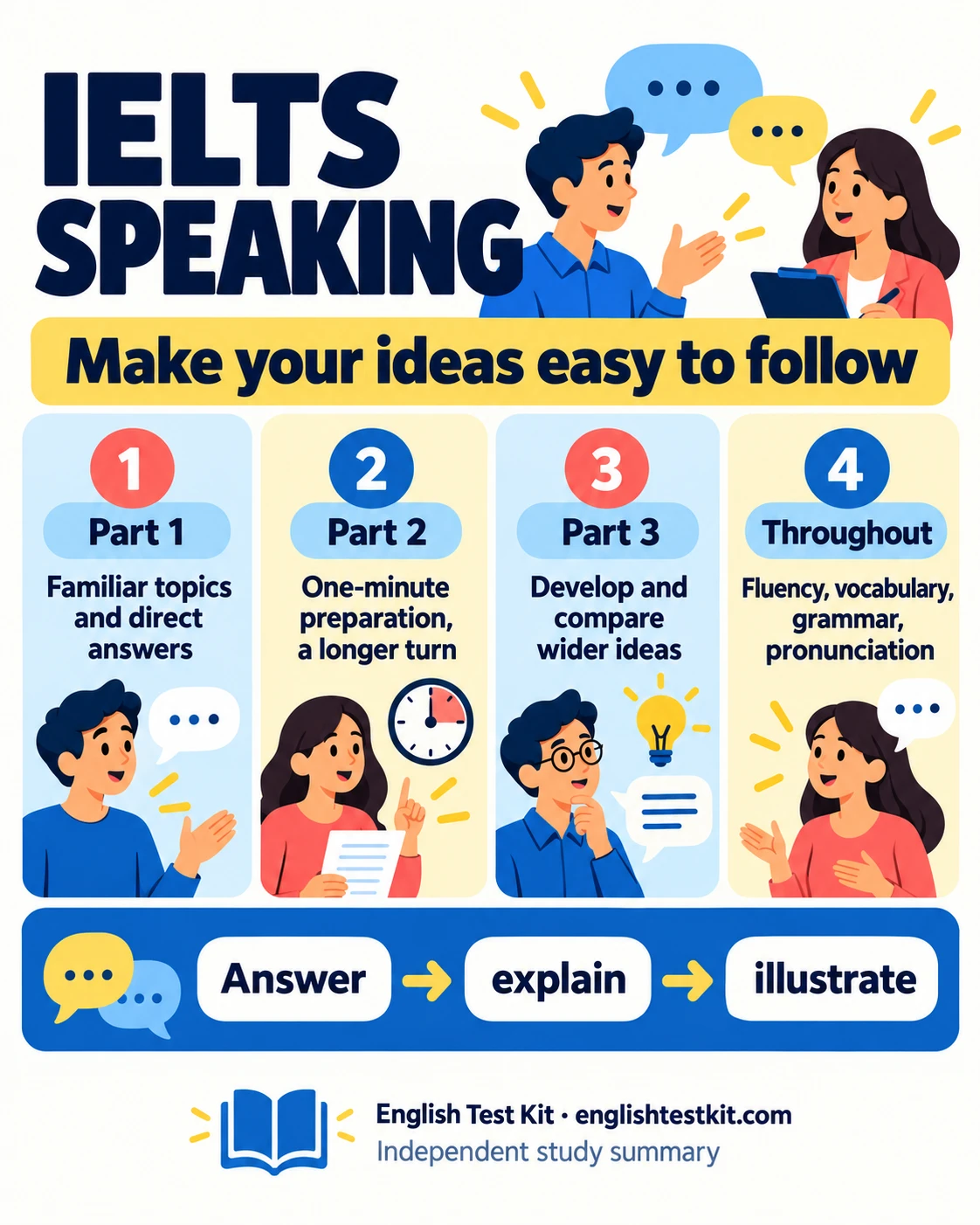
IELTS Speaking is a conversation in which your ideas need to be understandable, relevant and sufficiently developed. Learning the three-part format helps, but improvement comes from practising how you answer a particular question and how you respond when the topic changes. Build flexible habits rather than a speech that only fits one familiar prompt.
A short, structured interview
The Speaking test lasts 11–14 minutes and has three parts. At a test centre, it is conducted with an IELTS examiner; IELTS Online uses a video call with an examiner.
Part 1: familiar questions
The examiner introduces the test and asks questions about familiar areas such as home, work, studies, or interests. This part takes about four to five minutes.
Part 2: an individual long turn
You receive a topic card, have one minute to prepare, and then speak for up to two minutes. The examiner may ask a short follow-up question.
Part 3: a deeper discussion
The final part discusses ideas connected with the Part 2 topic, usually in a broader or more abstract way. Examiners assess fluency and coherence, vocabulary, grammar, and pronunciation.
Part 1: answer directly and add a useful detail
For the original practice question “Do you prefer studying in the morning or evening?”, “Morning” gives an answer but little language to evaluate. A fuller response might be: “I prefer the morning because I can concentrate before work. I usually read for half an hour while the house is quiet.” The reason and example develop the answer naturally.
Not every question needs a long story. Listen carefully, answer what was asked and add a relevant explanation when useful. If you do not share the experience mentioned in a question, you can say so and develop an honest related response. Inventing an elaborate story can make the language harder to control.
Part 2: use preparation time to build a route
Imagine an original cue-card topic about a useful place in your neighbourhood. A short plan might contain four cues: “library — near station — evening study — quiet tables”. These are reminders of a possible route through the answer, not sentences to read aloud. Start by identifying the place, describe a few concrete details, explain how you use it and finish with why it matters to you.
A connected long turn develops details in an order the listener can follow. For example, describing the library's evening opening hours can lead naturally to an explanation of studying after work. You do not need an unusual place or a dramatic story. Familiar material often gives you more accurate language and specific examples.
Practise speaking from a few keywords, then repeat the activity on a different topic. Notice whether you run out of ideas because the plan is too narrow, or because you spend too long explaining the first detail. Change the planning habit that causes the difficulty.
Part 3: move from a personal example to a wider idea
A follow-up discussion may ask why public places are important to a community. “Libraries are good” states a view without examining it. You could develop the idea by explaining that shared spaces provide access to resources, describing who benefits, and acknowledging that different neighbourhoods have different needs.
Use comparisons and qualifications when the question calls for them. “This may be especially useful for…” is often more accurate than claiming that everyone behaves the same way. You can consider another view without losing your own position. The goal is a clear discussion, not a contest to use the longest words.
Listen to a recording with specific questions
After a practice answer, first check content: did you answer the exact question, explain the point and include relevant detail? Then listen again for delivery. Can a listener follow the sentences? Are long pauses caused by unclear planning, word searching or trying to correct every small error? Are endings or stressed words difficult to hear?
Choose one change for the next recording. You might slow slightly to finish words clearly, connect two short ideas, or give a concrete example instead of repeating the question. Trying to repair everything at once makes progress difficult to measure.
Common habits that limit an answer
Repeating a memorised introduction even when the question asks something different.
Adding examples that do not support the point.
Speaking so quickly that useful words disappear.
Forcing idioms or complicated structures that you cannot control accurately.
Stopping after one short sentence when the task needs development.
Use the official assessment criteria to understand the broad areas being assessed, but avoid assigning yourself a precise band from one short recording. A consistent practice routine should strengthen fluency and coherence, vocabulary, grammar and intelligibility across unfamiliar prompts.
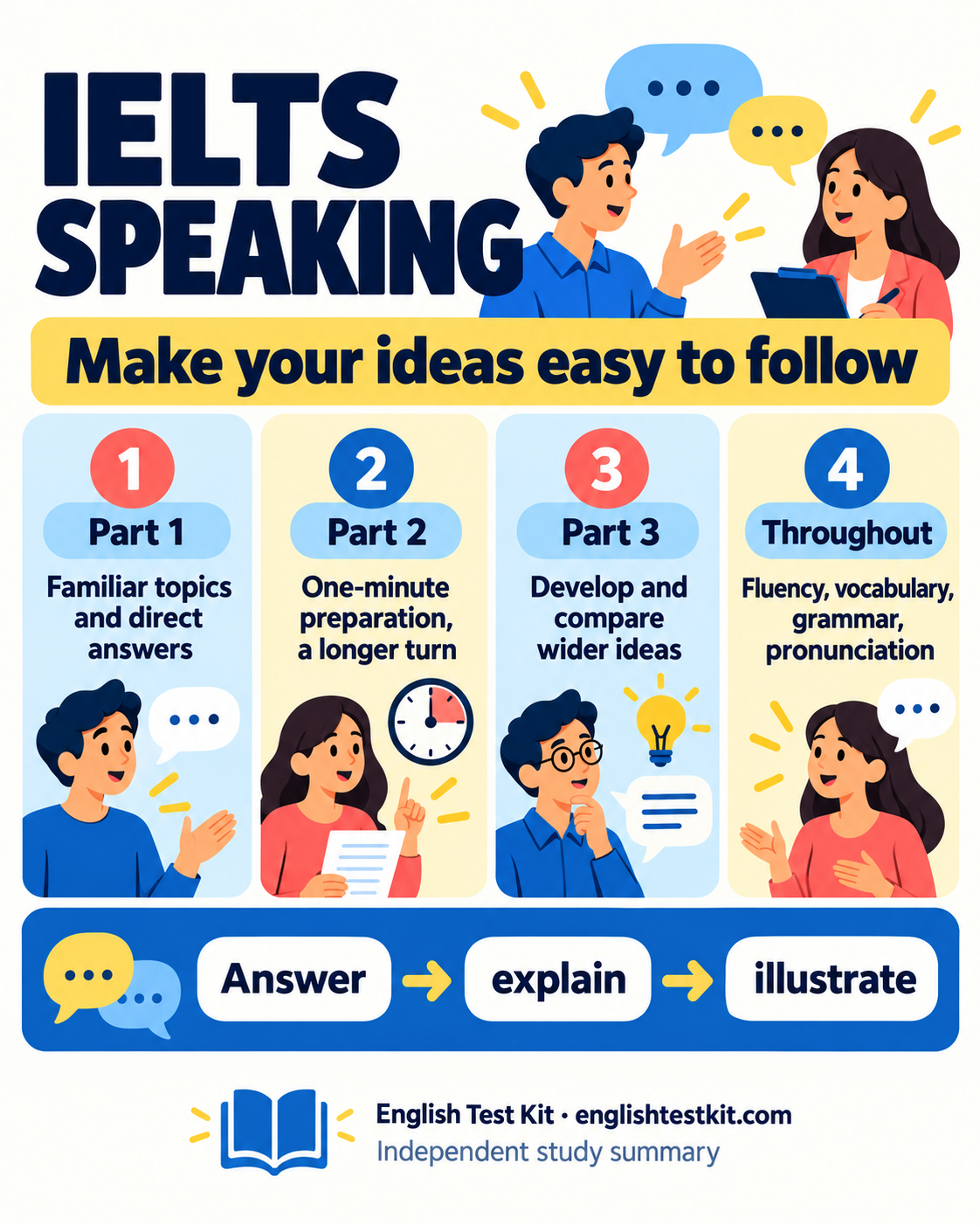
Save your one-page study summary