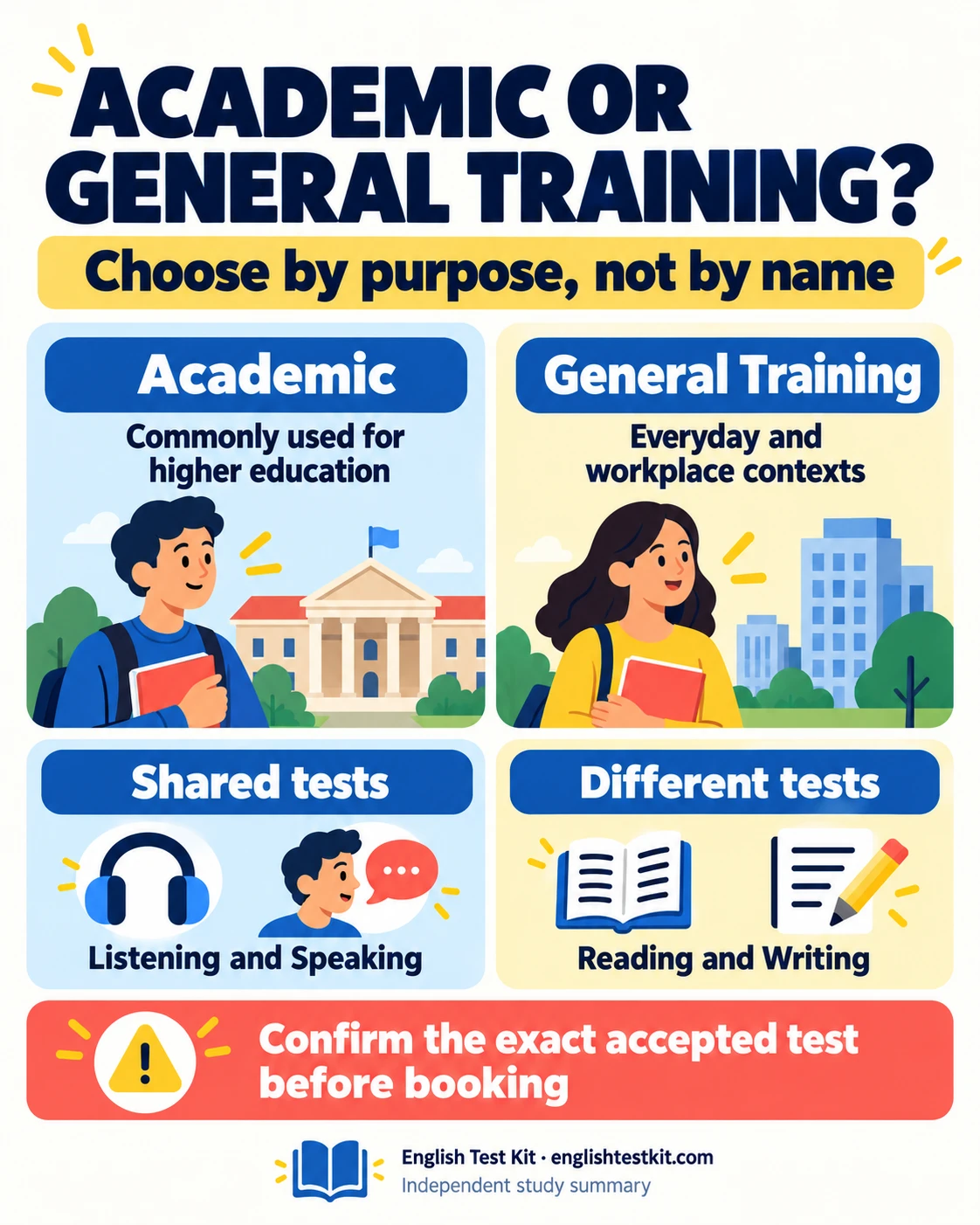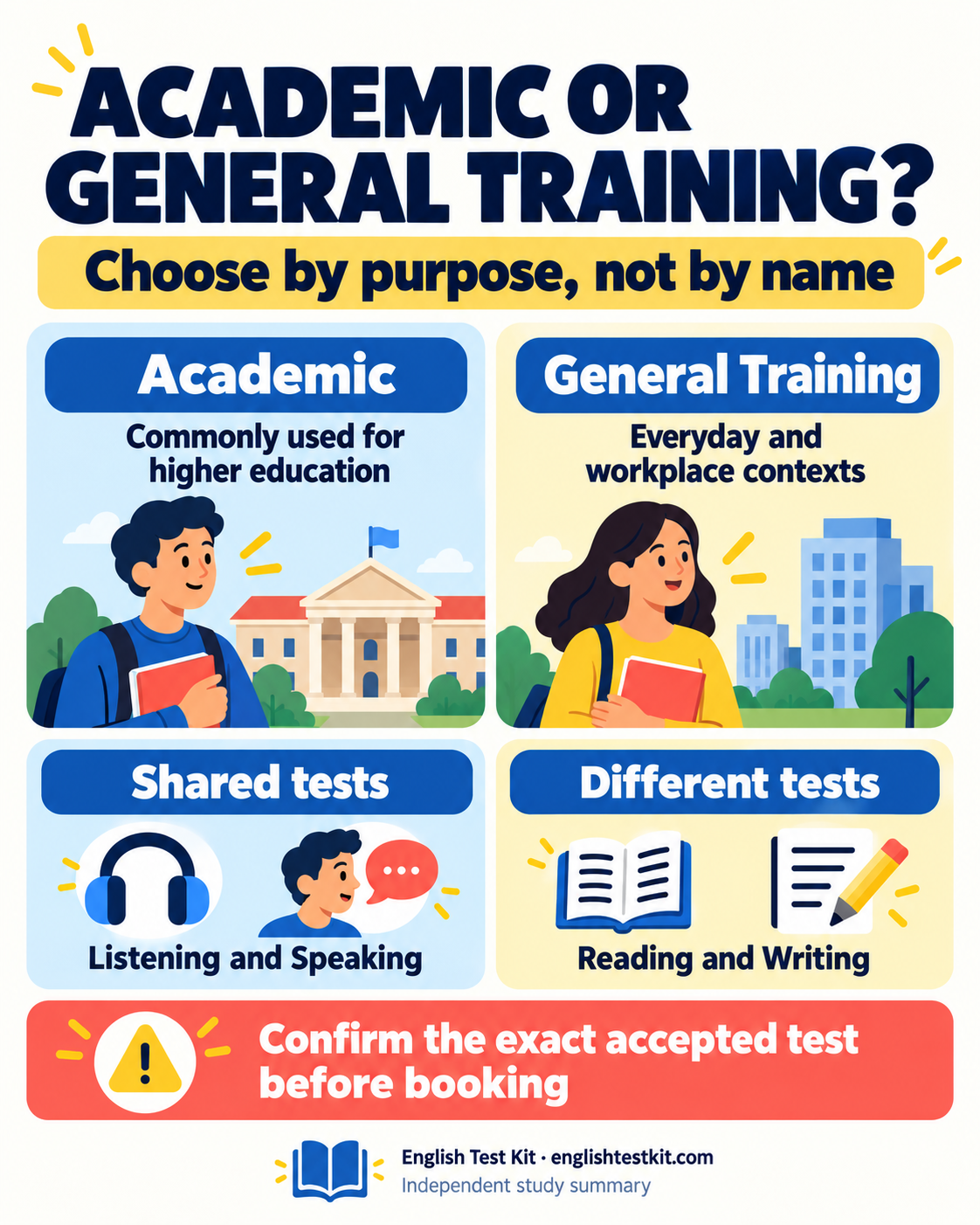
The right IELTS version is the one accepted for the decision you need to make. Academic and General Training share a four-skill structure, yet their Reading and Writing tasks serve different purposes. Choose using the receiving organisation's current instructions, then use those differences to select suitable practice material.
When Academic is commonly used
IELTS Academic is designed for people applying to undergraduate or postgraduate study in English, and it can also be used for some professional registration routes. Its Reading and Writing content reflects academic settings.
When General Training is commonly used
IELTS General Training focuses more on everyday and workplace English. It is commonly used for migration, work experience, training, and some study below degree level.
What is shared, and what changes?
Listening and Speaking are the same in Academic and General Training. Reading and Writing differ: the texts, situations, and task formats are chosen to suit each test purpose.
IELTS for UKVI and IELTS for UKVI Life Skills are separate options for specified UK visa routes. Life Skills assesses Speaking and Listening only. Check the exact visa and receiving organisation instructions; do not choose based on the test name alone.
A simple decision process
Begin with the official page for your exact course, professional registration or other application route. Look for the complete test name rather than a broad phrase such as “an English test”. Record whether the requirement mentions Academic, General Training, UKVI or a different approved option. If the wording is unclear, ask the receiving organisation a precise question before paying for a booking.
Consider two fictional learners. One is applying to a course that explicitly accepts IELTS Academic. Another is following a route that explicitly names IELTS General Training. Their personal interests do not reverse those requirements. A science student does not automatically need Academic for every possible application, and a working adult does not automatically need General Training. The purpose and published rule determine the choice.
What the Reading difference means for practice
Academic Reading uses material aimed at a general academic readership. You may need to follow an explanation, identify a writer's position or understand the relationship between ideas. Specialist knowledge is not a substitute for reading the passage: the answer must be supported by the text supplied.
General Training Reading includes everyday and workplace material as well as a longer general-interest text. Practice might involve notices, procedures, messages or employment information. These situations may feel familiar, but familiarity can tempt you to answer from experience rather than evidence. In both versions, practise explaining which words support your answer and why a plausible alternative does not fit.
What the Writing difference means for practice
Academic Task 1 asks you to report visual information. A useful preparation activity is to identify the overview, select meaningful comparisons and describe changes accurately. General Training Task 1 asks for a letter. Its planning questions are different: who is the reader, why are you writing, what points must you cover, and how formal should the language be?
Imagine an original practice situation in which an evening course has changed its timetable. A letter may need to explain the problem, request an alternative and provide your availability. Writing an excellent description of a chart would not answer that task. This is why using the correct version matters even when your general grammar and vocabulary are strong.
Keep UKVI and other specified options separate
A requirement may specify an approved test route or reporting arrangement in addition to the familiar IELTS name. Do not assume that an ordinary booking automatically meets a UKVI requirement, or that Life Skills is a substitute for a four-skill result. Check the current official instructions for your exact purpose and location. This guide explains the distinction; the receiving authority determines what it accepts.
Common mistakes when choosing materials
Mixing Academic visual-report practice with General Training letter practice without noticing which task you need.
Assuming that shared Listening and Speaking formats mean all four sections are identical.
Choosing a test because a friend obtained the desired result in it.
Checking only the overall score while overlooking individual-skill minimums, result validity or a deadline.
Before you book
Save the relevant requirement, confirm the test name and delivery option, and make sure the chosen appointment fits your reporting deadline. Then label your study materials clearly by version. You can still use general English activities to build vocabulary, listening and fluency, but your timed Reading and Writing rehearsal should match the test you have selected. Recheck the requirement if your course, route or application purpose changes.
Save your one-page study summary