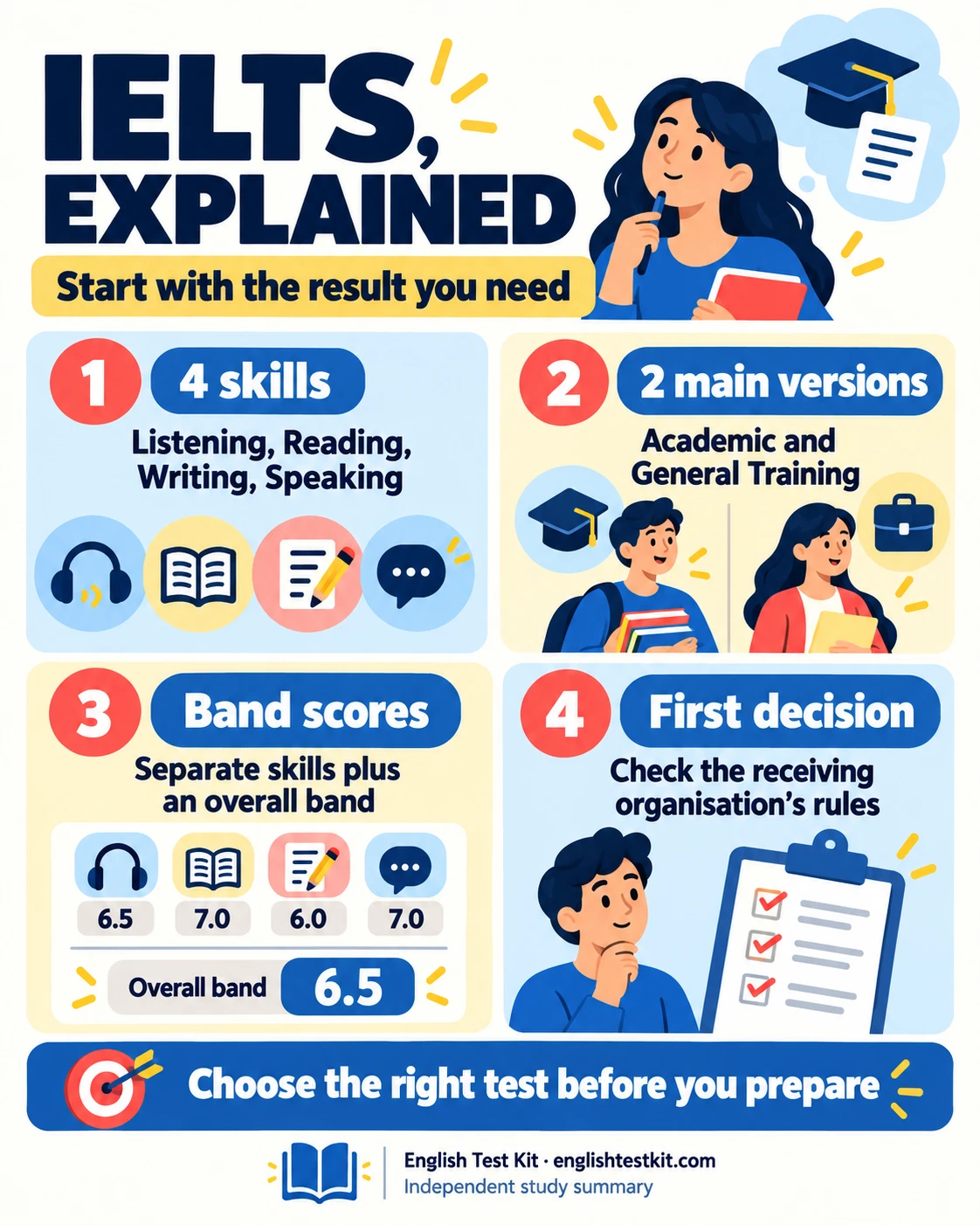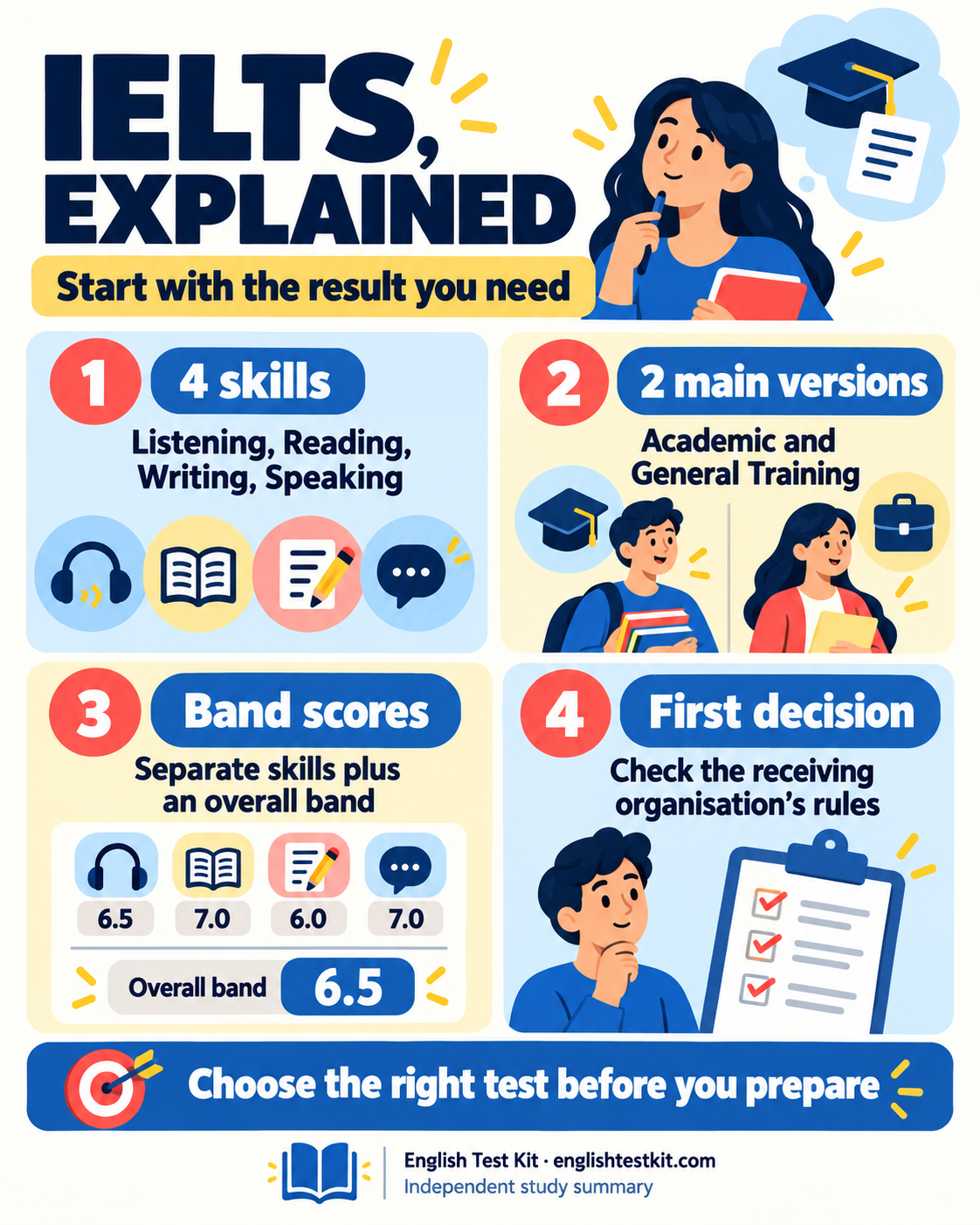
IELTS is useful when you understand both the test and the decision its result will support. A learner preparing for university, professional registration or another accepted purpose needs more than the name of an exam. Start by matching the required test version and score to your current language skills, then use the four sections to organise preparation.
What IELTS measures
IELTS stands for the International English Language Testing System. It assesses how well a person can use English in situations connected with study, work, migration, and everyday life.
IELTS is a test, not a course. A result gives evidence of English ability at the time of the test; it does not decide by itself whether someone can enter a university, receive a visa, or get a job.
Four skills, one overall result
The main IELTS tests assess Listening, Reading, Writing, and Speaking. Test takers receive a band score for each skill and an overall band score based on those four results.
The organisation receiving your result sets its own required score. Always check its current requirement before choosing a test or booking a date.
Start with your goal
IELTS Academic and IELTS General Training have different purposes and different Reading and Writing content. Some immigration routes also specify an IELTS for UKVI test. The right choice depends on the exact institution, visa, or professional body you are applying to.
Turn a broad goal into a test requirement
Write down who will receive the result and where its current requirement is published. Record the accepted test name, overall score, any minimum for an individual skill, result-date rules and application deadline. This small document prevents a common mistake: preparing for a familiar version because a friend took it, without checking whether it fits your own application.
For example, imagine that a fictional course requires IELTS Academic with an overall 6.5 and no skill below 6.0. A learner who achieves 7.0 overall but 5.5 in Writing would miss that illustrative requirement. The lesson is about reading conditions carefully, not about any real university's entry policy. Always replace the example figures with the receiving organisation's actual rules.
Understand what the four skills reveal
Listening checks whether you can follow spoken information and respond to the task. Reading asks you to locate, connect and interpret information in written texts. Writing requires purposeful, organised responses, while Speaking asks you to communicate ideas in real time. A learner can be strong in one area and need substantial work in another, so one overall number never tells the complete learning story.
Try a small diagnostic before buying a large preparation package. Read an unfamiliar passage, listen to a short talk, write a response to an appropriate prompt and record a spoken answer. Note the difference between understanding the language and understanding the test instructions. These are related difficulties, but they often need different kinds of practice.
A practical example of choosing what to study
Suppose Rina reads comfortably but loses her place in listening recordings and gives very short speaking answers. Repeating complete Reading tests every day would mostly exercise an existing strength. A better plan would keep some reading practice while adding one-play listening sets and short recorded responses that include a direct answer, a reason and an example.
After each session, she should name one observable change. “I followed the correction to the meeting date” and “I supported my opinion with a specific detail” are useful observations. “I studied for an hour” describes effort but gives little evidence about what improved. IELTS preparation becomes more purposeful when each practice session has a skill target and a review step.
Avoid common starting mistakes
Treating Academic as the universally harder or better option: choose the version required for your purpose, then prepare with its actual Reading and Writing tasks.
Learning answers instead of communication: a memorised speech or essay can fail to address the question you receive.
Ignoring one skill: keep all four visible in your study schedule, especially when the recipient sets section minimums.
Relying on a general score chart: check the exact receiving organisation and test-date policy rather than assuming a popular target applies everywhere.
Your first week of preparation
Use the first day to confirm the requirement and learn the section structure. Over the next few sessions, try representative tasks from each skill, review the instructions and record the main sources of difficulty. Finish the week by choosing two priorities and a realistic schedule. If spelling causes completion errors, for example, practise sound-to-spelling links alongside listening; if an essay lacks development, plan and explain one paragraph before writing another full essay.
You do not need a perfect study plan immediately. You need a reliable starting point, appropriate material and a habit of using evidence from practice to choose what happens next.
Save your one-page study summary