An IELTS band score is most useful when you read the complete profile and compare it with a real requirement. The overall band summarises four skills, while the individual scores show differences that an average can hide. Learn the calculation, then use the report to decide which kind of practice would address the actual gap.
A score for each skill
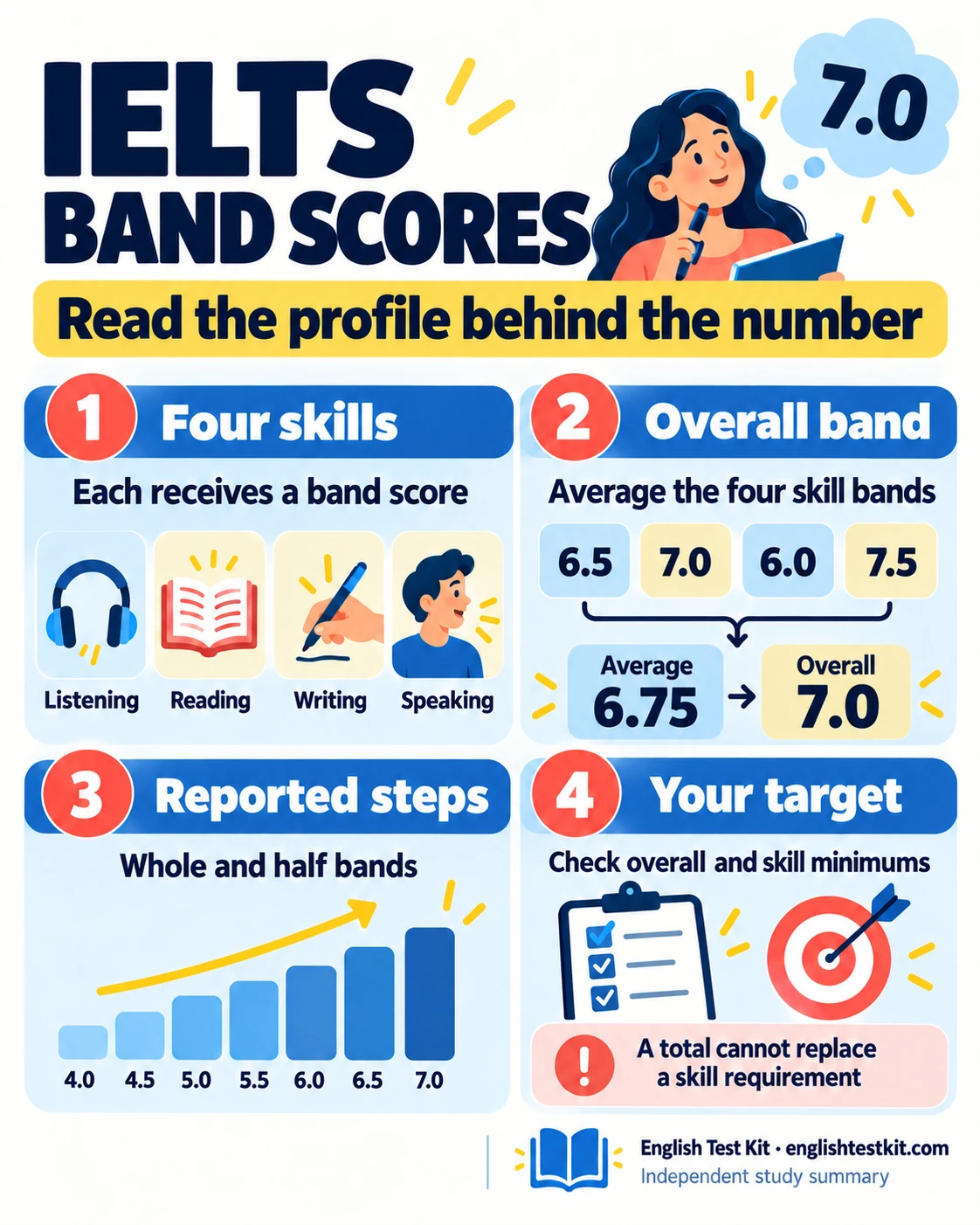
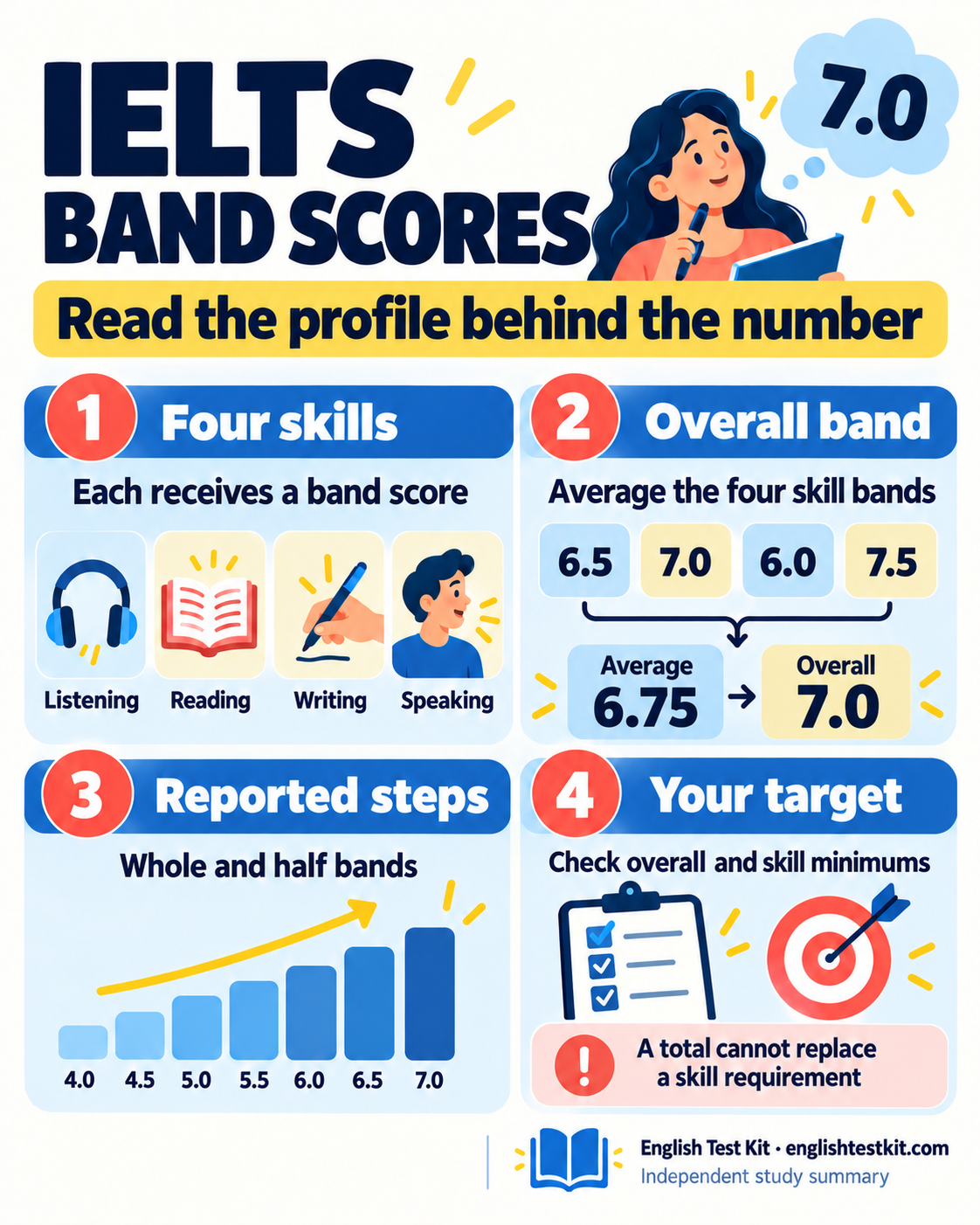
Your result reports separate band scores for Listening, Reading, Writing, and Speaking, plus an overall band. IELTS uses whole and half bands from 0 to 9 to describe English proficiency; the descriptors range from no attempt at band 0 to expert performance at band 9.
The band is a description of language ability. It is not a pass or fail grade, and the score an organisation requires depends on that organisation and the purpose of your application.
How the overall band is calculated
The overall band is the average of the four skill scores, rounded to the nearest half band. For example, section scores of 6.5, 6.5, 5.0, and 7.0 average to 6.25, which becomes an overall 6.5.
Read the four scores as well as the overall score
A required overall score may not be the only condition: a university, employer, regulator, or visa authority may also set a minimum for one or more skills. Check the current rule for the exact programme or route you are applying to.
Work through the arithmetic carefully
Consider a fictional result with Listening 6.5, Reading 6.5, Writing 5.0 and Speaking 7.0. The sum is 25, and dividing by four gives 6.25. Under IELTS's overall-band rounding rule, the reported overall band is 6.5. The calculation explains the overall result; it does not change the Writing band or make the skills equal.
For a second example, Listening 7.0, Reading 6.5, Writing 6.5 and Speaking 7.0 total 27. The average is 6.75, which becomes an overall 7.0. Keep the arithmetic transparent: list the four reported skill scores, add them, divide by four and apply the official rounding rule. Do not round individual components again before taking the average.
Compare a report with all parts of the requirement
Imagine a fictional programme asking for an overall 6.5 with every skill at least 6.0. The first example reaches the overall figure but misses the Writing condition. Another programme could use a different combination of requirements, so the same report might lead to a different decision. These invented examples demonstrate how to read conditions; they are not admissions advice or real institutional policies.
Create a simple comparison with one row per condition. Record the required overall band, each skill minimum, accepted test version and result-date policy, then mark whether the official report meets each one. If a rule is ambiguous, ask the receiving organisation which value it uses rather than assuming that a higher overall band solves every problem.
Understand what a band description can tell you
Public descriptors explain broad levels of language performance and the areas assessed in productive skills. Use them to ask useful questions about a response: is the argument developed, are ideas connected, is vocabulary accurate, and can the listener understand the speech? They are a framework for feedback, not a shortcut that turns one good phrase into a guaranteed score.
Listening and Reading responses are marked against task answers and reported on the band scale. Writing and Speaking require evaluation across their published criteria. Avoid treating a percentage in an unrelated practice activity as an official IELTS band. Material difficulty, task coverage and scoring procedures all affect the meaning of a practice result.
Turn a weaker skill into a practical target
Suppose a learner's writing is organised but often misses one part of the prompt. “Use more advanced vocabulary” would not directly repair that problem. A more useful practice target is to identify every required point, produce a plan that covers them and check the finished response against the plan. A learner who loses Listening answers through spelling needs a different intervention.
Use a short error record with a task, the evidence of the problem and one adjustment. After several fresh attempts, check whether the error becomes less frequent. Improvement should appear in what you can do consistently, not only in the best score from a familiar set you have repeated.
Questions to ask before relying on a result
Does the receiving organisation accept this exact IELTS version?
Is its requirement about the overall band, individual skills, or both?
Is the result recent enough for its policy and deadline?
Are you using the official report rather than a practice estimate?
Keep the four skill bands visible when setting your next goal. The overall number is useful, but the profile provides the more specific starting point for preparation.
Save your one-page study summary