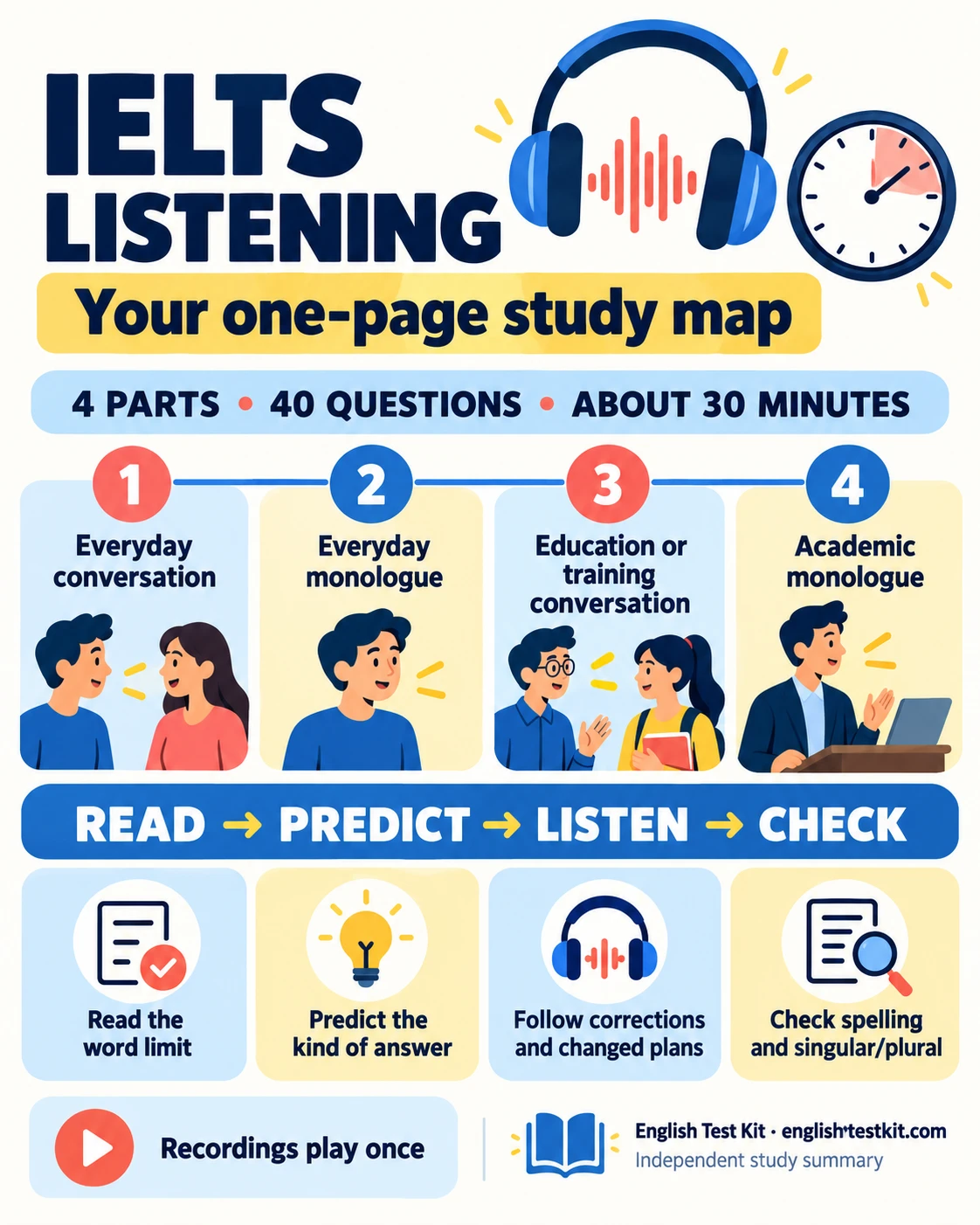
IELTS Listening rewards a combination of understanding spoken English and following a precise task. Knowing that there are four parts is only the beginning. You also need to predict the information a gap requires, follow a speaker who changes a plan, and enter an answer that fits the instruction. The method below turns those requirements into something you can practise.
Four parts and 40 questions
The Listening test has four parts, with ten questions in each part. The recordings include social, everyday, educational, and training situations.
Listen for the information requested
You hear each recording once. Question types can include multiple choice, matching, map or plan labelling, and completing notes or forms. Read the instructions carefully, especially any word limit.
Timing
The Listening component takes about 30 minutes. The voices use a range of English accents, so preparation should include listening to different speakers rather than only one variety.
How the four parts change your listening job
In Part 1, expect to follow an everyday exchange, such as a booking or enquiry. Names, dates, prices and arrangements can matter, so notice spelling and corrected details. Part 2 has one main speaker in a social setting. A tour or facilities talk may require you to connect directions with a map instead of simply recognising a word.
Part 3 moves into education or training. Two speakers may compare options, question an idea or agree on a final decision. Track who holds each view and whether it changes. Part 4 is an academic monologue: organise what you hear around the topic, main points and examples. You do not need specialist knowledge, but you do need to keep your place as the explanation develops.
A worked example: listen to the correction
This original transcript is a written demonstration, not a recording or an official test question: “We first planned to meet at the station on Thursday. The venue has changed, though. Please come to the library on Friday.” Imagine two completion items: “Meeting place: ___” and “Meeting day: ___”, with the instruction “ONE WORD ONLY”.
The answers are library and Friday. “Station” and “Thursday” are plausible distractors because the speaker mentions them, but the later correction replaces both details. An answer such as “the library” also breaks the one-word instruction, even though the intended place is right. This example shows why hearing a familiar word is not enough: you must follow the final meaning and then check the response format.
Use a read, predict, listen and check routine
Before the relevant recording starts, read the available questions and underline the information you need. A gap after “arrival time” suggests a time; a sentence about equipment may need a noun. Predicting the category helps you recognise the answer without guessing its actual content. For a map, establish your starting point and notice the landmarks before following movement.
During the recording, keep your attention on the current question and the next one. Follow signals such as “actually”, “instead”, “however” and “in the end”. If you miss an answer, move with the recording rather than sacrificing several later answers to reconstruct one lost sentence. Enter what you can support, then use any permitted checking time to review the form of the response.
Common mistakes and useful corrections
Selecting the first matching word: wait for the complete idea, especially when the speaker corrects a detail or contrasts two options.
Ignoring the instruction: check the required number of choices or the permitted words and numbers separately for each task.
Losing small endings: after a completion answer, ask whether the meaning and grammar require a singular or plural form.
Treating every task alike: a matching task needs speaker or category tracking; a map needs spatial orientation; a completion task needs exact information.
Build an error log that improves the next attempt
Do a short listening set once under realistic conditions. Afterwards, compare your answers with the key and locate the supporting phrase in a transcript. Label each miss: vocabulary, sound recognition, changed information, lost place, spelling or instruction. Replay the difficult section only during this review stage. Then practise a fresh item with the same weakness in mind. Your next goal might be “recognise corrections accurately” rather than simply “get more marks”.
Questions learners often ask
Is Listening different in Academic and General Training? The Listening format is shared. Should I practise one accent only? Use varied speakers because the test includes different English accents. Will every test contain the same number of each question type? No; learn the task families and follow the questions actually presented. Check your booking instructions for the delivery details and answer-entry procedure that apply to your test.
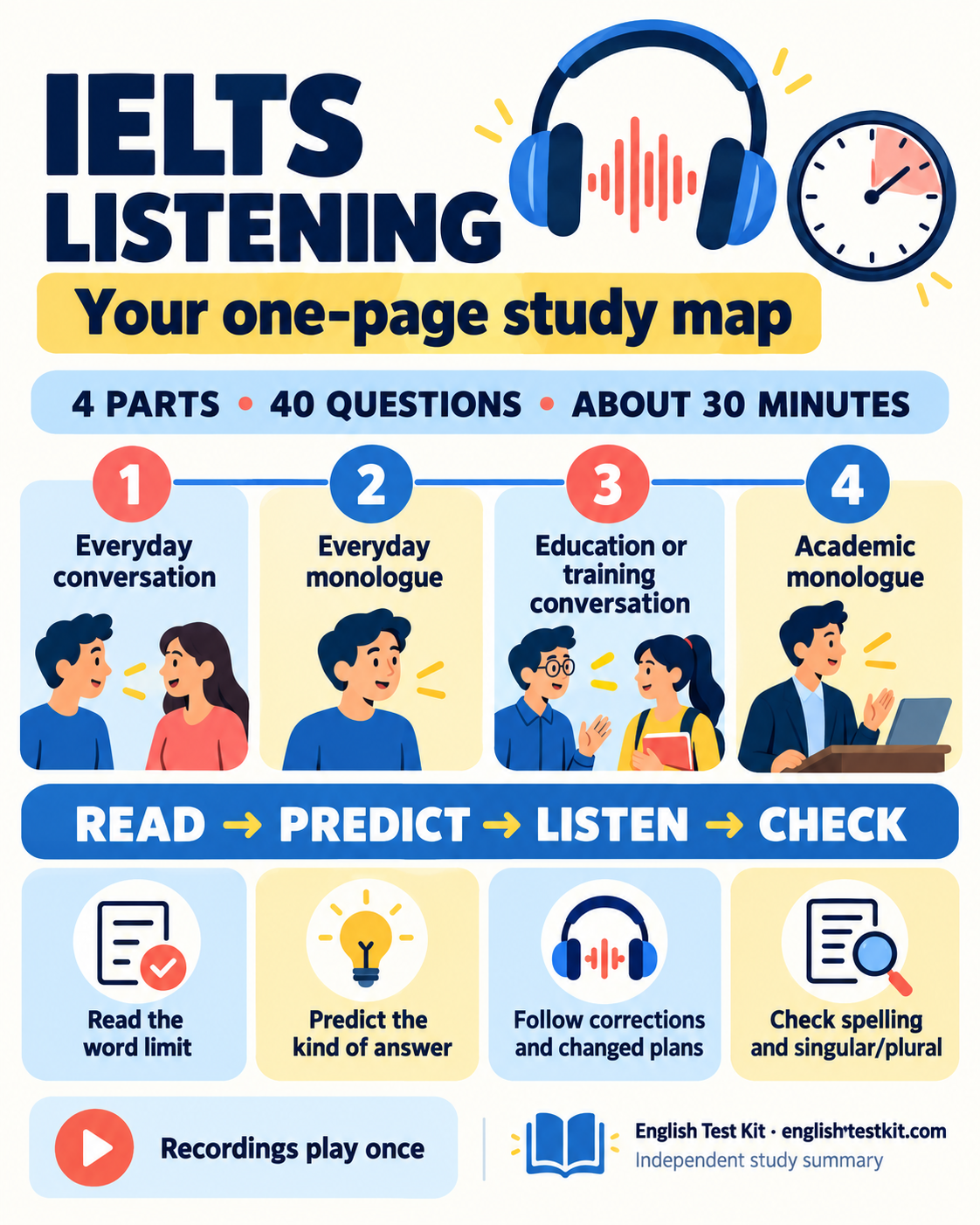
Save your one-page study summary