A Duolingo English Test score is useful when you read it against a specific application requirement. Start with the certified overall result, then check every required skill score. A high overall number does not automatically meet a separate minimum in writing or speaking, and a practice estimate is not a certified report.
The overall scale
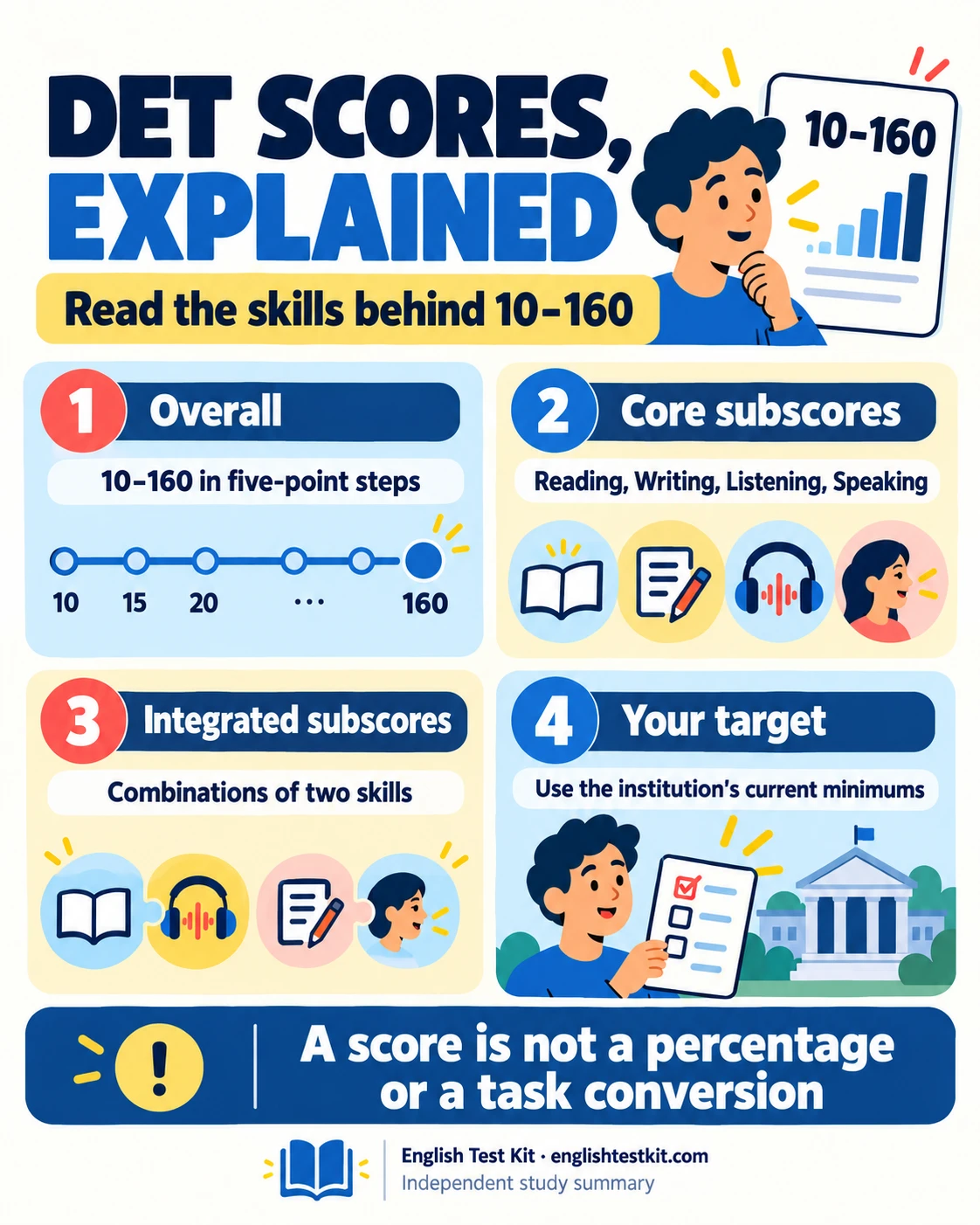
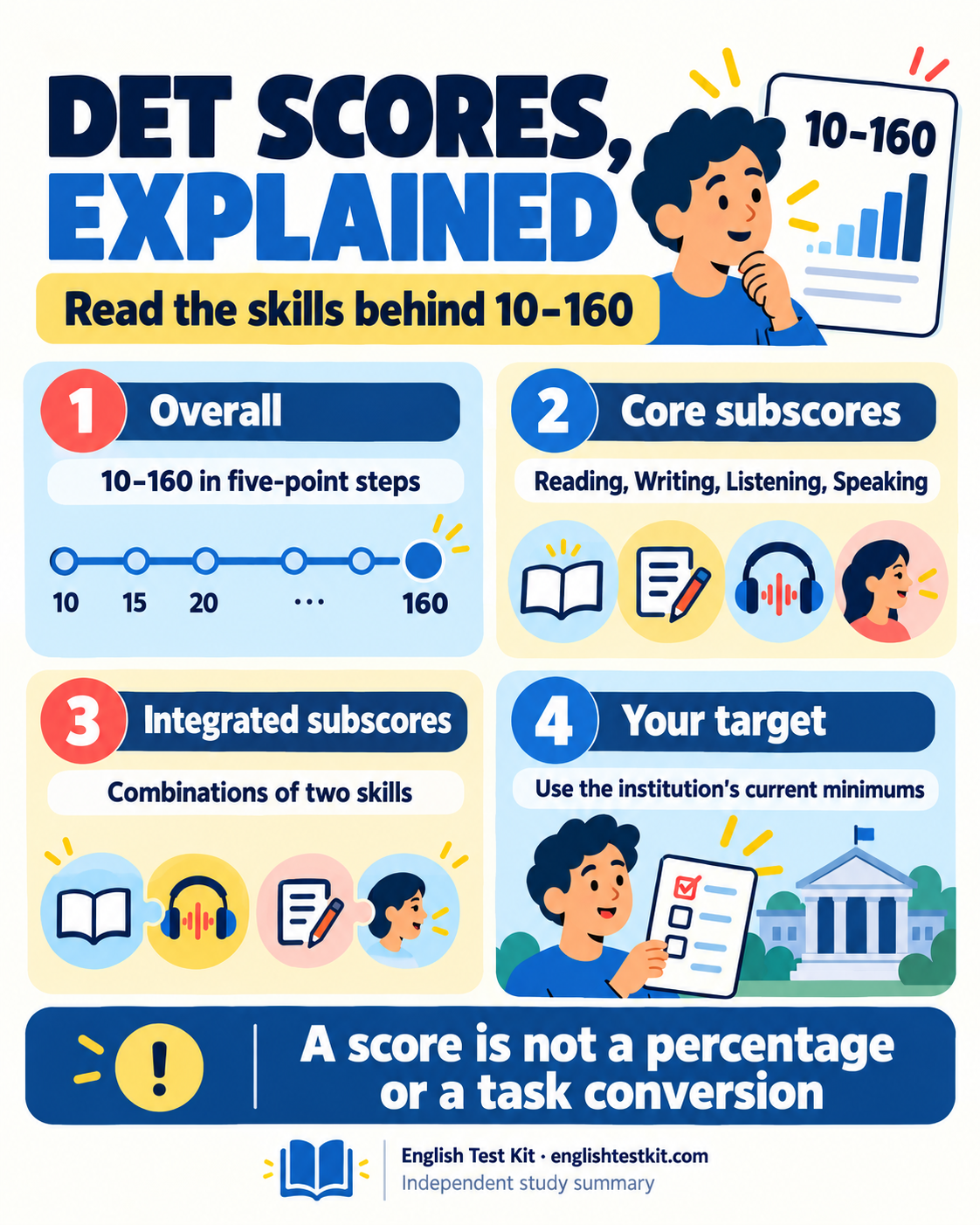
The Duolingo English Test reports an overall score from 10 to 160 in five-point increments. The number is a summary of performance across the adaptive test; it is not a percentage or a direct conversion from one question type.
Four core skill subscores
Subscore | What it represents |
|---|---|
Reading | Understanding written English across the reading tasks. |
Writing | Communicating ideas in written responses. |
Listening | Understanding spoken English and details in audio. |
Speaking | Communicating ideas through spoken responses. |
Integrated subscores
Literacy combines Reading and Writing.
Comprehension combines Reading and Listening.
Conversation combines Speaking and Listening.
Production combines Speaking and Writing.
The adaptive design uses item-response modelling to estimate ability from the pattern of your answers. Automated models score many open responses, and the system is developed with expert-rated examples. Use the official score report for your exact result and the institution’s current requirement for your target.
Understand how the overall score is formed
Current official guidance calculates the overall score from the average of the four individual skill subscores, rounded to the nearest five. For an arithmetic illustration, Reading 120, Writing 115, Listening 125 and Speaking 115 average 118.75, which rounds to an overall 120. These invented numbers explain the calculation; they are not a prediction of your result.
The subscores themselves come from assessment of performance across the relevant tasks. You cannot reliably calculate a certified skill score by counting a few correct practice answers. Adaptive comprehension tasks and evaluated open responses do not behave like a simple classroom percentage test.
Separate core skills from integrated subscores
The four core skills describe reading, writing, listening and speaking individually. Integrated subscores combine pairs of those skills to describe broader communication areas. They provide another view of performance rather than additional points that you add to the overall result.
For example, Production draws on writing and speaking, while Comprehension draws on reading and listening. A learner may find the integrated view useful for spotting a pattern, but should still inspect the individual skills when a university specifies individual minimums. Do not average every number printed on the report together or treat an integrated subscore as a fifth independent skill.
Check a fictional requirement correctly
Imagine a programme requiring an overall score of 120 and at least 115 in each core skill. A fictional applicant with overall 125 but Writing 110 has not met that stated writing minimum. Another programme may publish only an overall threshold, or may specify a different combination of subscores.
Write down the exact test, programme, intake, overall minimum and any subscore conditions. If a requirement uses unfamiliar terminology or an older report format, ask the recipient how it applies to the current report. A general acceptance statement for the institution does not necessarily settle the requirements of every department or professional course.
Use score patterns to choose practice
Suppose reading is consistently stronger than speaking in your practice evidence. The useful next step is to inspect speaking responses for specific causes: incomplete answers, thin development, unclear delivery or difficulty responding to a follow-up. Repeating general reading drills may not address that weakness.
Use recordings, written responses and comprehension reviews alongside practice estimates. Look for a repeated pattern across several attempts rather than reacting to one small change. A score tells you where to investigate; the response evidence helps you decide what to practise. No single template or question type guarantees a particular increase.
Avoid misleading comparisons and deadline decisions
A DET score is not a percentage, and equal-looking numbers across different English tests do not represent equal performance. Official comparison information can provide context, but it does not replace the recipient’s named test and score requirement. Never convert your own result to another exam and assume it will be accepted.
Before applying, check certification, the test date, validity and the report-sharing procedure as well as the score. Keep a copy of the published requirement with the date you checked it. If you need to improve, leave time for preparation, another test if appropriate, certification and the institution’s receipt of the report.
Save your one-page study summary