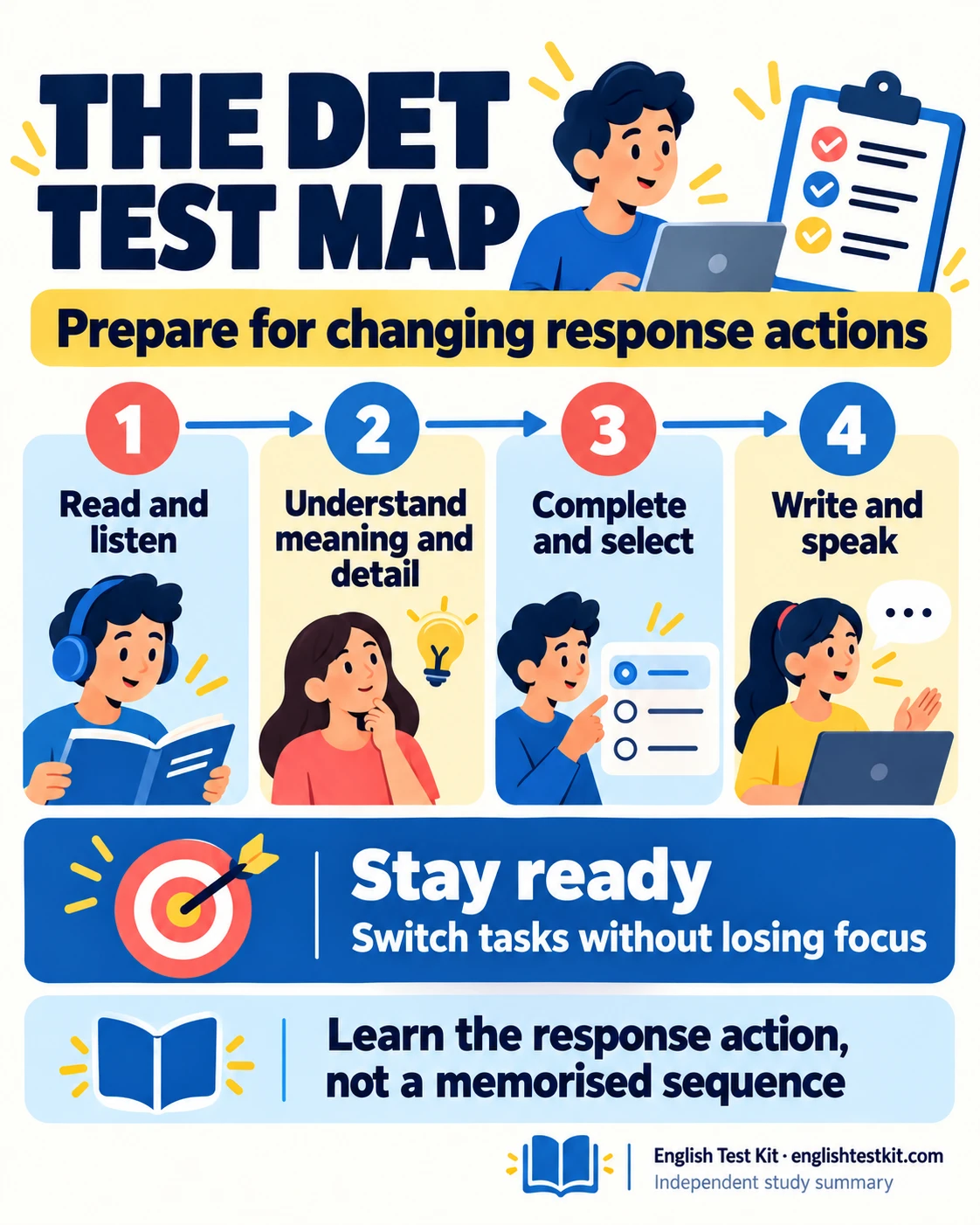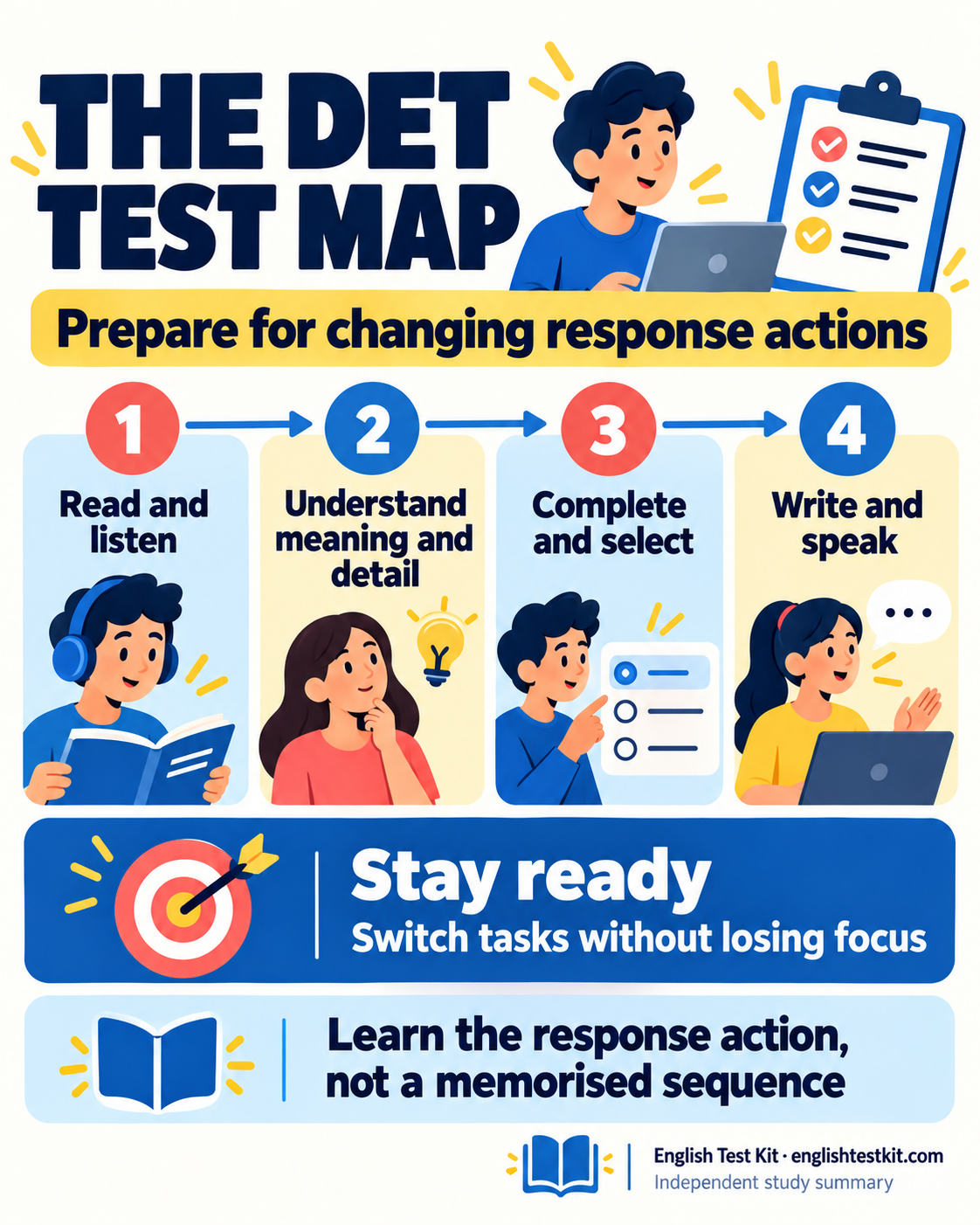
The DET format is easier to manage when you learn what each task requires rather than memorising one exact sequence. Some work is adaptive, and the test combines short comprehension activities with connected and open responses. Prepare to reset your attention whenever the input or response action changes.
A compact, adaptive experience
Plan for about one hour of uninterrupted time. After the setup checks, you complete a graded test, including tasks that adapt to your performance, and also provide a writing sample and a speaking sample. The exact path through the graded tasks is not identical for every test taker: the system selects later work using your responses.
The question counts below are the current ranges published by Duolingo. They are a useful map for preparation, not a promise of an identical paper for every candidate.
Current question-type ranges
Question type | Typical number |
|---|---|
Read and Select | 15–18 |
Fill in the Blanks | 6–9 |
Read and Complete | 3–6 |
Listen and Type | 6–9 |
Interactive Reading | 2 sets of 6 |
Interactive Listening | 2 sets of 8–10 |
Write About the Photo | 3 |
Interactive Writing | 1 set of 2 |
Speak About the Photo | 1 |
Read, Then Speak | 1 |
Interactive Speaking | 1 set of 6–8 |
Writing Sample | 1 |
Speaking Sample | 1 |
Prepare for a moving sequence
Learn the purpose and response method for each task before test day.
Practise switching between reading, audio, typing, and speaking without losing time to setup.
Keep your equipment and testing space ready so the adaptive section can measure English rather than interruptions.
Map the input, output and constraint
For each task family, note what you receive, what you must produce and the main condition. A word-recognition activity asks for a different decision from typing heard language. An interactive reading set requires you to maintain an understanding of a passage, while a spoken response needs relevant development and intelligible delivery.
This map helps separate language difficulty from instruction confusion. If you understand a prompt but use the wrong response form, the next learning activity should include task familiarity. If you know the action but cannot understand the source, work on the relevant English skill rather than only rehearsing the interface.
A short task-switching demonstration
Imagine moving from an original notice about a rescheduled class to a photo-description prompt. The notice requires locating a stated day and keeping any registration condition separate. The photo task requires describing visible details and connecting them into a response. Continuing to search for one short factual answer would not satisfy the second task.
Now imagine a listening-and-typing activity after a written opinion response. The aim changes again: recover the spoken language accurately rather than continue developing your own argument. Practise recognising these changes quickly so familiar habits do not become inappropriate shortcuts.
Keep adaptive performance in perspective
The system's task selection is not an invitation to estimate your result after every item. A single unfamiliar word or difficult prompt does not establish a final score. Concentrate on responding to the current task using the evidence and language available to you.
Practice materials may have a predictable order for teaching purposes, but that order should not be treated as a promise about the certified test. Use the current official catalogue to check task names and directions, especially when a resource describes an activity removed or replaced in an earlier update.
Rehearse connected and extended work
Interactive tasks require carrying meaning forward across prompts. Keep the topic, participants or paragraph roles in mind instead of treating every question as unrelated. For writing and speaking, develop the requested idea with relevant support and organise it clearly. Follow the response window and instructions shown for the actual task.
Writing and speaking samples are also purposeful responses shared with institutions and covered by current scoring guidance. Prepare them with the same attention to relevance, clarity and honest independent work as the rest of the assessment.
Build a realistic rehearsal routine
Begin with isolated tasks while learning the method. Then combine short activities so you practise switching between reading, audio, selection, typing and speaking. Review mistakes afterwards by cause: language comprehension, response action, form, development or timing. Separately rehearse equipment and room setup. The goal is a familiar process that leaves attention available for English, not a memorised script for a sequence that can vary.
Save your one-page study summary