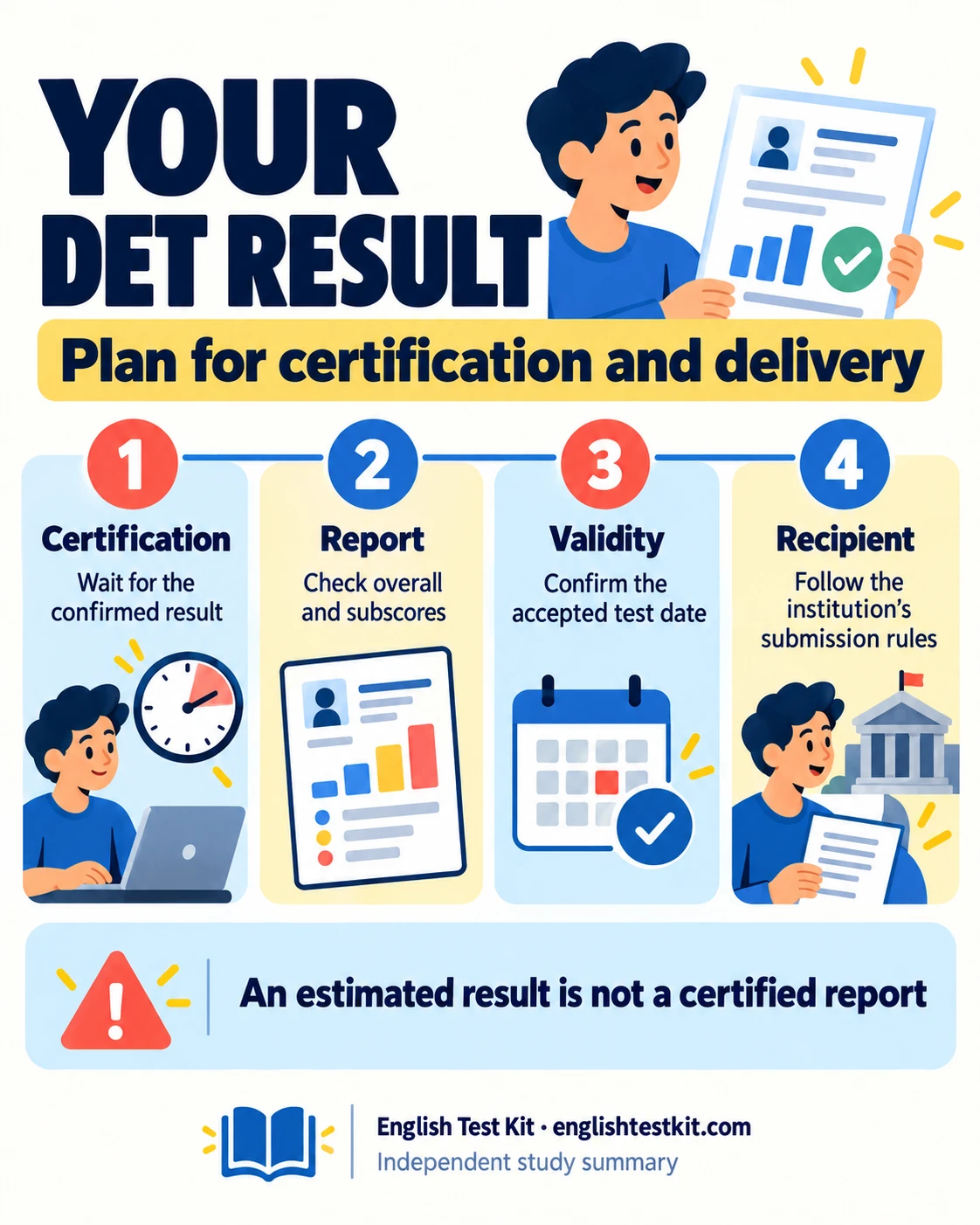
Receiving a Duolingo English Test result and meeting an application deadline are separate steps. Your test must be reviewed and certified, the score must satisfy the recipient’s requirements, and the report must reach the right institution. Plan those steps together rather than treating the test date as the final deadline.
When results arrive
Duolingo says standard results are usually available within two days. A Faster Results option can provide a result within 12 hours when it is available for the test, but it cannot be added after a test has already entered review.
How long scores remain valid
A Duolingo English Test result is valid for two years from the test date. An institution may set its own policy for which test dates it will accept, so check the application instructions as well.
What is shared
The certified overall score, four core subscores, and integrated subscores appear in the score report.
The writing and speaking samples can be shared with institutions together with the certified result. Current official task pages identify the subscores that these responses contribute to.
Your score report is the best place to confirm the exact result and subscores for an application.
If a result is still in review, wait for the email notification and avoid booking around an unconfirmed score. Keep the test date and the receiving institution’s deadline in the same plan.
Distinguish a practice estimate from a certified result
The free practice test can help you understand the format and estimate readiness. Its result does not replace a certified score report. Completing a paid test also does not mean a certified result is already available: review and certification must take place before you use the official reporting process.
Read the status and instructions in your account carefully. If the result is still under review or the test cannot be certified, follow the official next steps for that status. Do not describe an estimate, an expected score or a pending result as a certified achievement on an application that asks for a completed official report.
Work backwards from the recipient’s deadline
Start with the date by which the institution must receive an acceptable report. Allow time for the test, the normal review window, report sharing and any processing the institution describes. Leave a practical margin for technical problems or further action rather than scheduling around the shortest advertised turnaround.
For a fictional deadline of 30 November, a learner might set an earlier internal target for completing the test and checking the report. That target should reflect their preparation and the institution’s instructions; it is not a universal recommendation to test a fixed number of days before every deadline. Confirm whether the deadline concerns submission, receipt, or completion of an application checklist.
Read validity against the application policy
The standard DET validity period is two years from the test date. The date a result is released does not restart that period. A receiving organisation may also apply its own rules about how recent a result must be for a particular intake or application stage.
For example, a report may still fall within the provider’s validity period on the day an application opens, while a programme requires a result valid at a later enrolment date. This is a fictional policy example, not a claim about all universities. Check the actual wording and ask the recipient to resolve ambiguity before relying on the report.
Check the report before sharing it
Confirm your identity details, test date, certified status, overall score and any required subscores. Compare the result with the exact programme requirement, including minimum individual skills where specified. A report can be valid and correctly issued while still falling short of the recipient’s score conditions.
Use the official account workflow to select the receiving institution and follow any application-identification instructions. Keep a record of the sharing action, then check the recipient’s stated process for acknowledging receipt. A screenshot or a downloaded copy may be useful for your own records, but does not automatically replace an official delivery requirement.
Handle delays with evidence and clear communication
If a result is delayed, check official notifications and support guidance rather than repeatedly assuming a release time. If the institution allows a pending result, follow its documented process and provide accurate dates. Do not assume an extension or an exception without confirmation from the recipient.
Keep a small application record containing the published requirement, test date, result status, sharing date and any relevant reference number. This makes a support enquiry specific and helps you distinguish a certification issue from a recipient-processing issue. Current guidance treats the shared writing and speaking samples as assessed responses, so review the current report information rather than relying on older descriptions of ungraded samples.
Save your one-page study summary