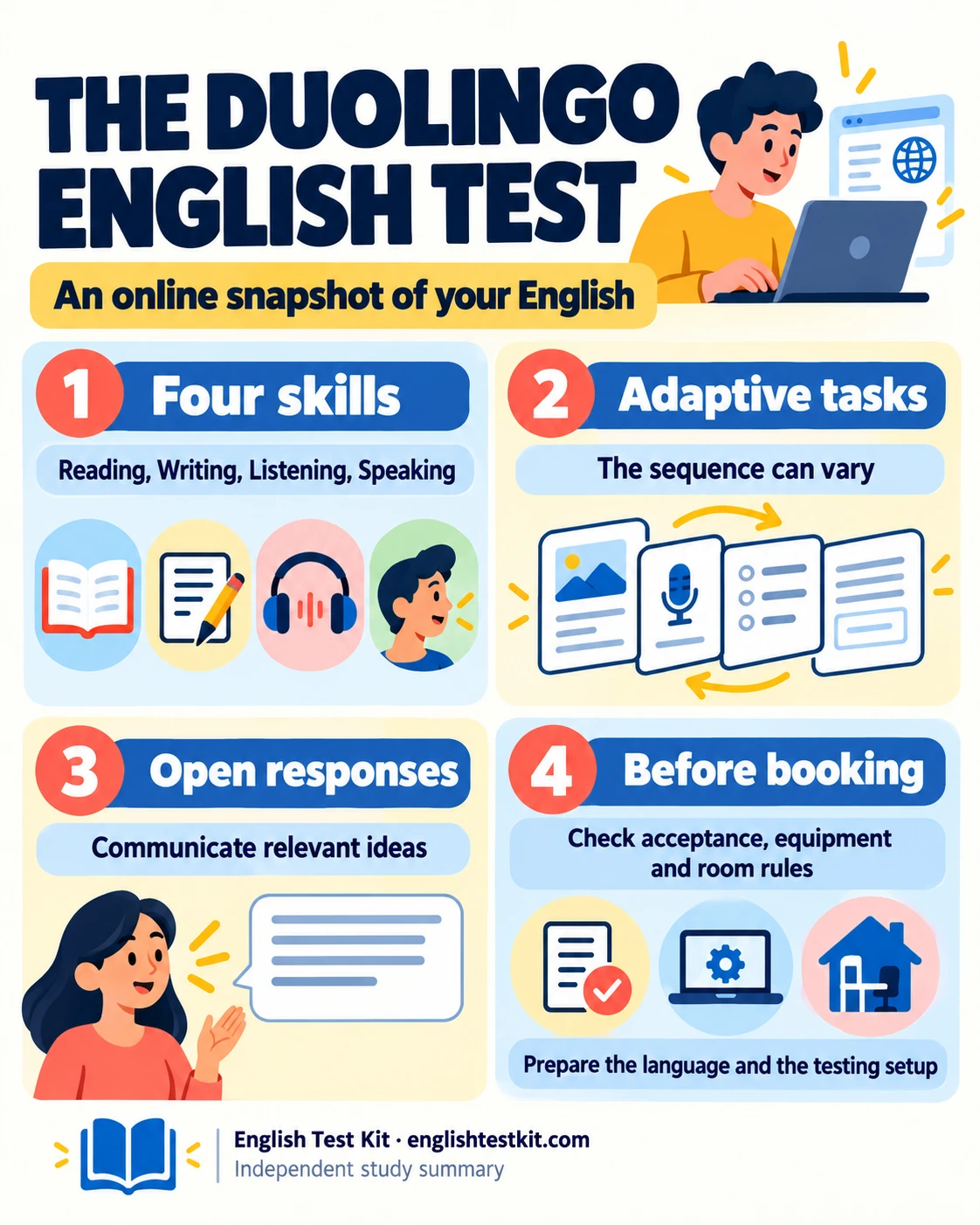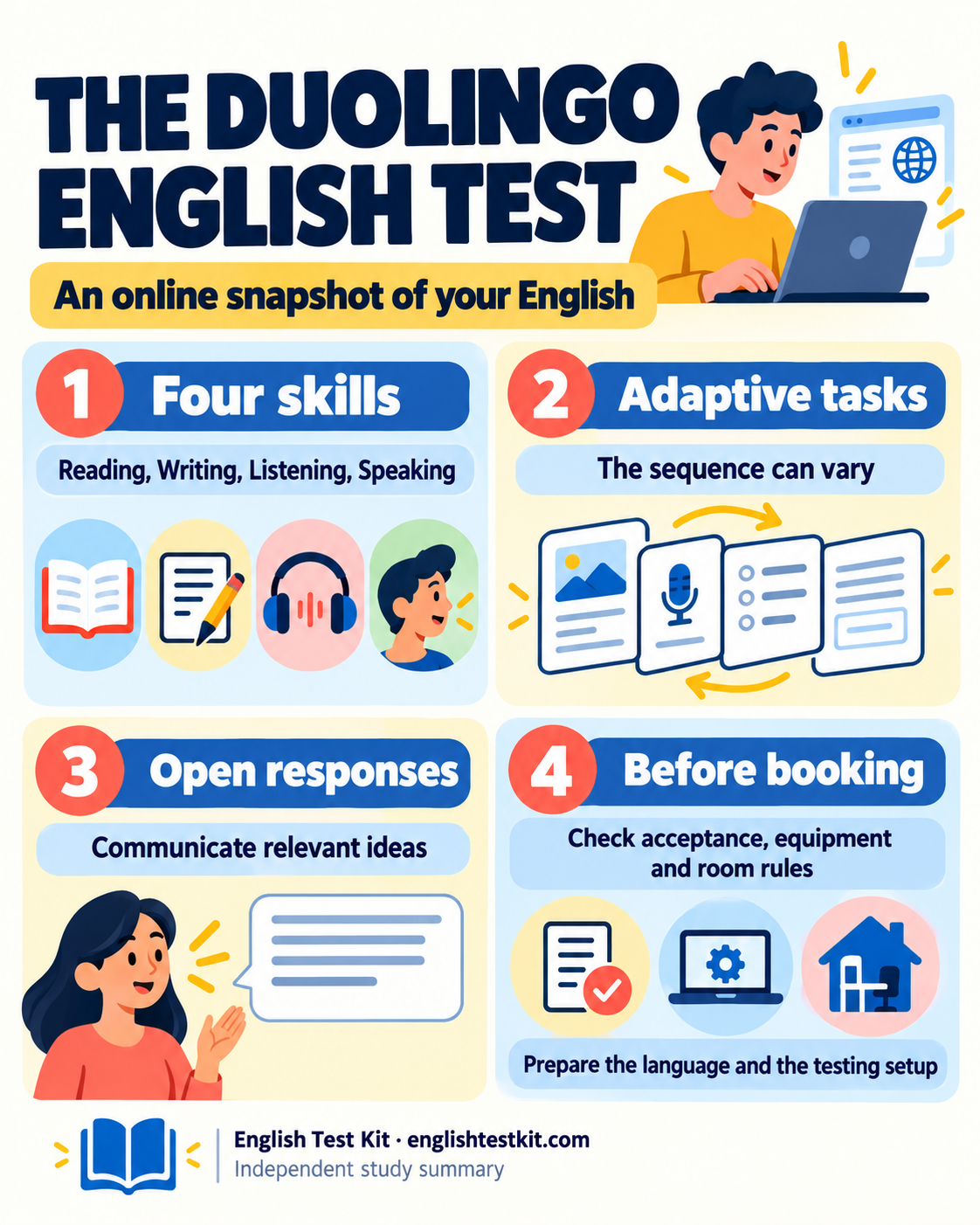
The Duolingo English Test is an online assessment that combines comprehension tasks with written and spoken communication. Preparation should develop both English and familiarity with the response actions. Before booking, check that the recipient accepts the test and that you can meet the current equipment, room and identity requirements.
A test of current English ability
The Duolingo English Test (DET) is an online English proficiency exam that measures how you use English in reading, writing, listening, and speaking tasks. It is designed to be taken on a computer in a quiet private setting, with a second camera supplied by a phone.
The experience combines comprehension tasks with open writing and speaking responses, including samples shared with institutions. Some tasks adapt using your responses, and the samples also give institutions evidence of your communication.
What your result contains
A certified overall score on the DET scale, reported in five-point increments.
Separate Reading, Writing, Listening, and Speaking subscores.
Integrated subscores that combine two skills, plus writing and speaking samples that are shared with institutions and assessed under the current task guidance.
Use the DET as a focused snapshot of your English today. Your target institution decides whether it accepts the test and what score it requires.
Start with the requirement
Before you book a test, check the current English-language requirement for the exact institution or programme. A recognised test and a suitable score are separate decisions.
Begin with the decision the result must support
Find the official requirement for your exact programme or purpose. Record the accepted test, overall minimum, any subscore conditions, result-date policy and submission deadline. A test can be recognised by an institution without every programme applying identical score rules. Use the specific requirement rather than a general list of accepting organisations.
Imagine a fictional course requiring an overall 120 and minimum Writing 115. A report reaching the overall figure but showing Writing 110 would miss the illustrated subscore condition. These invented values demonstrate requirement checking, not a real admission policy. Keep each condition visible when planning preparation.
Understand adaptive work without predicting the sequence
Some tasks change in difficulty according to the test's design and your responses. This means that memorising an exact sequence is less useful than knowing what each task asks you to do. You may select, complete, type, summarise, describe, write or speak. Learn the response action and the current directions for each family.
A difficult item is not, by itself, a reliable message about your final score. Focus on the prompt and provide the best response you can under its conditions. Trying to diagnose the adaptive system during the attempt can distract from the language you actually need to understand or produce.
See the difference between comprehension and communication
Consider an original short notice: “The workshop has moved to Friday. Anyone already registered keeps their place.” A comprehension task might ask which day applies or whether registration must be repeated. The answer should come from the notice, not from an assumption about how workshops usually operate.
An open response requires you to communicate something. For an original practice question about a useful study habit, a developed answer could explain the habit, describe when you use it and give a relevant example. Repeating the topic words does not replace development. These demonstrations illustrate different language processes; they are not official scored questions.
Treat samples as purposeful assessed responses
Writing and speaking samples are shared with institutions, and the current provider task and scoring pages describe their assessment and subscore contributions. Do not treat them as an irrelevant ungraded afterthought. Read the prompt, use the response time to develop a relevant answer and follow the same honest communication habits as in other open tasks.
The receiving institution may also use the shared sample as additional information. That makes relevance and clarity important independently of any unofficial score prediction.
A useful first-week routine
Learn the current task families and try a short range of activities independently. Record whether difficulty comes from understanding the source, following the instruction, spelling, organising ideas or speaking clearly. Choose two recurring weaknesses and practise them with fresh prompts. Separately rehearse the actual computer, second-camera and room setup. A dependable beginning combines appropriate test choice, flexible English practice and familiarity with the current rules.
Save your one-page study summary