

C2 Proficiency Writing asks you to control demanding ideas for a clear communicative purpose. In source-based work, that means identifying, connecting and evaluating arguments before presenting your own view. In other text types, it means selecting an effective structure and register for the reader. Complexity is useful when it makes those relationships more exact.
Two tasks, different decisions
Follow the exact instruction in front of you. The task choices and word ranges differ across qualifications.
C2 Proficiency Writing paper overview
Task | What you write | Word range |
|---|---|---|
Part 1 | Compulsory essay: summarize and evaluate two short source texts, then develop your view. | 240–280 words |
Part 2 | Choose one of three contextual tasks; types include article, letter, report or review. | 280–320 words |
Plan for the reader
Before drafting, identify the purpose, audience and each required point. Choose a structure that helps that reader follow your message; do not force every prompt into one memorized template.
Make a short plan with one purpose and a logical order for the main ideas.
Support opinions with reasons, examples or evaluation.
Use linking phrases when they show a real connection.
Leave time to check task coverage, paragraphing, grammar and spelling.
What changes at this level
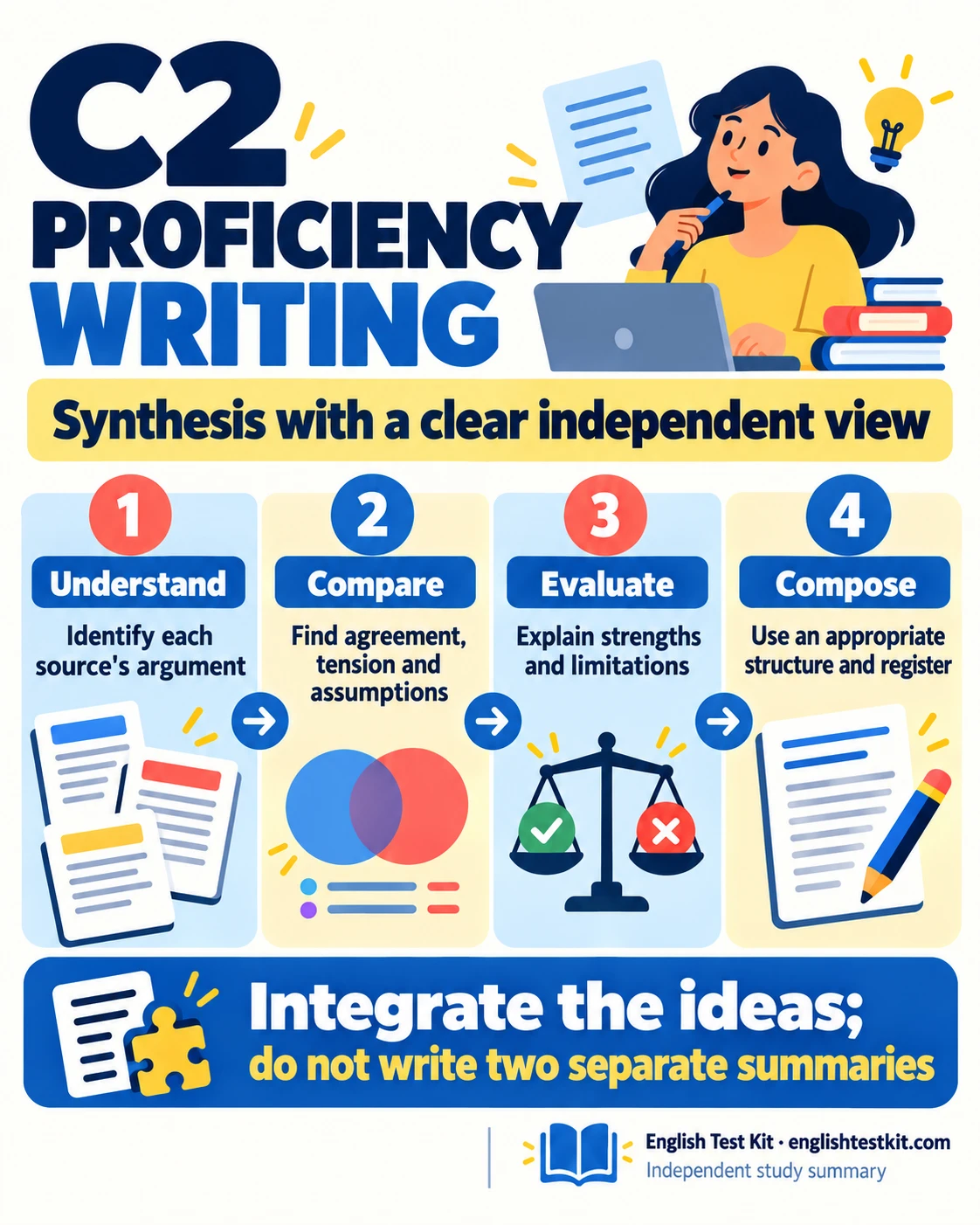
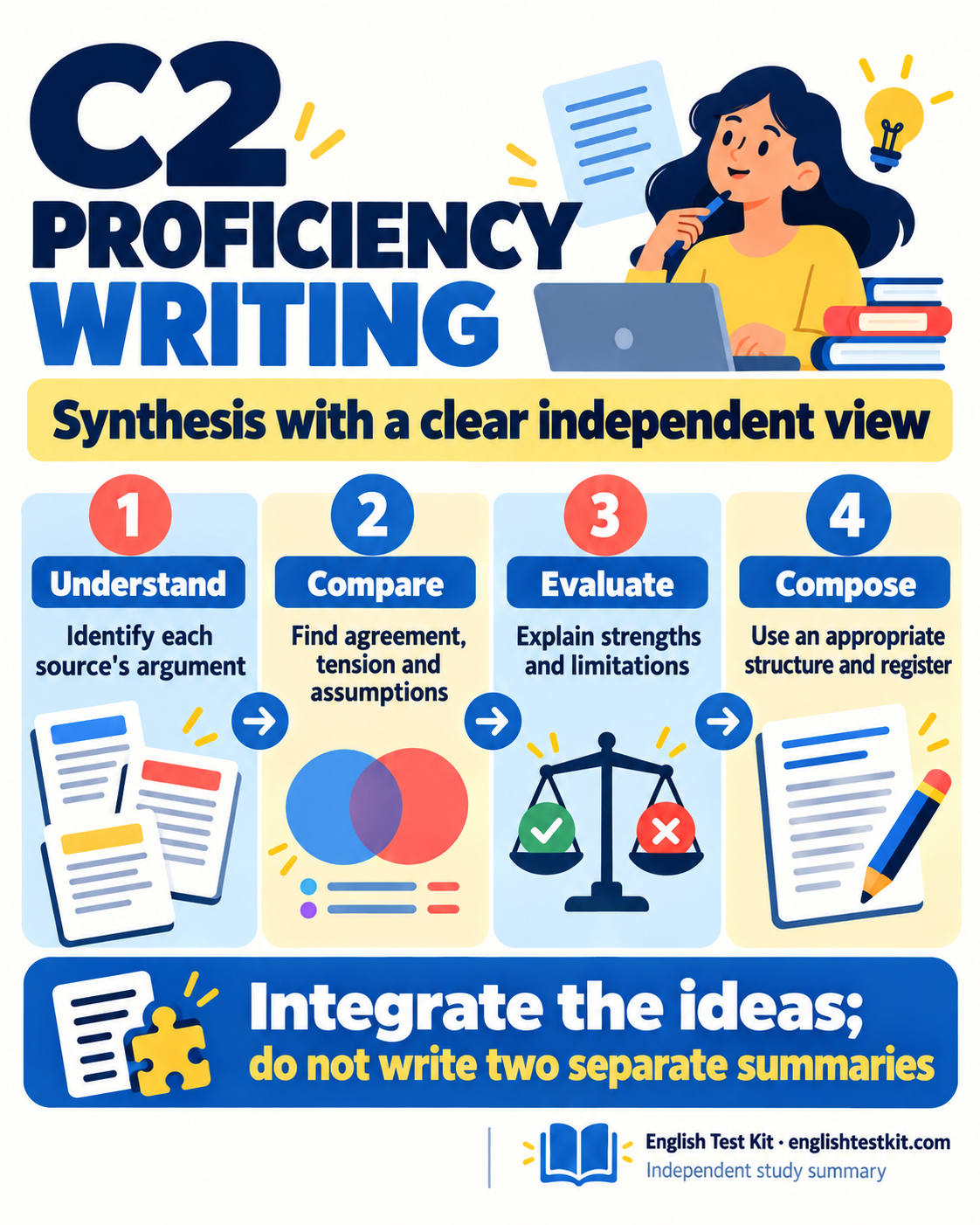
Part 1 is more than summary: compare and evaluate the source arguments and integrate your own ideas. In Part 2, select a structure and tone for the stated reader and purpose.
Use the official sample paper and assessment guidance for the precise instructions and task types in the version you are taking.
Synthesis is more than two separate summaries
Consider two original miniature source positions. Source A argues that digital library collections improve access for people who cannot visit during opening hours. Source B argues that physical libraries provide quiet space and personal support that some users lack elsewhere. The sources emphasise different needs, but they are not necessarily in direct opposition.
A response that writes one paragraph retelling A and another retelling B has reported the sources without fully connecting them. A synthesis can explain their shared concern with access, distinguish the kinds of access involved and evaluate how the services might complement each other. The relationship between ideas is part of the intellectual work.
Evaluate the assumptions and limits
An original practice excerpt might say: “Digital access can extend a library's reach, but its value depends on users having suitable equipment and confidence online. Physical spaces address a different barrier by providing resources and support in one place. The strongest approach may therefore combine the services rather than treat them as substitutes.”
This is an excerpt demonstrating synthesis and evaluation, not a full answer meeting the official task's word range. It identifies an assumption, connects the arguments and develops a qualified conclusion. Any evaluation in your actual response must remain relevant to the supplied sources and task.
Build a coherent essay plan
Identify the main claim and support in each source, then note agreement, tension, limitations and possible implications. Choose an organising principle that makes the connection visible. You might group related arguments or evaluate a central contrast, rather than following the sources mechanically in the order presented.
Keep your own view distinguishable from what the sources say. Do not attribute an invented example or conclusion to a source that does not contain it. A clear contribution develops the discussion while representing the original ideas accurately.
Adapt other writing to its reader
For an article, report, letter or review, ask what the reader needs to understand or decide. A review may need evaluation supported by specific observations; a report may need findings organised around a practical purpose. Choose tone, detail and structure accordingly. A sophisticated sentence does not help if it obscures the recommendation or ignores the reader's context.
Avoid treating one memorised formal style as suitable for every task. C2 control includes the ability to be direct, engaging or appropriately restrained when the text requires it.
Edit for precision and effect
First check the task and argument: have you covered the required ideas, connected them and reached a supported position? Then inspect cohesion, paragraph function and register. Finally check exact word sense, collocation, grammar and punctuation. Remove inflated phrases that contribute no meaning. Keep a draft and revision so you can explain what improved, then apply the lesson to a fresh prompt using current official assessment guidance and suitable feedback.
Save your one-page study summary
Continue with related guides
Sources and further information
This guide is an independent explanation. Cambridge English publishes the exam rules and is the final source for current instructions.