

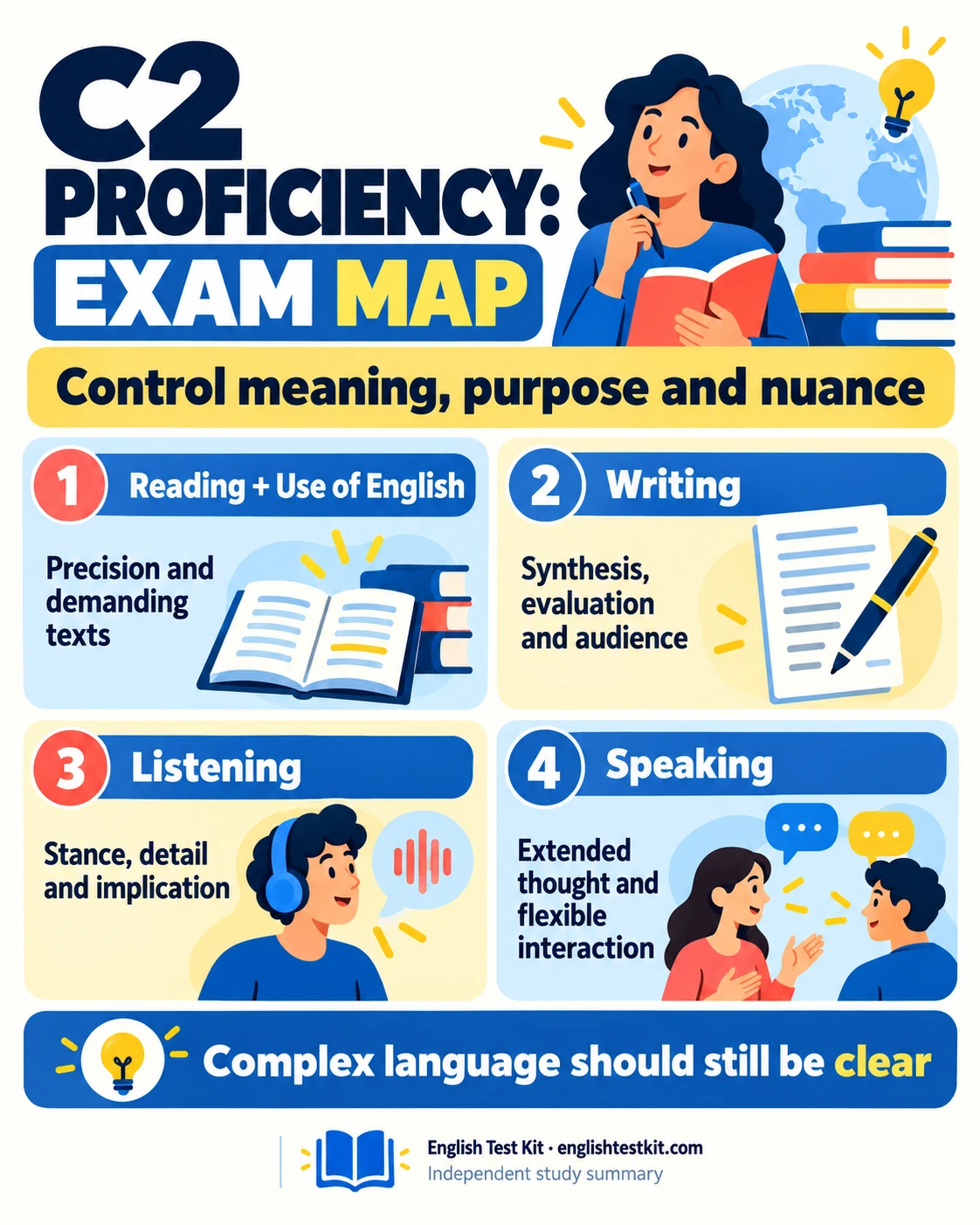
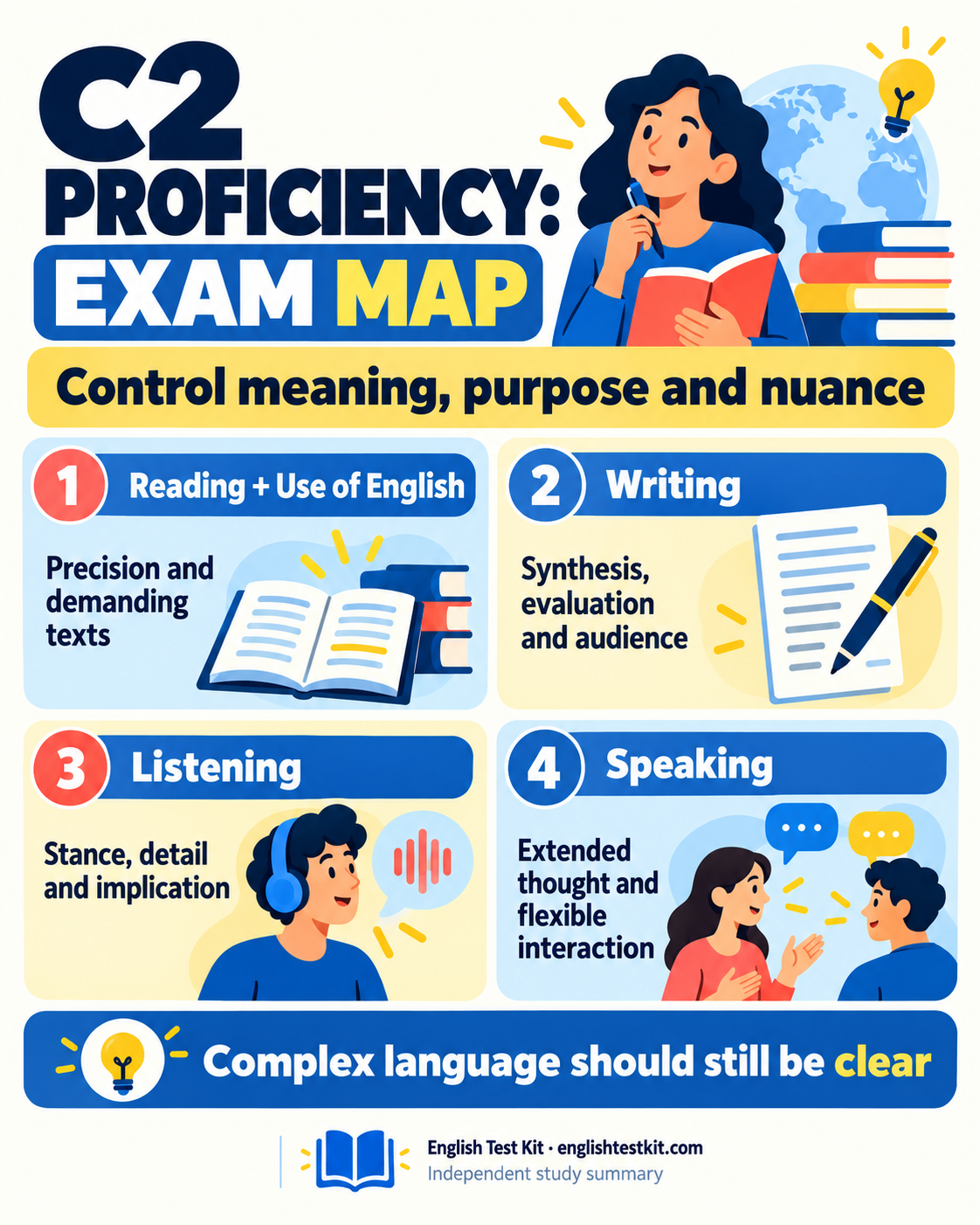
C2 Proficiency preparation should develop controlled, purposeful language across demanding texts and communication tasks. The format is a map of where those demands appear, not a reason to make every answer as complicated as possible. Precision means expressing the intended relationship clearly, including nuance and limitation where the task requires them.
The four components at a glance
C2 Proficiency targets CEFR C2. Its four components assess reading and language use, writing, listening and speaking.
Current C2 Proficiency component overview
Component | Time and structure | What it samples |
|---|---|---|
Reading and Use of English | 1 h 30 min · 7 parts · 53 questions | Interpret demanding texts and make precise language choices. |
Writing | 1 h 30 min · 2 parts | Write a source-based essay and one task chosen from three. |
Listening | About 40 min · 4 parts · 30 questions | Follow lectures, interviews and extended spoken material. |
Speaking | 16 min per pair; 24 min for three · 3 parts | Interview, collaborative task, long turn and discussion. |
How to read the timetable
Adding the listed component durations gives about 4 hours of component time. This is content time, not a promise about your total time at a test centre; arrival, breaks and local arrangements may add time.
Cambridge states that the exam format is the same for digital and paper-based delivery. The exact date and availability depend on your centre.
Check the official format page and your exam centre's confirmation for current instructions.
A useful first pass
Try one representative task from each component before you plan a study schedule. That first run shows whether the main difficulty is comprehension, language control, writing under time, or responding in real time.
Learn the instructions and task order before attempting a full paper.
Keep an error log by cause: misunderstanding, vocabulary, grammar, timing, planning or interaction.
Use official sample material to confirm the current task wording.
Look beyond the familiar task label
A multiple-choice question can depend on the exact strength of a claim or the function of a paragraph. A language gap may require a precise collocation rather than a broad synonym. Writing can require synthesising and evaluating source ideas, while speaking asks for an extended line of thought and flexible interaction.
A learner may understand the topic of a difficult text yet miss the writer's reservations. Another may use varied vocabulary but organise a source-based essay as two unrelated summaries. These are different gaps, even when both learners feel generally advanced. Use representative C2 tasks to identify the specific demand that needs practice.
A diagnostic example of precision
Consider an original source saying, “The findings do not rule out a benefit, but the evidence remains limited.” That is not the same as proving the benefit. An answer claiming a conclusive result would overstate the source. At C2, small differences in scope, stance and certainty can carry substantial meaning.
In writing, the corresponding habit is to evaluate what a source supports before drawing a conclusion. In speaking, it is to qualify a claim appropriately rather than presenting every opinion as universal. Practise those distinctions across skills while still following each task's response rules.
Sample all four components
Try current-format reading/language, writing, listening and speaking work independently, then use official keys, transcripts, criteria and suitable feedback. Record the task and the evidence of the issue: exact word sense, argument connection, source integration, audience control or interaction, for example.
For source-based writing, check whether the response connects the ideas and evaluates them. For listening, distinguish a stated position from an implied reservation. For speaking, inspect whether the argument develops coherently and responds to the discussion rather than merely displaying vocabulary.
Build a plan around control
Choose a small number of recurring weaknesses and practise them with fresh material. A precision session might compare near-equivalent phrases in context. A writing session might revise a paragraph to connect two source ideas. A spoken session might develop an argument, consider a counterpoint and reach a qualified conclusion.
Use complexity where it serves those purposes. An elaborate sentence that obscures the main point is not a useful improvement over a clear, accurate one. Keep feedback specific enough that the next attempt tests a recognisable change.
Add realistic rehearsal and practical checks
Once methods are established, rehearse longer components to observe pacing, concentration and transitions. Include planning and checking in written work and actual spoken interaction in speaking preparation. Confirm the current provider format and your centre's appointment instructions. A complete preparation route combines precise language, thoughtful response development and reliable test familiarity rather than relying on a single impressive performance.
Save your one-page study summary
Continue with related guides
Sources and further information
This guide is an independent explanation. Cambridge English publishes the exam rules and is the final source for current instructions.