

The three Cambridge qualifications target different levels of independent language use. Choosing well requires more than comparing exam length or recognising the highest level on a chart. Match the receiving organisation's requirement with your current ability, then use representative tasks to see which demands you can meet consistently.
Three qualifications, three target levels
B2 First, C1 Advanced and C2 Proficiency target progressively higher CEFR levels. Each assesses Reading, Writing, Listening and Speaking, with Use of English integrated into Reading and Use of English.
The exam name describes its target, not a guarantee of the result every candidate will receive. Cambridge reports scores that can indicate achievement at a neighbouring level.
At-a-glance comparison
Qualification | Target | Reading and Use of English | Speaking |
|---|---|---|---|
B2 First | B2 | 75 min · 7 parts · 52 questions | 4 parts · 14 min per pair |
C1 Advanced | C1 | 90 min · 8 parts · 56 questions | 4 parts · 15 min per pair |
C2 Proficiency | C2 | 90 min · 7 parts · 53 questions | 3 parts · 16 min per pair |
Choose by the requirement you need to meet
Start with the receiving organisation's written requirement. It may ask for a named exam, a CEFR level, an overall scale score or a minimum in a specific skill. Those requirements are not interchangeable.
Then compare that target with your current ability using timed sample papers. Do not choose by exam name alone; choose the qualification whose target and reporting rules fit your purpose.
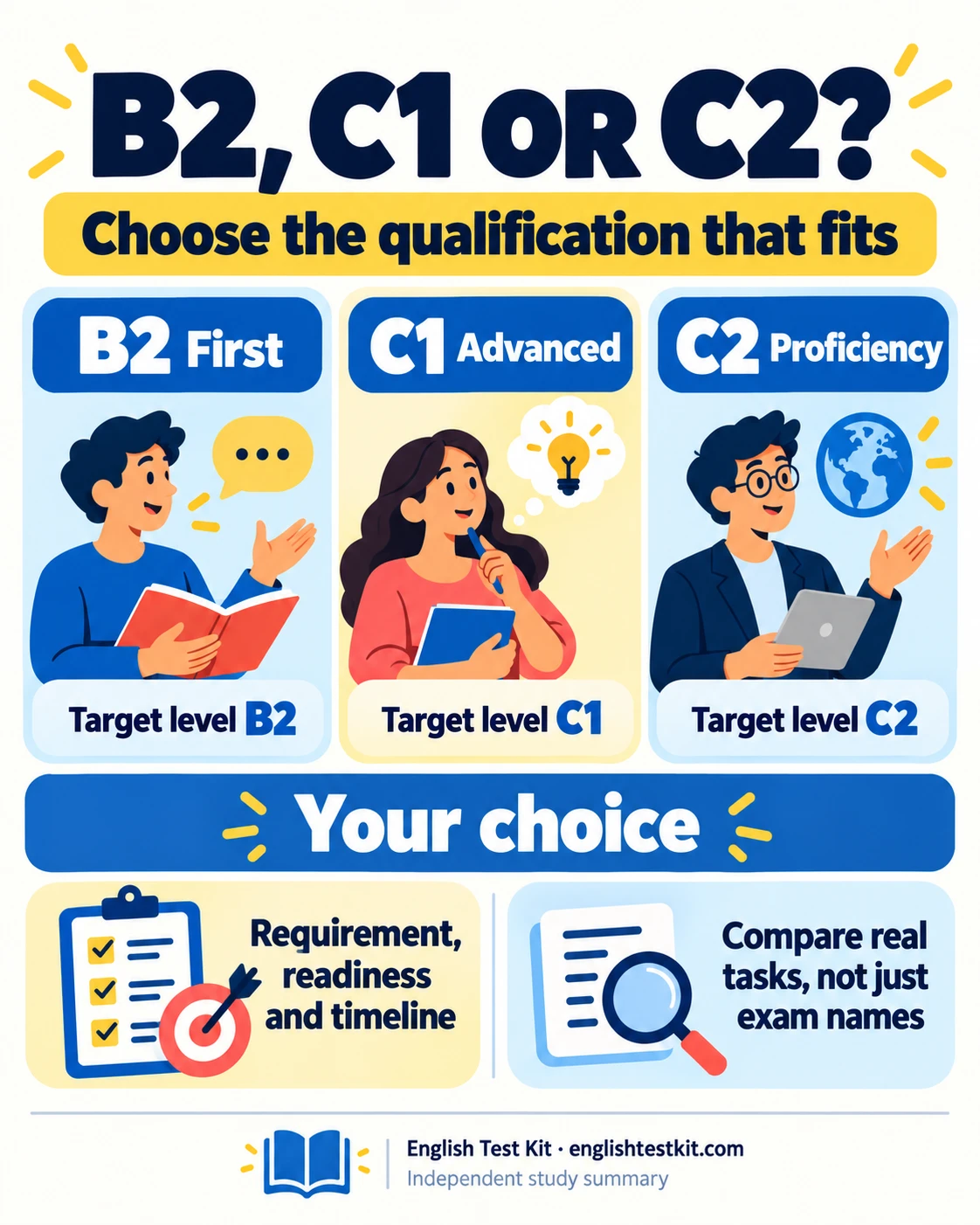
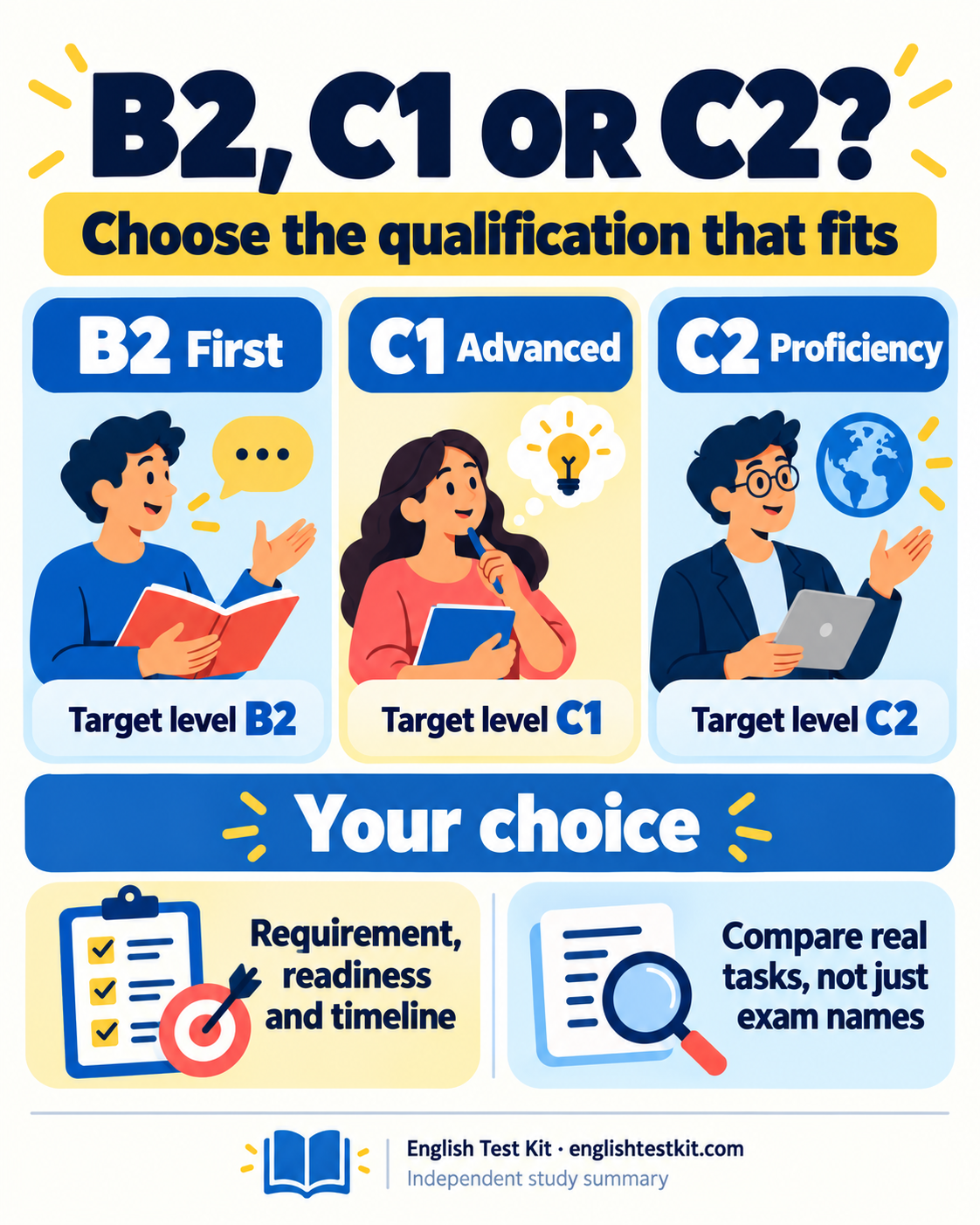
B2 First is targeted at B2.
C1 Advanced is targeted at C1 and includes cross-text matching in Reading and Use of English.
C2 Proficiency is targeted at C2 and has a three-part Speaking test.
Before you register
Delivery choices, dates and centre availability are local and can change. Read the official format and preparation information, then confirm the version, date and entry details with your exam centre.
This is an independent comparison, not a substitute for an institution's current admissions or employment rules.
Compare what a response needs to do
At B2, a learner should be able to communicate and support ideas clearly across familiar and some less familiar situations. C1 work places greater demands on flexible expression, complex texts, viewpoint and appropriate register. C2 requires particularly precise control of meaning, nuance and demanding communication. These descriptions orient preparation; the official qualification guidance explains the assessment in detail.
Consider the same broad topic, a town's transport policy. A useful B2 response may explain a position with clear reasons and examples. A C1 response may evaluate competing priorities for a specific reader. A C2 response may integrate several arguments, recognise limitations and express a carefully qualified conclusion. Complexity should improve the message rather than make it harder to follow.
Three fictional learner scenarios
One learner needs a qualification targeted at B2 for a named course and can handle representative B2 tasks with some recurring language errors. The sensible first check is that the course accepts B2 First and the required score. A higher-level exam is not automatically a better choice if it does not fit the requirement or available preparation time.
A second learner reads complex material comfortably but struggles to compare viewpoints or adapt a proposal to its audience. C1 sample work can reveal whether those are the main gaps. A third learner considering C2 should examine demanding source-based writing and nuanced comprehension rather than assuming that a strong C1 result alone demonstrates every C2 demand.
These are invented planning scenarios, not admission policies or a diagnostic score system. Use suitable official practice and informed feedback when assessing readiness.
Interpret the target and reported level separately
An exam's target level identifies its design, while the reported outcome may indicate achievement at a neighbouring level within the provider's reporting rules. Do not replace a requirement for a named qualification with a different result merely because a CEFR label looks similar. The receiving organisation decides what it accepts.
Read the full score profile as well as the overall result. A strength in comprehension can coexist with a weakness in writing or speaking, and a recipient may specify a minimum in a particular area. Choose preparation from that evidence rather than treating all skills as equally ready.
Try a meaningful comparison session
Sample reading/language, writing, listening and speaking tasks from the qualification you are considering. Record whether the challenge is understanding the task, following complex meaning, selecting precise language or producing an organised response. Review a manageable amount thoroughly before attempting several complete papers.
Then compare the observed gaps with your deadline and available study time. Ask what kind of practice and feedback would be needed, not simply which exam sounds more impressive. Finally confirm the accepted qualification, score conditions, delivery availability and appointment details. A good choice creates a clear preparation route and supplies evidence relevant to your actual goal.
Save your one-page study summary
Continue with related guides
Sources and further information
This guide is an independent explanation. Cambridge English publishes the exam rules and is the final source for current instructions.