

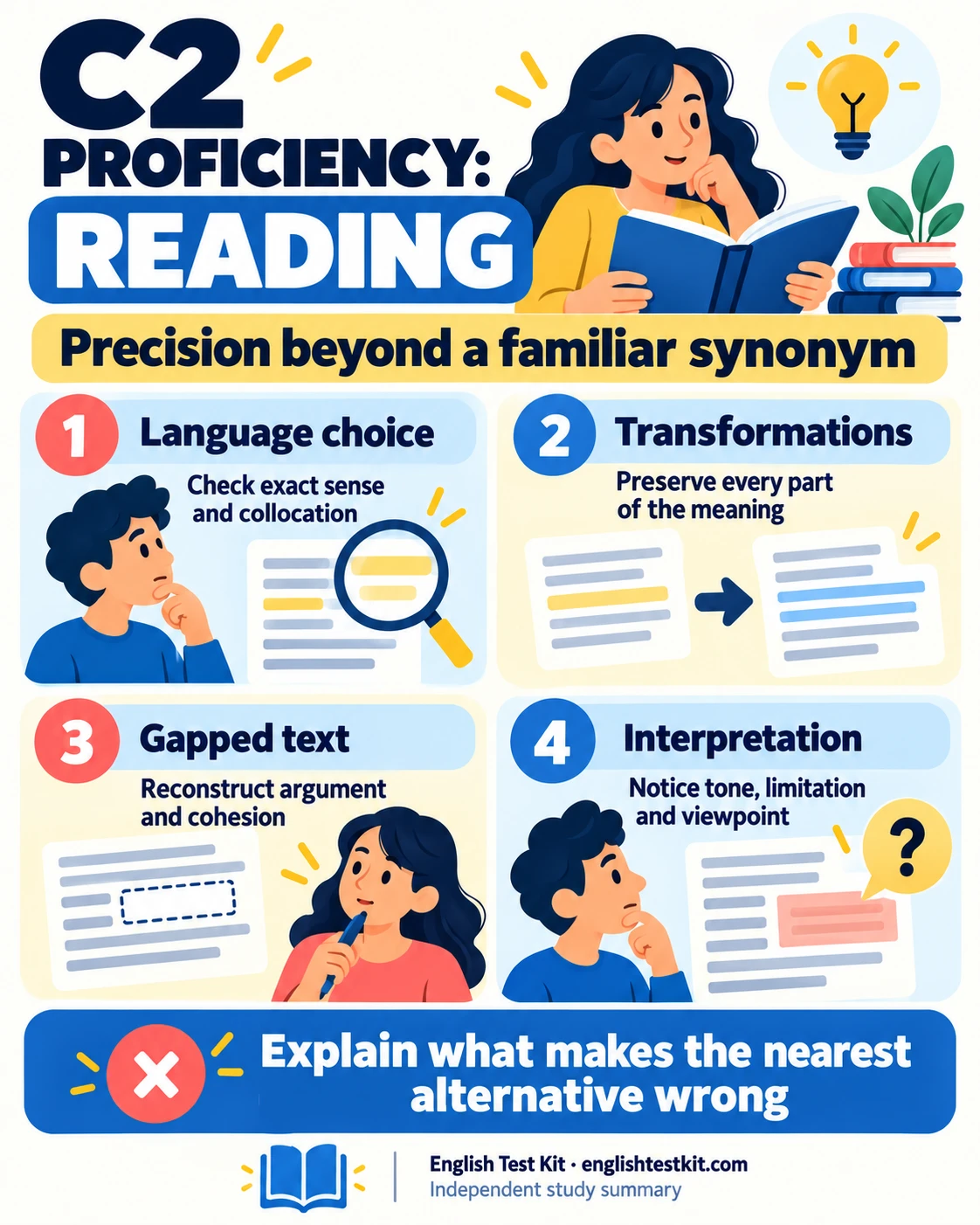
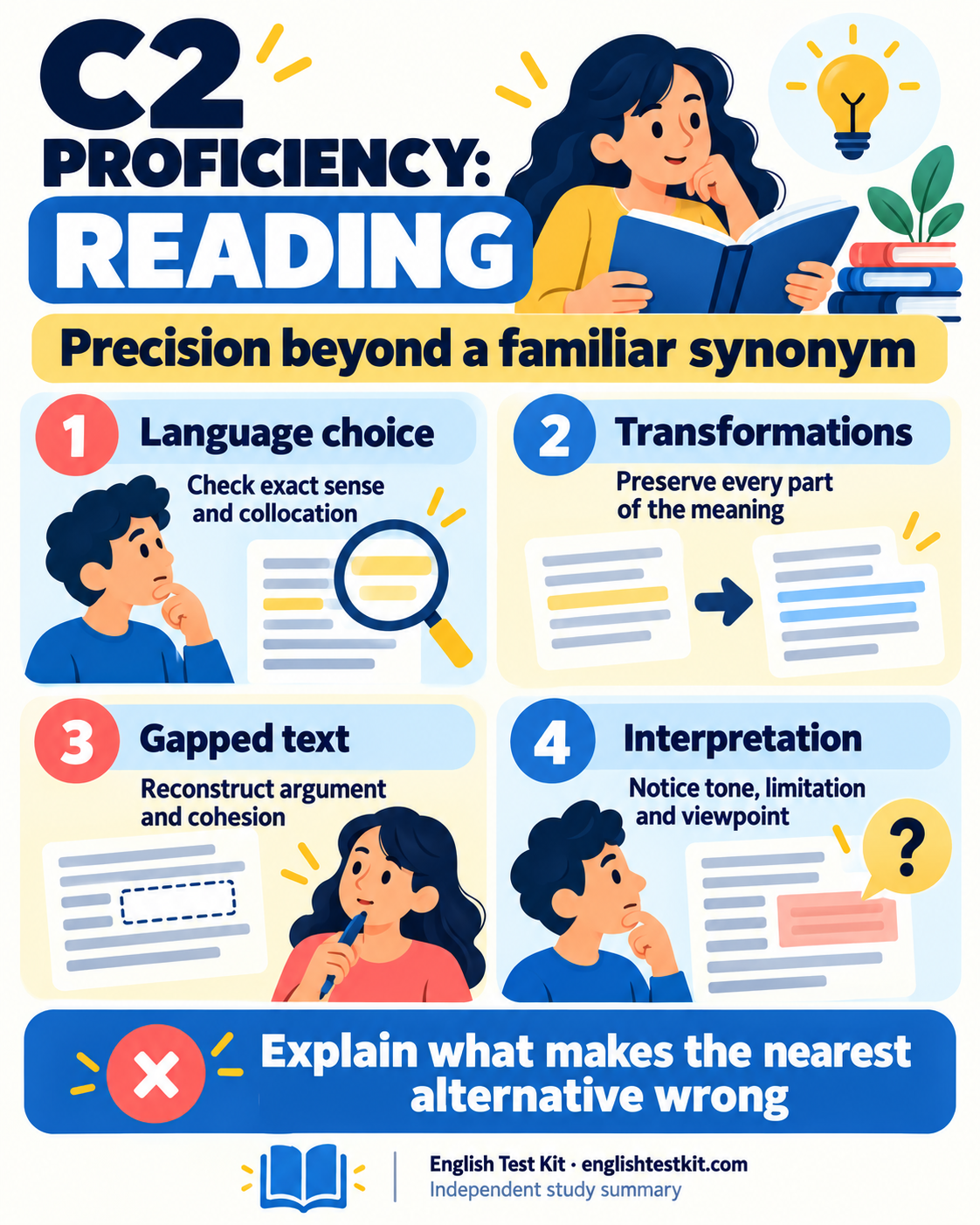
C2 Reading and Use of English requires control of fine distinctions in language and interpretation. Knowing the broad topic or recognising a synonym is not always enough. A strong method checks exact sense, collocation, qualification and the role a passage plays in the argument.
Paper snapshot
You have 1 hour 30 minutes for 7 parts and 53 questions. The paper combines reading comprehension with control of vocabulary and grammar.
C2 Proficiency Reading and Use of English task map
Part | Task type | What to do | Questions |
|---|---|---|---|
1 | Multiple-choice cloze | Choose a precise word or phrase for each gap. | 8 |
2 | Open cloze | Supply one missing word per gap. | 8 |
3 | Word formation | Form words accurately from prompt stems. | 8 |
4 | Key word transformations | Recast meaning using a key word and word limit. | 6 |
5 | Multiple choice | Interpret tone, organization and implication. | 6 |
6 | Gapped text | Reconstruct cohesion and argument structure. | 7 |
7 | Multiple matching | Match prompts to details or viewpoints. | 10 |
Practise the language and the reading
A single strategy will not fit every part. Identify whether the task asks for language knowledge, close reading, text structure or comparison across texts, then choose a matching approach.
Build a notebook for collocations, word families, prefixes and fixed phrases.
For sentence transformations, preserve meaning and obey the word limit.
For longer texts, mark the sentence that proves an answer and explain why a distractor is wrong.
For gapped or matching texts, track reference words, connectors, topic shifts and viewpoint.
The reading load is about 3,000 words. At this level, an answer may depend on exact sense, collocation, tone or how an argument develops.
Manage time without rushing
Do one timed paper to learn your pace. Then review every uncertain answer and identify the clue you missed. Practise your slowest task type separately before returning to a full-paper run.
Compare the strength of near-equivalent claims
Consider these original statements: “The findings suggest a possible benefit” and “The findings prove a universal benefit.” They concern the same topic, but the second changes both certainty and scope. A reading answer that makes that change would not preserve the first statement's meaning.
During review, identify the precise difference: possibility versus certainty, a limited group versus everyone, a tendency versus an exception, or a reported belief versus the writer's own position. This is more useful than saying that an option was “almost the same”. At this level, the difference may be the reason it is wrong.
Treat lexical choice as a contextual decision
Words that share a dictionary meaning can differ in collocation, register, implication or grammatical pattern. Keep phrases in their original context and add a sentence of your own that preserves the use. Check whether an apparently sophisticated alternative changes the writer's attitude or combines unnaturally with the surrounding words.
For word formation, inspect the complete grammatical and semantic demand, including negative meaning and number where relevant. Accuracy matters at the level of the whole sentence, not only the ability to recognise a familiar stem or suffix.
Preserve every important relationship in a transformation
Use the original sentence “She was by no means convinced that the plan would work.” A possible re-expression is “She was far from convinced that the plan would work.” The emphatic lack of conviction is retained. In a real key-word task, you must also satisfy the given word and required word limit.
Check tense, negation, modality, degree and who is responsible for the action or view. A grammatical completion can still alter a condition, soften an emphasis or attribute a belief to the wrong person. Explain the full equivalence before treating a transformation as solved.
Reconstruct cohesion and argument
For a gap in a longer text, read on both sides and ask what the missing passage must do. It might introduce a limitation, answer an objection or connect an example with the main claim. A reference such as “this qualification” cannot be resolved by topic similarity alone; you need the specific earlier idea it points to.
For interpretation questions, identify whether the writer endorses, reports, questions or distances themselves from a view. Preserve that stance when comparing an option. Prior subject knowledge should not override the evidence in the supplied text.
Make difficult review productive
Record the closest wrong option and the exact feature that rules it out. Use a fresh example to practise that distinction before returning to a full timed paper. Balance precision with pacing: learn the reasoning slowly enough to understand it, then rehearse making the decision reliably under the component conditions. A remembered answer provides less evidence than an accurate explanation applied to unfamiliar material.
Save your one-page study summary
Continue with related guides
Sources and further information
This guide is an independent explanation. Cambridge English publishes the exam rules and is the final source for current instructions.