

C2 communication involves understanding and expressing nuance without losing clarity. A speaker can praise one aspect of a project while doubting another, and a strong spoken argument can acknowledge a limitation without abandoning its position. Practise these relationships explicitly rather than relying only on broad topic comprehension or an impressive vocabulary range.
Listening: four different listening jobs
The Listening paper lasts about 40 minutes and contains four parts with 30 questions. Cambridge says each recording is played twice. Read the task before the audio begins and decide whether you need a detail, opinion, main idea or match.
C2 Proficiency Listening part map
Part | Task | Questions | |
|---|---|---|---|
1 | Short multiple choice | Answer questions about three unrelated recordings. | 6 |
2 | Sentence completion | Write missing information from a monologue. | 9 |
3 | Multiple choice | Interpret a conversation between speakers. | 5 |
4 | Multiple matching | Match themed monologues in two tasks. | 10 |
Speaking: make interaction work
The Speaking test has three parts and takes 16 minutes per pair; 24 minutes for a group of three. Depending on the task, you speak to an examiner, with another candidate, or on your own.
A partner is not an obstacle to work around. Listen, respond to the point they made, and help the conversation reach a useful next step.
C2 Proficiency Speaking task map
Part | Task | What you do | Typical time |
|---|---|---|---|
1 | Interview | Discuss personal experience and speculate. | About 2 min |
2 | Collaborative task | React to pictures and negotiate a decision. | About 4 min |
3 | Long turn and discussion | Speak from a prompt, then discuss its topic. | About 10 min |
Build reliable habits
For Listening, do one attempt without pausing; afterwards, replay and note the cue that supports each answer. For Speaking, answer the question directly, develop one point, and make space for your partner in collaborative tasks.
Clear communication is more useful than forcing complicated vocabulary into an answer. Practise extending a response with a reason, example or comparison.
Speaking durations are approximate and can vary with the number of candidates. Confirm arrangements with your centre.
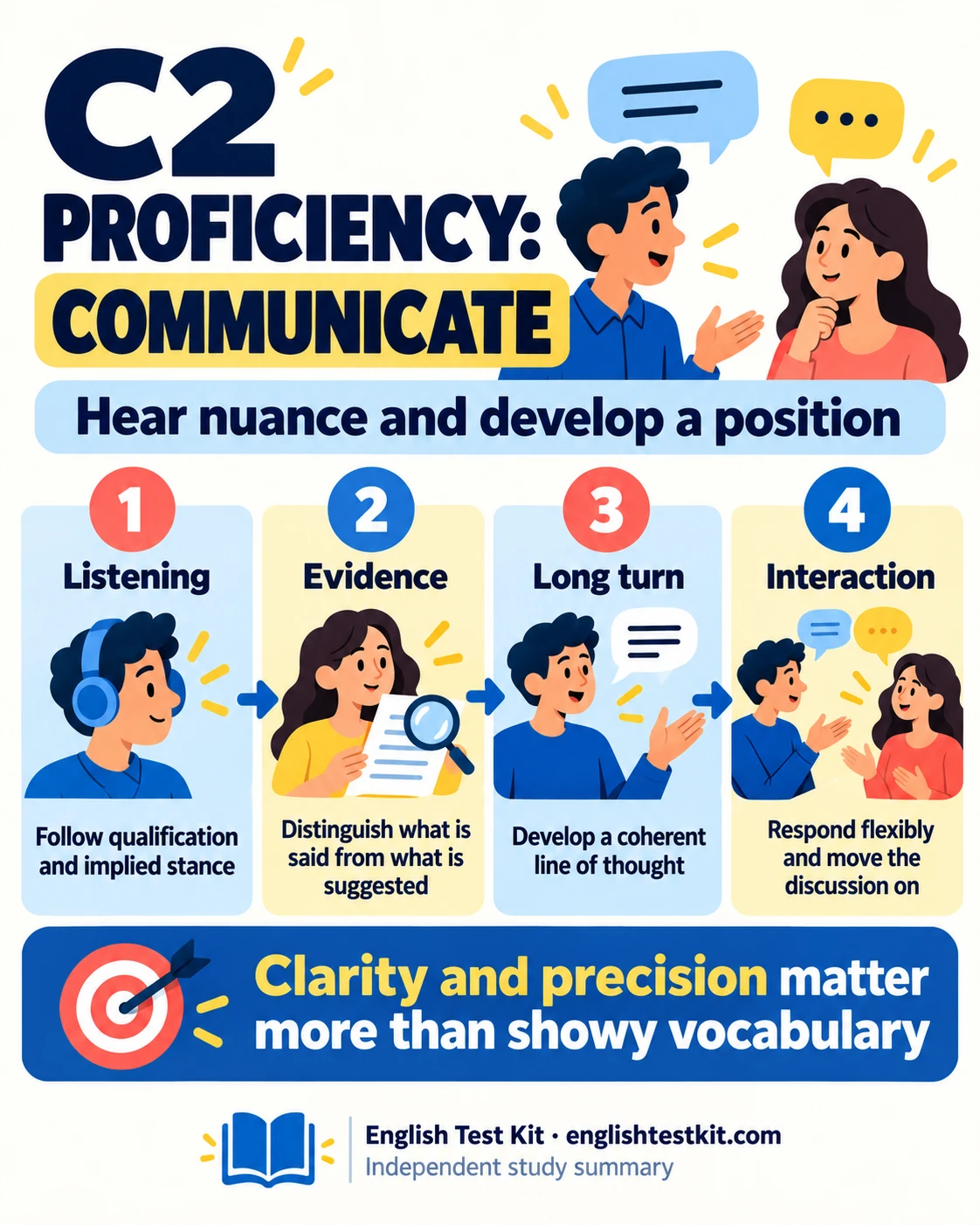
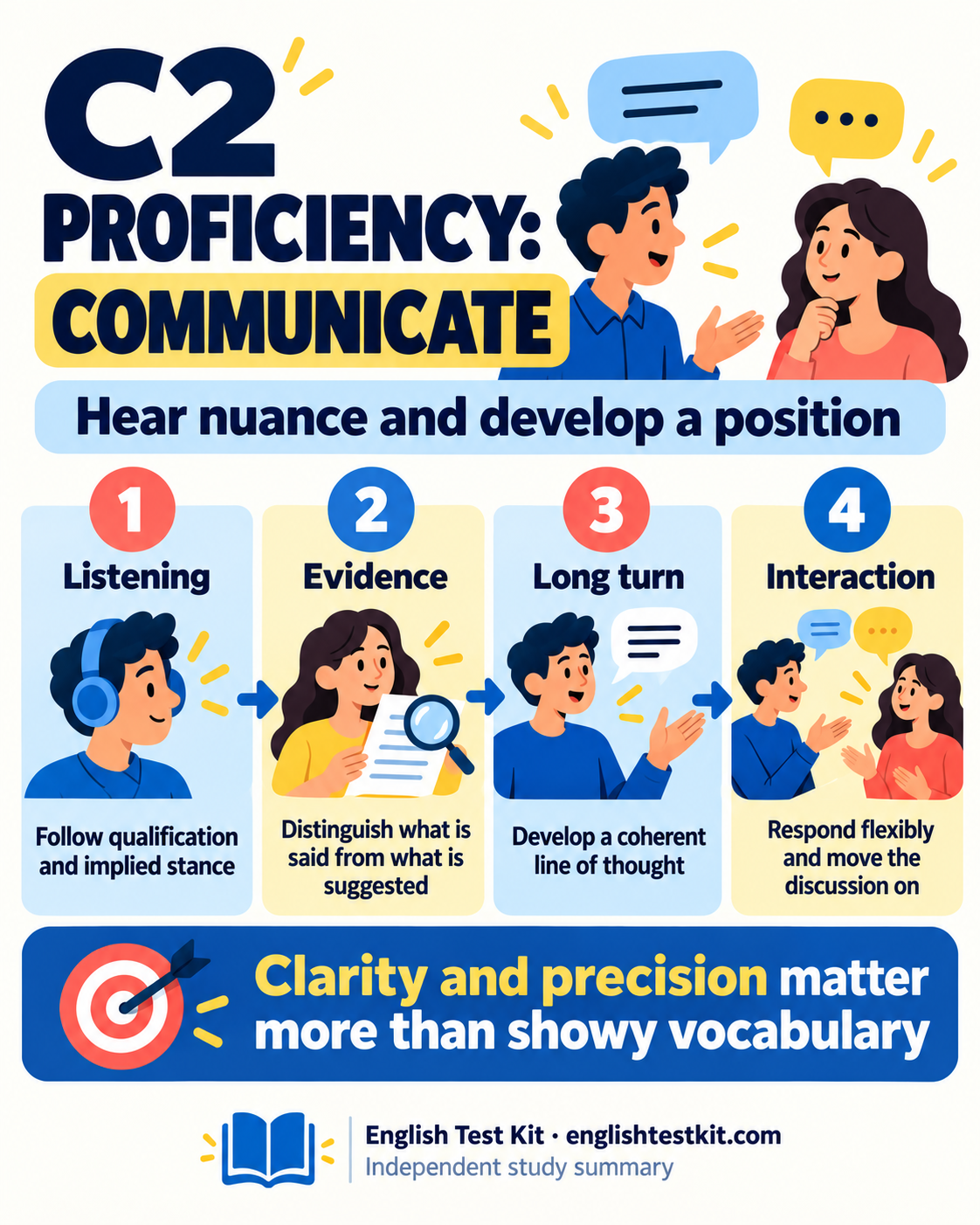
Interpret implied stance carefully
Consider this original transcript excerpt: “I admire the project's ambition. Whether its leadership can sustain that effort is another question.” The speaker praises the aim while raising doubt about delivery. An answer claiming complete confidence would ignore the second sentence; an answer claiming the speaker dislikes every aspect would ignore the first.
The task is to preserve the mixed position. Notice contrast, understatement, qualification and what the speaker chooses to leave unresolved. During review, identify the actual language supporting the interpretation. An inference should arise from the recording, not from an imagined personality or outside knowledge of the topic.
Follow argument structure in longer listening
Keep track of the central position, supporting examples, objections and changes of emphasis. A detail may illustrate a claim rather than become the speaker's final conclusion. In multiple-speaker work, distinguish who accepts a view and who merely reports it.
Use replay and a transcript after an independent attempt to diagnose the missed relationship. If you heard the words but misread their function, repeated listening alone may not solve the issue. Practise explaining the speaker's stance accurately in your own words, then test the method with an unfamiliar recording.
Develop a spoken line of thought
For an original practice topic, consider whether rapid access to information always leads to better decisions. A developed answer could distinguish access from evaluation, explain the benefit of timely evidence, examine unreliable or excessive information and reach a qualified position. Each stage should advance the same argument.
A string of unrelated examples can sound fluent without producing a clear line of thought. Select examples that support the reason you are giving, and show how a counterpoint affects the conclusion. A useful qualification makes the claim more exact rather than merely adding “it depends” without explanation.
Make interaction flexible
Respond to the point your partner actually makes. You might acknowledge a useful distinction, challenge an assumption with a reason or bring the discussion back to the required decision. Avoid preparing the next long turn so intensely that you stop following the exchange.
In collaborative practice, review whether both speakers build the discussion rather than alternate unrelated monologues. The ability to invite, develop, qualify and redirect a view can matter as much as the length of an individual answer.
Review precision and intelligibility separately
First ask whether the content is accurate, relevant and coherently developed. Then listen for pace, clarity, grammatical control and precise vocabulary. Do not force complexity where it makes the message harder to follow. Choose one correction for a fresh response or recording, and periodically rehearse the complete component under the current official conditions. The aim is reliable control across unfamiliar situations, not a rehearsed performance on one favourite topic.
Save your one-page study summary
Continue with related guides
Sources and further information
This guide is an independent explanation. Cambridge English publishes the exam rules and is the final source for current instructions.