

A C2 Proficiency result reports a qualification outcome and a component profile, not a claim that every aspect of a learner's English is identical. Read the scale score and reported level carefully, then compare the individual results with any conditions the recipient sets. C2 is the highest CEFR level; there is no additional CEFR level above it.
The score bands
The qualification is targeted at CEFR C2, but Cambridge results can report achievement at a neighbouring level as well.
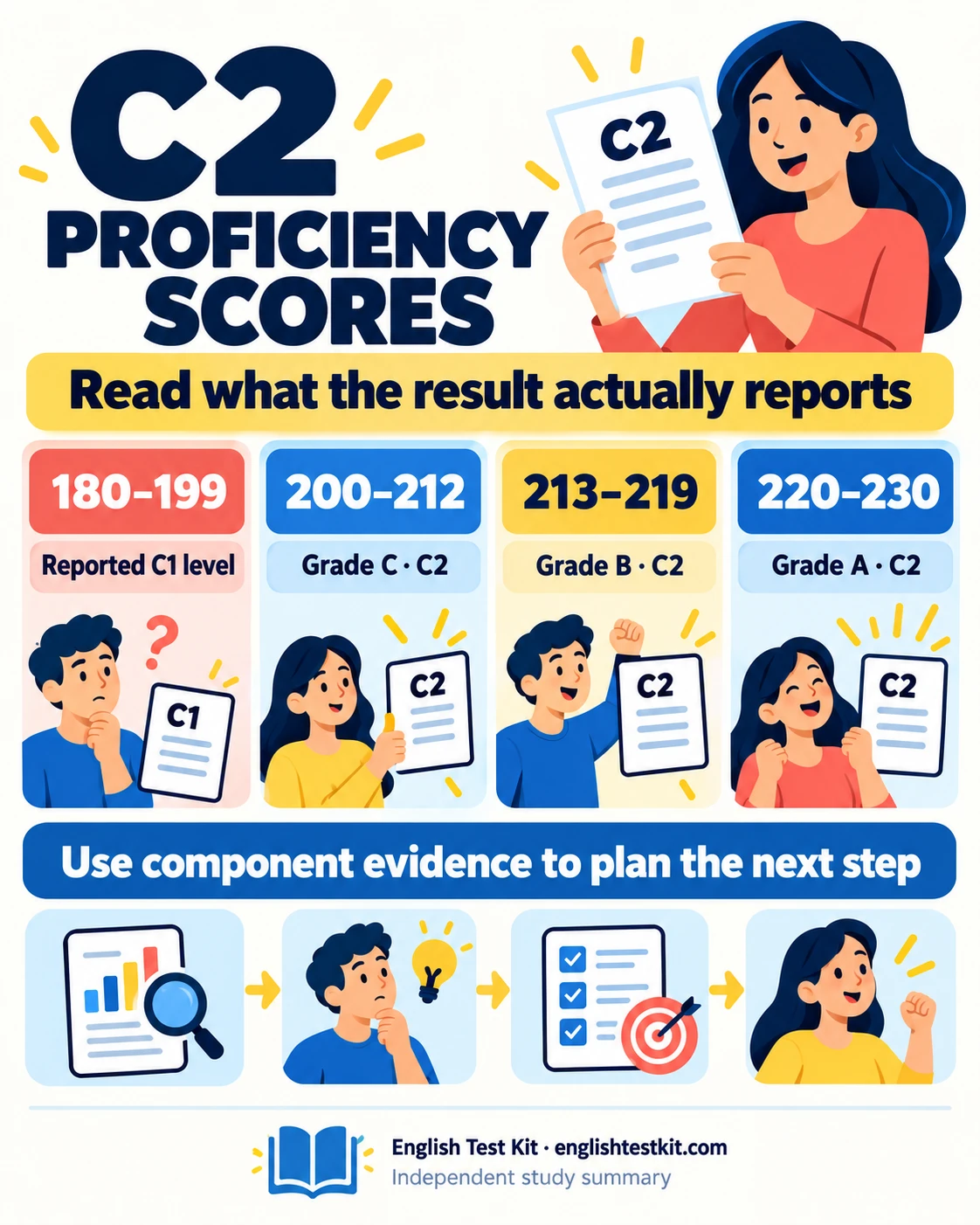
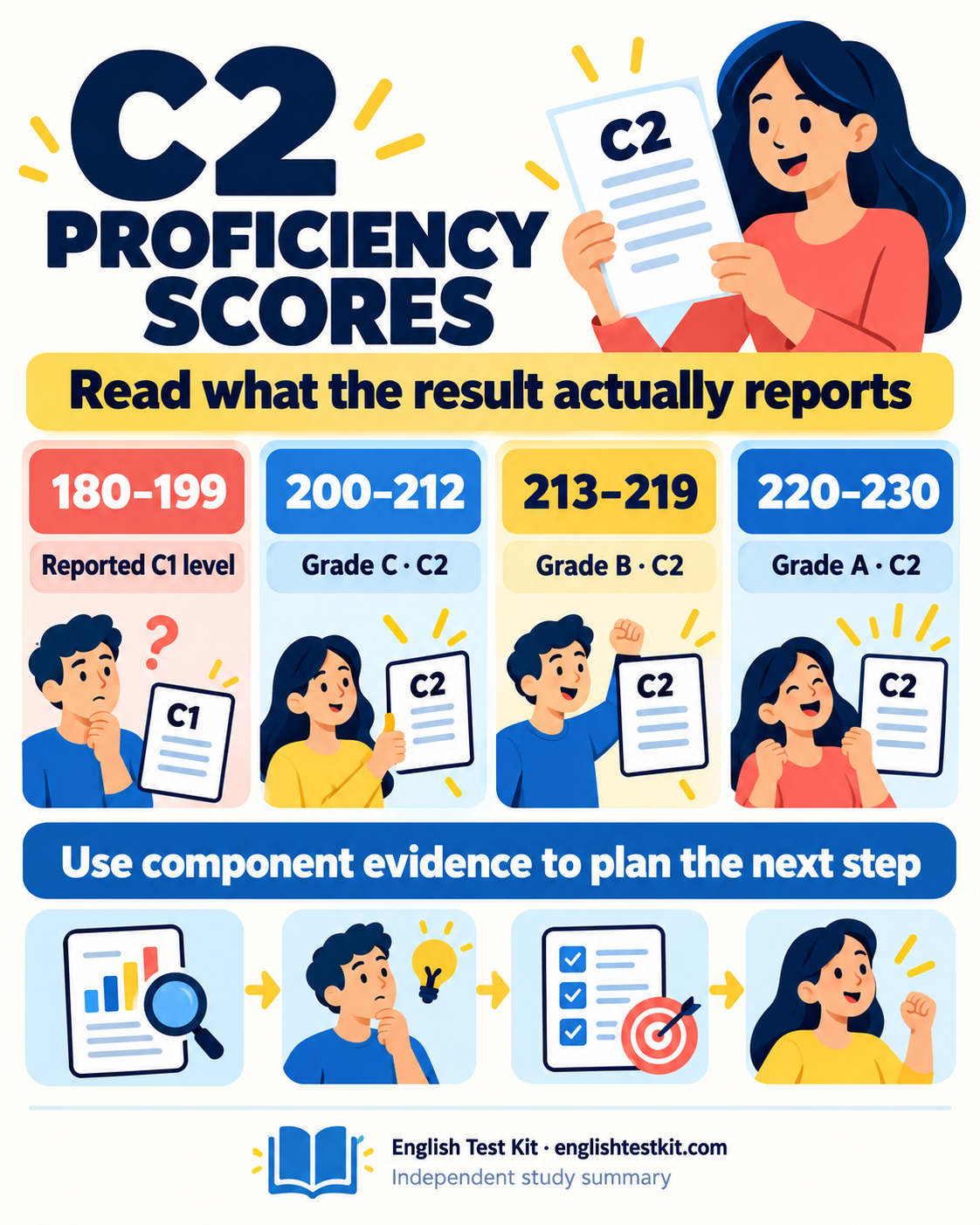
C2 Proficiency Cambridge English Scale reporting bands
Scale score | Grade or outcome | CEFR level |
|---|---|---|
220–230 | A | C2 |
213–219 | B | C2 |
200–212 | C | C2 |
180–199 | Level reported | C1 |
162–179 | Score reported; no certificate | — |
What the result shows
The Statement of Results gives an overall Cambridge English Scale score and component information. For B2 First, C1 Advanced and C2 Proficiency, Reading, Use of English, Writing, Listening and Speaking scores contribute equally to the overall score.
Use individual component scores to understand your profile. An institution may set a minimum overall score, a minimum for one skill, or both.
A score band's Cambridge reporting outcome does not guarantee acceptance by a university, employer or other organisation. Check its current requirement.
Interpret the level, not just the letter
C2 Proficiency targets C2. Grades A, B and C at the certificate threshold report C2, while the lower certificate band reports C1. There is no CEFR level above C2.
Scores below the certificate bands can still appear on a Statement of Results. The Cambridge results page identifies which lower scores are reported without a certificate.
Interpret the outcome for this qualification
The qualification targets C2, with the published grade bands reporting C2 and the lower certificate range reporting C1. Use those qualification-specific rules rather than carrying over an explanation about Grade A in B2 First. The same grade letter does not identify the same scale band across different exams.
If a recipient asks for a named qualification and a score, check both. A general statement that you have a particular CEFR level may not supply every piece of evidence requested. Use the official report and current provider guidance when clarifying the outcome.
Work through a fictional component comparison
Consider illustrative scores of Reading 218, Use of English 214, Writing 199, Listening 212 and Speaking 217. Their average is 212. The profile shows a relative writing weakness even though the average is strong. It is an invented example for interpretation, not a real report or a way to convert a small practice set.
Imagine a fictional recipient requiring overall 200 and Writing 200. The illustrated overall figure meets one condition while Writing misses the other. A stronger score elsewhere does not automatically replace an explicit individual requirement. Record the actual recipient's thresholds and result-date policy instead of using these teaching figures.
Diagnose precision rather than chasing ornament
For Writing, review source integration, evaluation, reader awareness and language control. A response may use impressive vocabulary while misrepresenting a source's claim or failing to connect the arguments. For Reading and Listening, inspect subtle scope, qualification, reference and implied stance. For Speaking, consider the development of a coherent position and responsiveness in interaction.
A useful target might be to preserve a source's limitation when synthesising it, or to explain why a near-equivalent lexical option changes the meaning. These are more actionable than the instruction to make every sentence longer. Complexity should serve an exact communicative purpose.
Use practice estimates responsibly
Follow the guidance supplied for appropriate official practice material when interpreting marks. Raw scores from unrelated tasks are not automatically Cambridge English Scale scores, and productive responses benefit from informed feedback. Keep estimates separate from the certified report.
Track progress across fresh material rather than only a polished familiar essay or a remembered paper. Save an original response and a revision, then identify whether the change improves accuracy, reasoning, register or cohesion. This produces evidence that can guide another preparation cycle.
Check the report's intended use
Confirm the accepted qualification, overall and component conditions, date policy and submission route. Ask the recipient about an ambiguity with the exact report details. A clear comparison lets the result support the required decision while the component evidence points to a specific next learning goal.
Save your one-page study summary
Continue with related guides
Sources and further information
This guide is an independent explanation. Cambridge English publishes the exam rules and is the final source for current instructions.