

C1 listening and speaking preparation should develop attention to attitude, qualification and connected argument. Understanding individual words is necessary, but a speaker's position may depend on a contrast or limitation. In your own responses, the same precision helps you develop a view without making claims stronger than you intend.
Listening: four different listening jobs
The Listening paper lasts about 40 minutes and contains four parts with 30 questions. Cambridge says each recording is played twice. Read the task before the audio begins and decide whether you need a detail, opinion, main idea or match.
C1 Advanced Listening part map
Part | Task | Questions | |
|---|---|---|---|
1 | Short multiple choice | Two questions for each of three short extracts. | 6 |
2 | Sentence completion | Record details from a monologue. | 8 |
3 | Multiple choice | Follow a longer conversation. | 6 |
4 | Multiple matching | Match five themed monologues to statements. | 10 |
Speaking: make interaction work
The Speaking test has four parts and takes 15 minutes per pair; 23 minutes for a group of three. Depending on the task, you speak to an examiner, with another candidate, or on your own.
A partner is not an obstacle to work around. Listen, respond to the point they made, and help the conversation reach a useful next step.
C1 Advanced Speaking task map
Part | Task | What you do | Typical time |
|---|---|---|---|
1 | Interview | Answer questions on familiar topics. | About 2 min |
2 | Long turn | Compare pictures and comment on them. | 1 min + response |
3 | Collaborative task | Discuss options and reach a decision. | About 3 min |
4 | Discussion | Explore the topic further with reasons. | About 5 min |
Build reliable habits
For Listening, do one attempt without pausing; afterwards, replay and note the cue that supports each answer. For Speaking, answer the question directly, develop one point, and make space for your partner in collaborative tasks.
Clear communication is more useful than forcing complicated vocabulary into an answer. Practise extending a response with a reason, example or comparison.
Speaking durations are approximate and can vary with the number of candidates. Confirm arrangements with your centre.
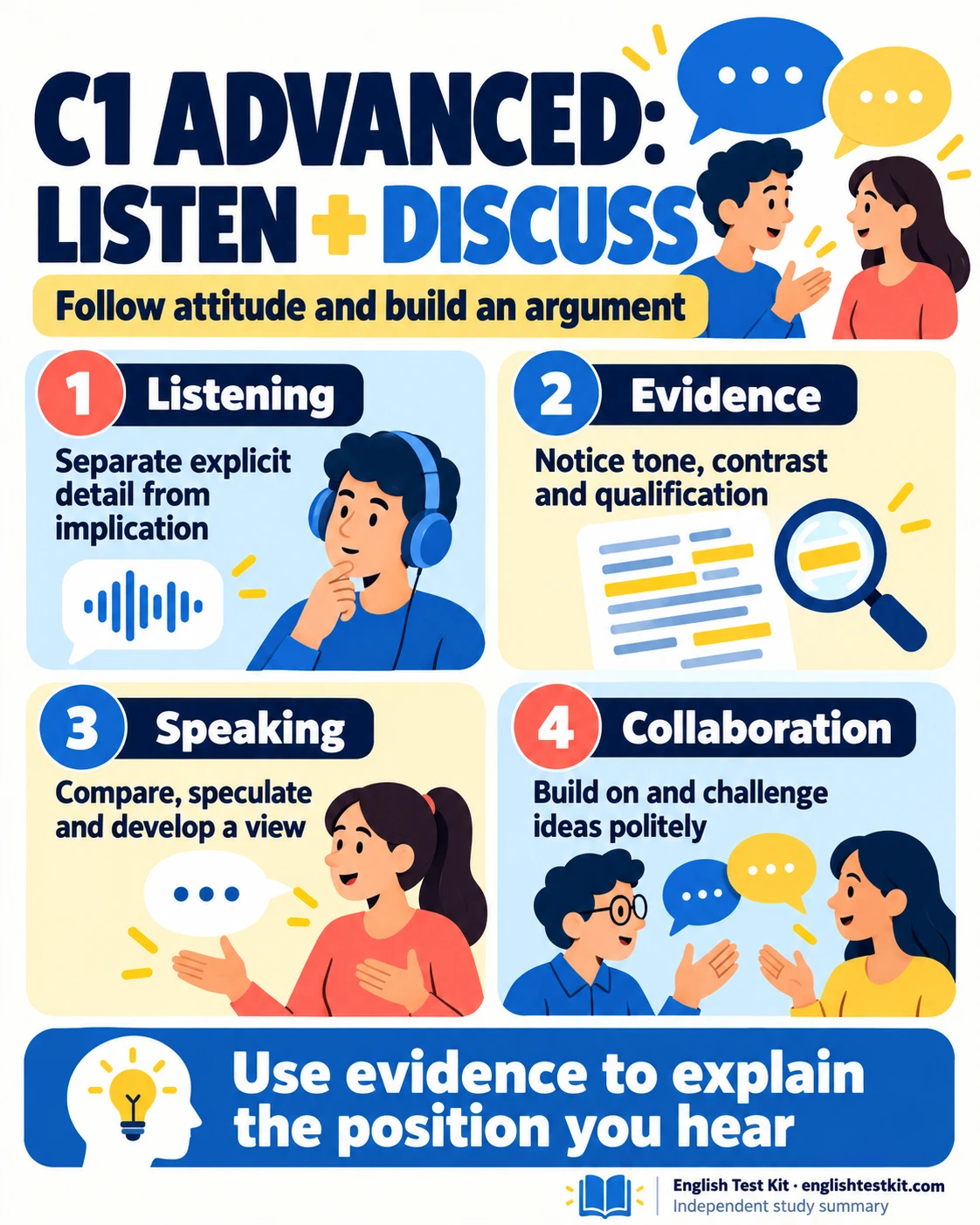
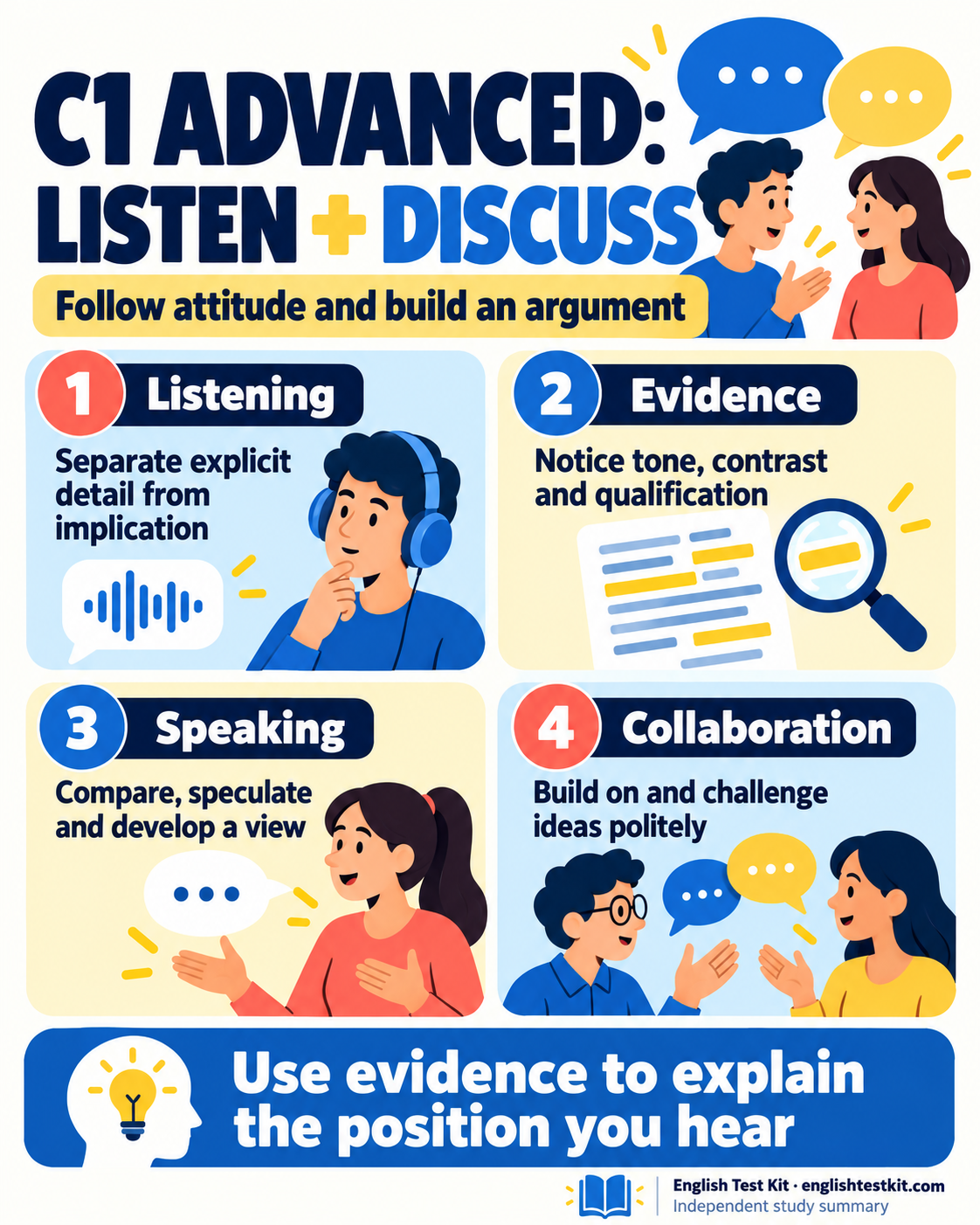
Hear the position, not only the positive words
Consider this original transcript excerpt: “The trial was promising, although I would want a larger study before recommending the method widely.” The speaker recognises potential but withholds a broad recommendation. An option saying the speaker fully endorses immediate adoption would ignore the qualification.
During review, identify which words establish the attitude and which limit it. A confident tone does not automatically mean complete agreement, and mentioning a benefit does not remove a later concern. Use replay and the transcript after the independent attempt to check whether the problem was hearing the phrase or interpreting its function.
Keep speakers and viewpoints distinct
In an interview or set of themed monologues, similar vocabulary can appear in different positions. One speaker may value convenience but regret a loss of interaction; another may prioritise interaction despite the inconvenience. Record the relationship between benefit and concern rather than only the topic words.
Explain why a rejected option belongs to another speaker, overstates the view or supplies a reason not given. This produces a useful listening target for a fresh recording. Repeatedly recognising the same familiar audio is not the same as interpreting an unfamiliar voice independently.
Develop a spoken comparison with appropriate caution
Imagine a practice photo comparison involving people studying alone and working together. A C1 response can compare the visible situations and speculate about their benefits while answering the actual question. “The group may be sharing ideas, whereas the individual seems able to control the pace” is appropriately cautious about information a photograph cannot establish with certainty.
Avoid turning every inference into a fact about the people. Use the image and prompt as evidence, then develop the relevant comparison. An organised answer with accurate language is more useful than a catalogue of speculative details.
Make a collaborative exchange responsive
For an original discussion about improving a community learning programme, one person might propose more online sessions and another worry about access. A useful reply could acknowledge the flexibility benefit and suggest retaining some in-person support. It builds on the partner's point and advances the decision.
Practise qualifying disagreement: explain the condition under which an idea might work, identify a limitation and invite a response. A prepared monologue that ignores the previous turn does not demonstrate the same interaction. Keep the exchange moving towards the outcome required by the task.
Review listening and speaking separately
For listening, locate evidence and classify the distractor's problem. For speaking, first check relevance, development and response to the partner, then inspect pace, intelligibility and language control. Choose one next adjustment and test it on fresh material. Periodically rehearse the complete component under current official conditions so the more precise habits remain available when time and attention are limited.
Save your one-page study summary
Continue with related guides
Sources and further information
This guide is an independent explanation. Cambridge English publishes the exam rules and is the final source for current instructions.