

C1 Advanced preparation should develop flexible language use, precise comprehension and communication for a clear purpose. The format includes familiar-looking task families, but the demands are not simply a longer version of B2 work. Use representative C1 material to see how well you handle viewpoint, complex relationships, register and developed argument.
The four components at a glance
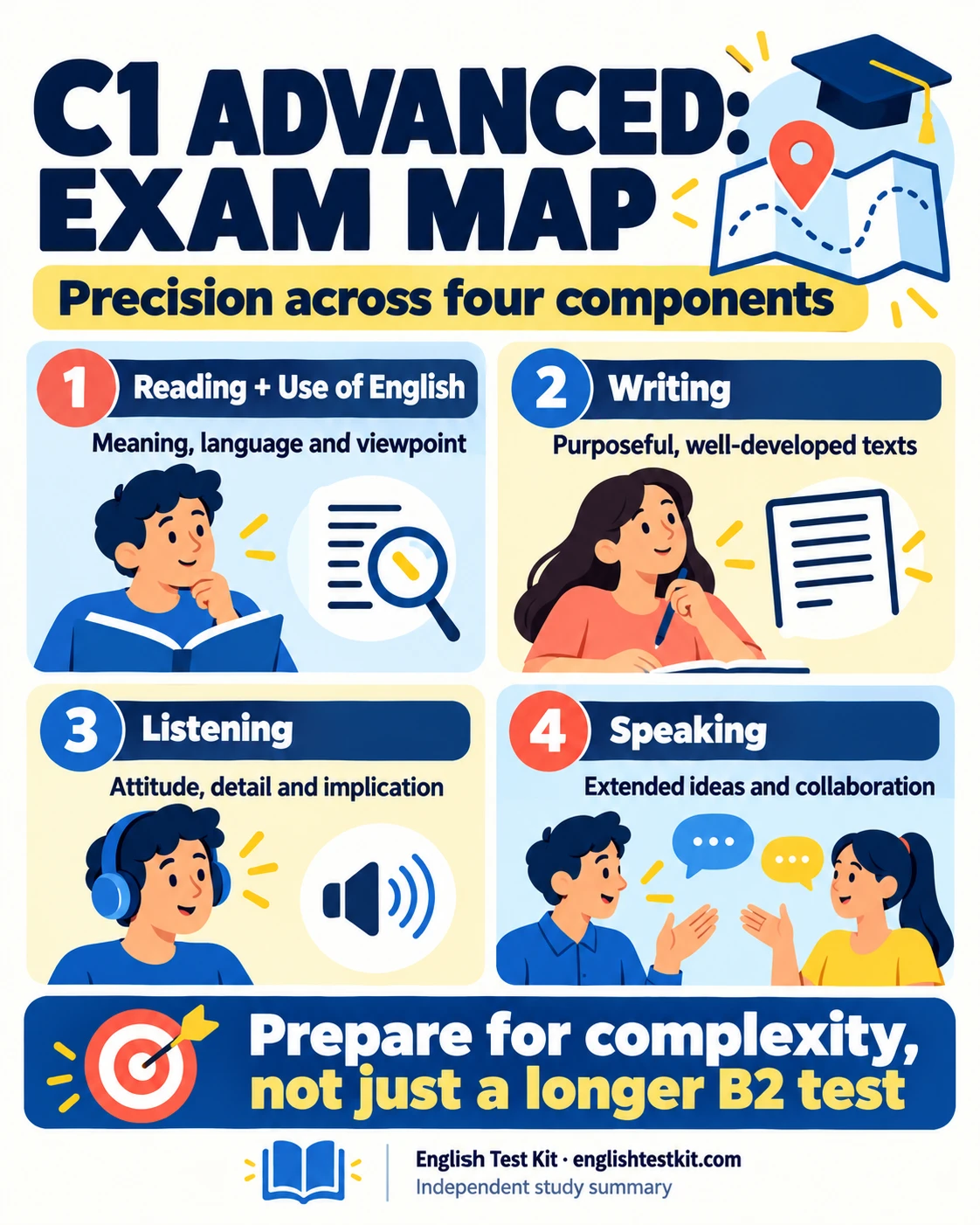
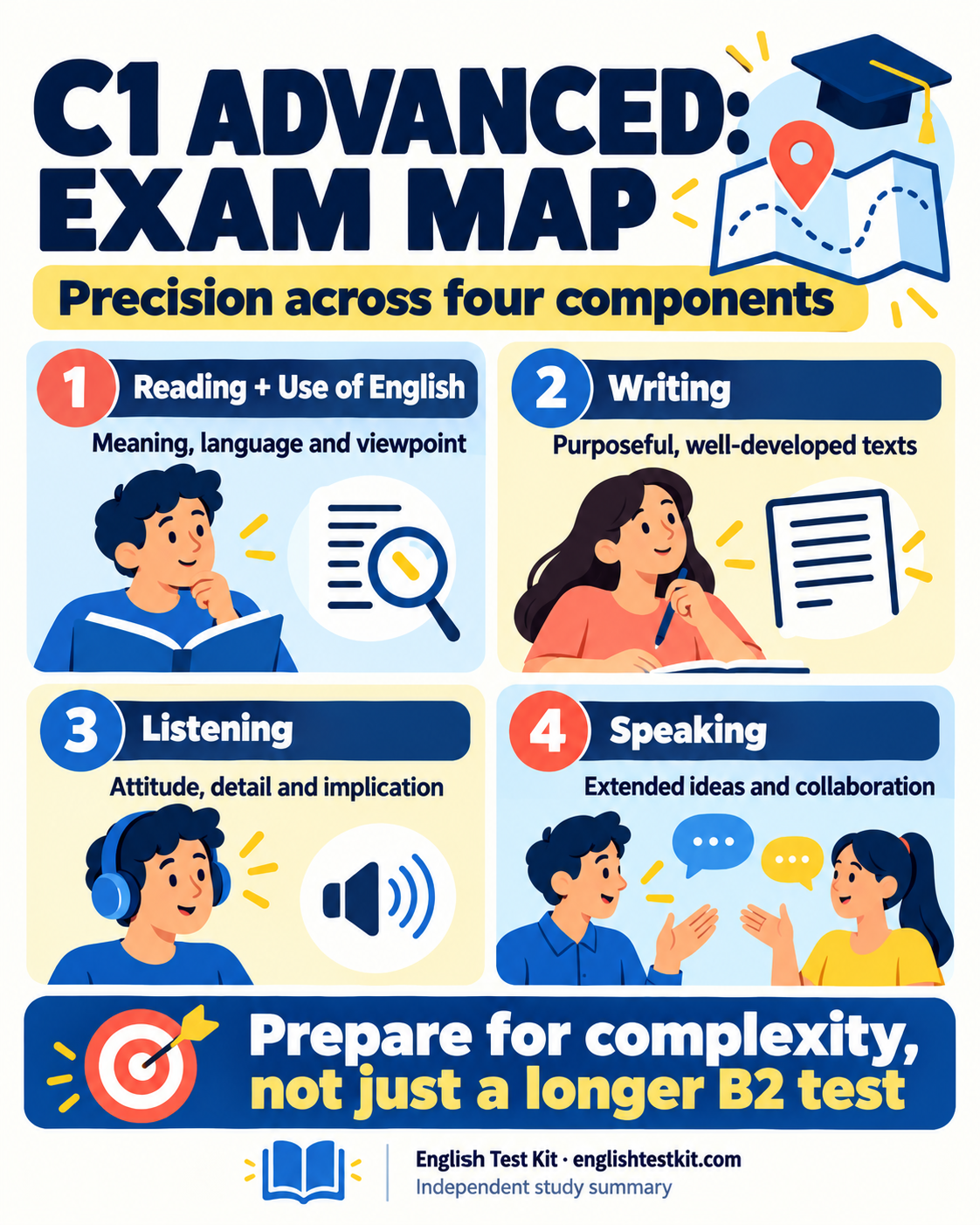
C1 Advanced targets CEFR C1. Its four components assess reading and language use, writing, listening and speaking.
Current C1 Advanced component overview
Component | Time and structure | What it samples |
|---|---|---|
Reading and Use of English | 1 h 30 min · 8 parts · 56 questions | Read complex texts and demonstrate control of grammar and vocabulary. |
Writing | 1 h 30 min · 2 parts | Write a compulsory essay and one task chosen from three. |
Listening | About 40 min · 4 parts · 30 questions | Follow conversations, interviews, talks and themed monologues. |
Speaking | 15 min per pair; 23 min for three · 4 parts | Interview, long turn, collaborative task and discussion. |
How to read the timetable
Adding the listed component durations gives about 3 hours 55 minutes of component time. This is content time, not a promise about your total time at a test centre; arrival, breaks and local arrangements may add time.
Cambridge states that the exam format is the same for digital and paper-based delivery. The exact date and availability depend on your centre.
Check the official format page and your exam centre's confirmation for current instructions.
A useful first pass
Try one representative task from each component before you plan a study schedule. That first run shows whether the main difficulty is comprehension, language control, writing under time, or responding in real time.
Learn the instructions and task order before attempting a full paper.
Keep an error log by cause: misunderstanding, vocabulary, grammar, timing, planning or interaction.
Use official sample material to confirm the current task wording.
Recognise the demands behind the component names
Reading and Use of English combines language control with understanding demanding texts and relationships between ideas. A question may depend on a writer's qualification or attitude rather than a directly repeated fact. Writing requires selecting and developing relevant content for a specified reader and purpose. Listening can test implication and stance alongside detail, while Speaking requires extended thought and responsive interaction.
These areas overlap in real language use, but each task still has its own response rules. A precise reading interpretation does not prove that you can produce an appropriately organised proposal, and a fluent discussion does not remove the need for accurate word formation or transformations.
A diagnostic example with different causes
Imagine a learner who understands the main argument of a text but chooses an answer that is too strong. The writer says a policy “may help in some circumstances”, while the option claims it always succeeds. The difficulty is scope and qualification, not necessarily an unknown word.
In a writing task, the same learner may provide several sensible ideas without evaluating which option best serves the reader. That is a development and purpose issue. A useful study plan records these causes separately instead of prescribing only more vocabulary or more complete papers.
Sample each component before prioritising
Try manageable current-format tasks from reading/language, writing, listening and speaking. Keep the initial attempts independent, then use official keys, transcripts, assessment guidance and suitable feedback. Note the task, evidence of the problem and the next action.
For example, close reading of qualifying language may address the overstatement error. Planning a recommendation with explicit reasons may address the writing problem. Both should eventually return to timed and mixed practice so the improved habits remain available under normal working conditions.
Build depth before increasing workload
Review why the nearest distractor fails, why a paragraph needs a transition or how a proposal should help the reader decide. A small amount of fully analysed work can reveal more than a long series of unchecked answers. Use fresh material to test transfer after learning a method.
For Speaking, practise developing and qualifying a view while responding to a partner. For Listening, distinguish hearing the words from interpreting the speaker's position. Keep feedback specific enough that the next attempt has a clear purpose.
Rehearse the whole assessment appropriately
Once task methods are familiar, complete longer components to test pacing, stamina and transitions. Include planning and checking in writing practice and actual spoken delivery in speaking practice. Follow current official directions and your centre's appointment instructions for delivery and scheduling. A complete preparation route combines component knowledge, precise language work and reliable rehearsal rather than relying on one impressive-looking skill.
Save your one-page study summary
Continue with related guides
Sources and further information
This guide is an independent explanation. Cambridge English publishes the exam rules and is the final source for current instructions.