

C1 Advanced Writing requires more than accurate description. Your response should select relevant ideas, develop them and use an appropriate style for a particular reader. Preparation becomes more effective when you practise evaluating a point and explaining why it matters, rather than adding longer sentences to a B2-style outline.
Two tasks, different decisions
Follow the exact instruction in front of you. The task choices and word ranges differ across qualifications.
C1 Advanced Writing paper overview
Task | What you write | Word range |
|---|---|---|
Part 1 | Compulsory essay using information and points in the prompt. | 220–260 words |
Part 2 | Choose one of three tasks: letter/email, proposal, report or review. | 220–260 words |
Plan for the reader
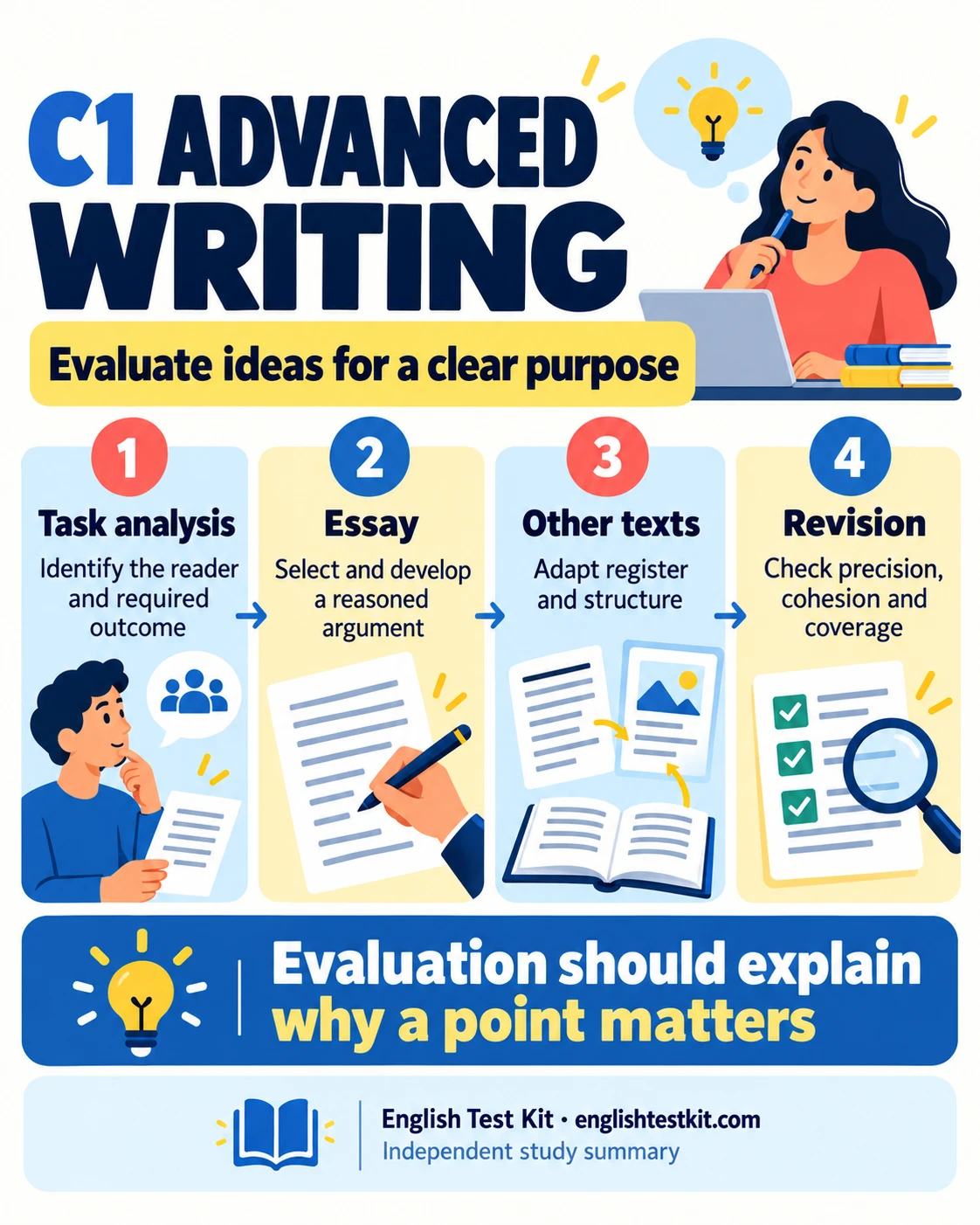
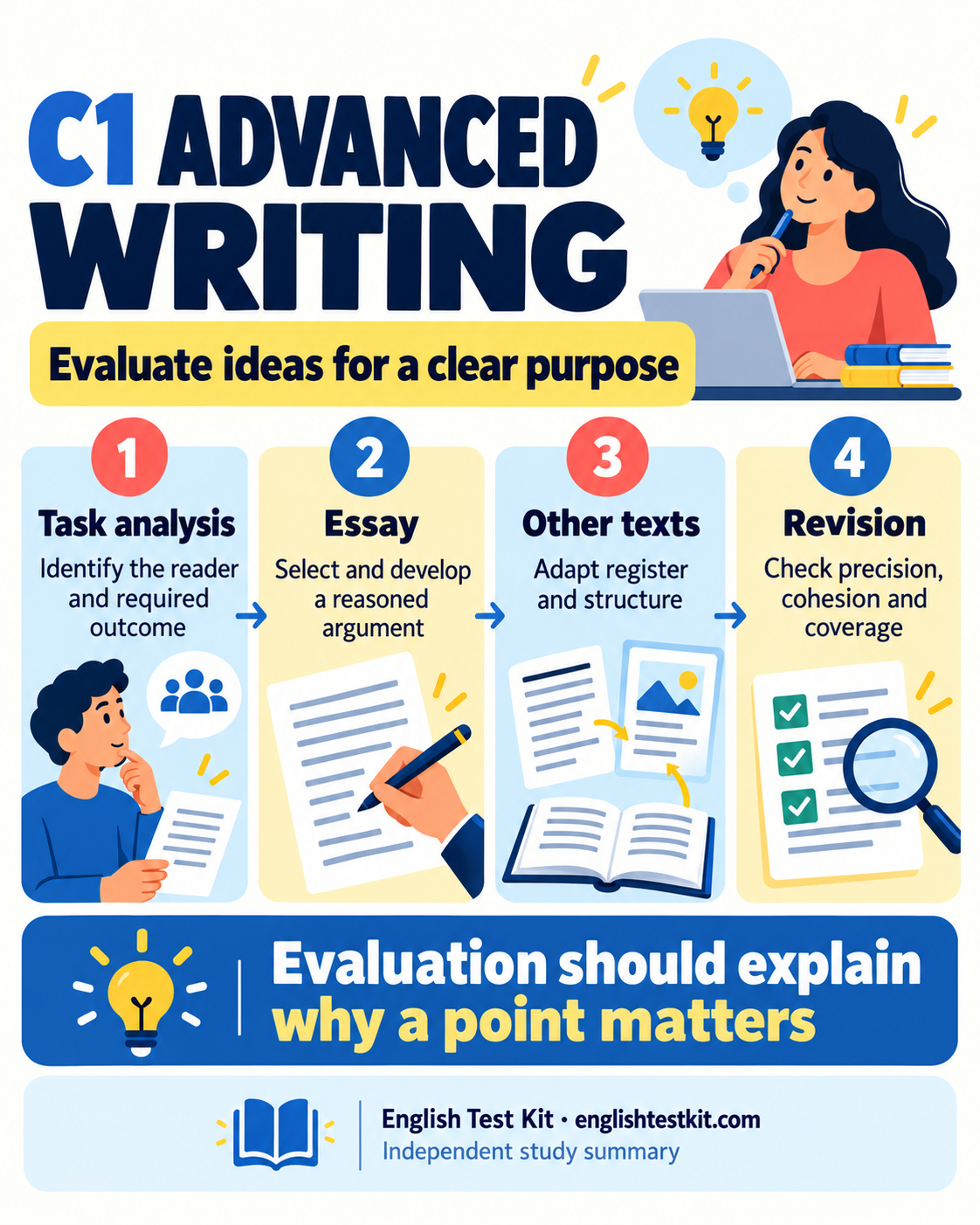
Before drafting, identify the purpose, audience and each required point. Choose a structure that helps that reader follow your message; do not force every prompt into one memorized template.
Make a short plan with one purpose and a logical order for the main ideas.
Support opinions with reasons, examples or evaluation.
Use linking phrases when they show a real connection.
Leave time to check task coverage, paragraphing, grammar and spelling.
What changes at this level
Part 1 asks you to develop an argument from supplied material. Part 2 tests whether you can adapt structure and tone to the purpose and reader.
Use the official sample paper and assessment guidance for the precise instructions and task types in the version you are taking.
Turn a point into an evaluation
Imagine an original essay topic about improving travel around a town, with ideas concerning cycle routes and public information. “Cycle routes are useful” states an opinion. A developed evaluation could explain that safer connections may help people who already want to cycle, while an information campaign alone cannot remove a dangerous junction.
The stronger version identifies a criterion—whether the measure addresses the practical barrier—and uses it to compare ideas. Your actual response must follow the supplied task and notes. Do not memorise the example position or assume that one policy is always the best answer regardless of the prompt.
Plan the essay around a line of reasoning
Identify the required issue, the ideas you must consider and the decision or argument the task needs. Choose points you can explain and arrange them in an order that supports the conclusion. A paragraph should do a clear job: evaluate a proposal, examine a limitation or connect a reason with its consequence.
Avoid writing several disconnected advantages and expecting a final sentence to supply the argument. A reader should be able to see why the discussion leads to the position you take. Relevant detail and a clear relationship between ideas are more valuable than a large collection of formal linking expressions.
Adapt a proposal to the person who will use it
For an original planning exercise, imagine a learning-centre manager asking for recommendations to improve evening study sessions. A useful proposal might identify a practical problem, recommend a change and explain the expected benefit and implementation consideration. The manager needs enough information to judge the recommendation, not only a description of an ideal centre.
Compare “The centre should provide more activities” with “A weekly guided discussion could give evening learners speaking practice without requiring another full course.” The second makes a more specific recommendation and explains its purpose. Any figures or findings used in a real task should come from the prompt or be supplied only where the task permits invention.
Control register without making the text heavy
Choose a level of formality suited to the relationship and text type. A report or proposal can use direct, precise language and clear sections; it does not need inflated phrases in every sentence. An email or review may call for a different voice. Check the current optional tasks and choose one whose purpose you understand.
Vocabulary should express an exact distinction, not merely display variety. If a synonym changes the meaning or sounds unnatural in its collocation, the simpler accurate word is preferable.
Revise content before surface detail
Check task coverage and reader usefulness first, then organisation and paragraph development, and finally language accuracy. Keep a draft and revision so you can identify which changes improve reasoning, register or grammar. Practise a fresh task after feedback to see whether the correction transfers. These original examples illustrate methods, not official scored answers or guaranteed grade features.
Save your one-page study summary
Continue with related guides
Sources and further information
This guide is an independent explanation. Cambridge English publishes the exam rules and is the final source for current instructions.