

B2 First Writing asks you to communicate for a particular purpose and reader. Preparation should include recognising the required points, planning a clear route and checking that the finished text does its job. Accurate sentences matter, but they cannot replace an answer that covers the task.
Two tasks, different decisions
Follow the exact instruction in front of you. The task choices and word ranges differ across qualifications.
B2 First Writing paper overview
Task | What you write | Word range |
|---|---|---|
Part 1 | Compulsory essay using two supplied ideas and one of your own. | 140–190 words |
Part 2 | Choose one of the optional tasks offered for your test version. | 140–190 words |
Plan for the reader
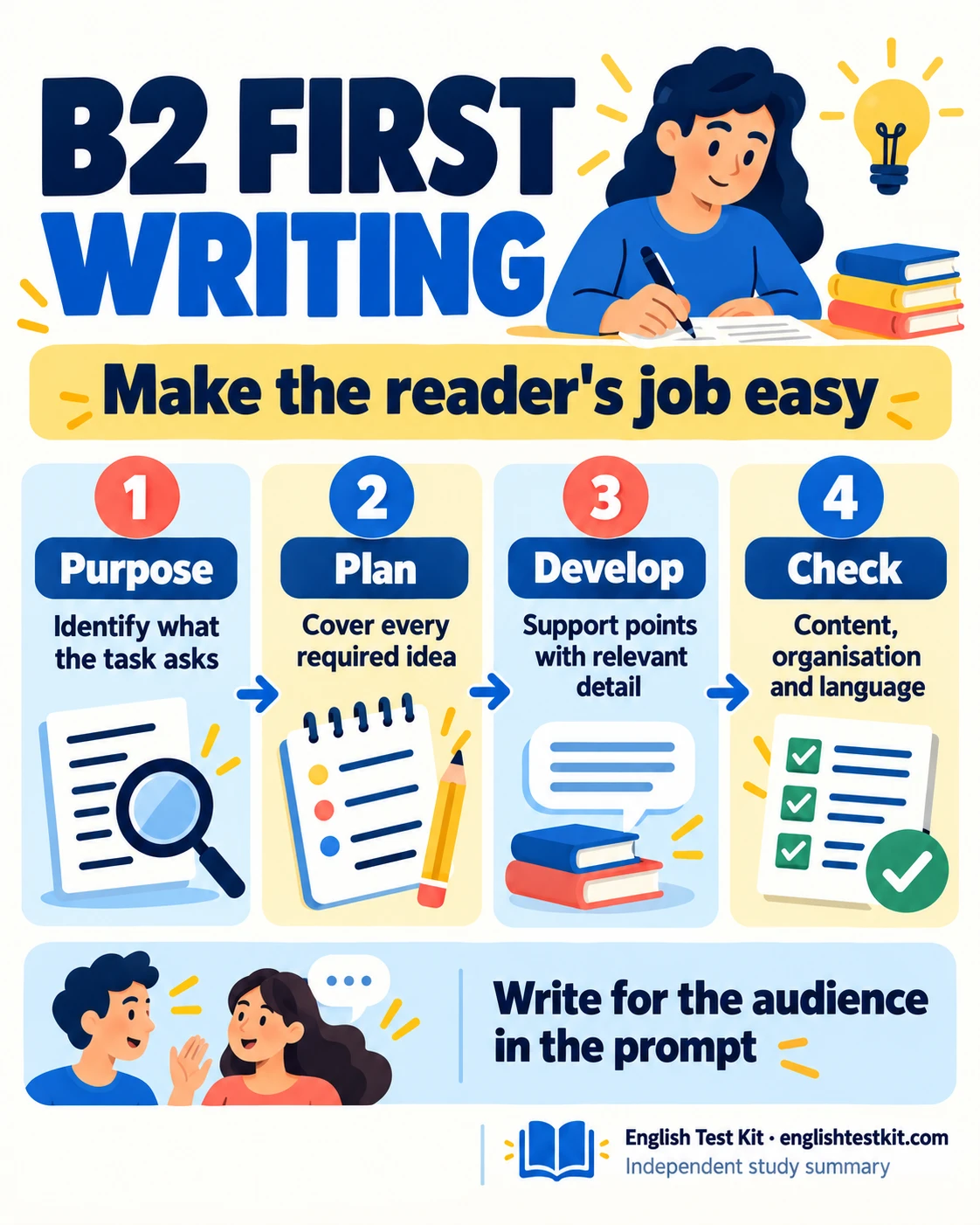
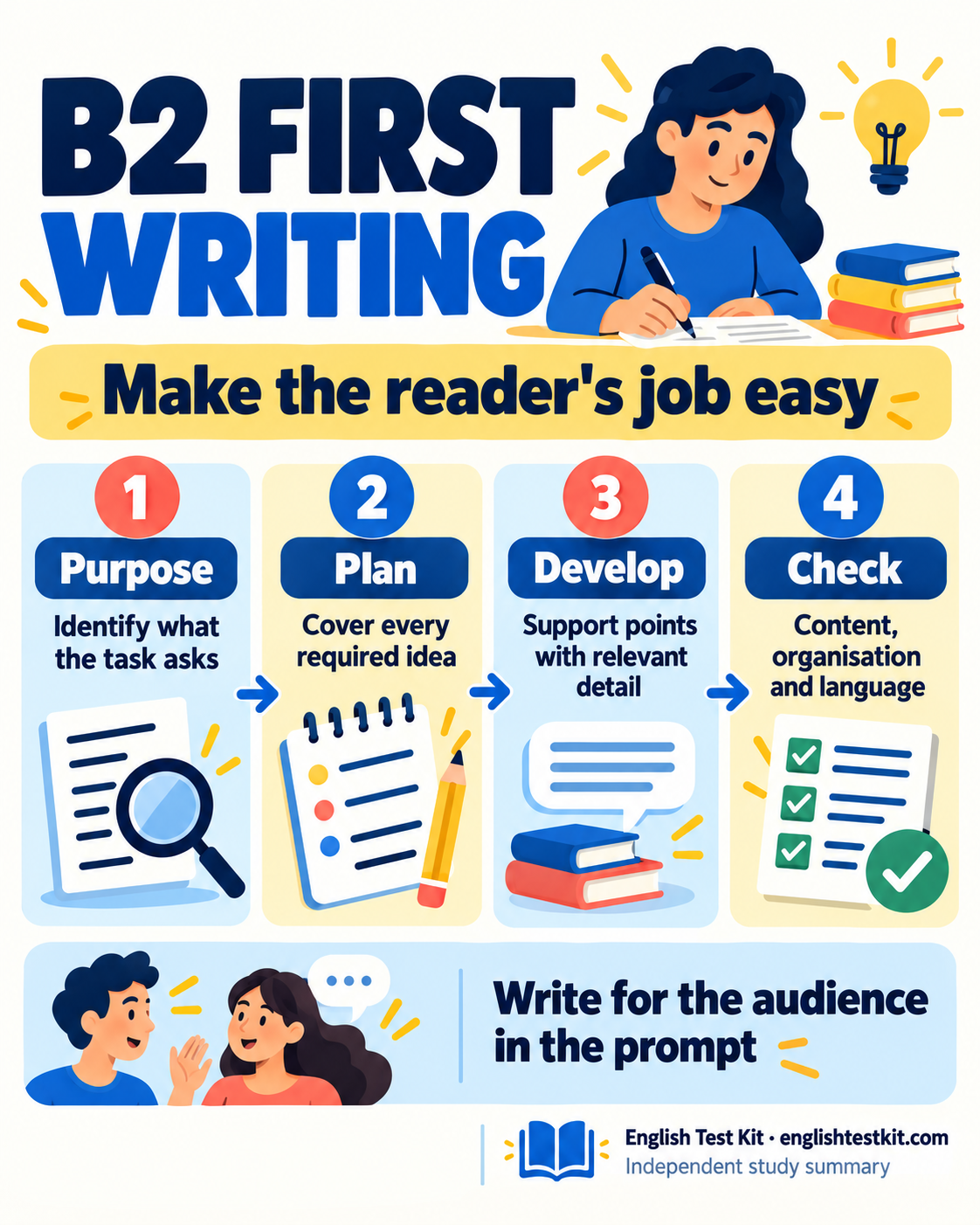
Before drafting, identify the purpose, audience and each required point. Choose a structure that helps that reader follow your message; do not force every prompt into one memorized template.
Make a short plan with one purpose and a logical order for the main ideas.
Support opinions with reasons, examples or evaluation.
Use linking phrases when they show a real connection.
Leave time to check task coverage, paragraphing, grammar and spelling.
What changes at this level
For standard B2 First, Part 2 can include an article, email or letter, review, or report. The story task is a B2 First for Schools option; the report is a standard B2 First option.
Use the official sample paper and assessment guidance for the precise instructions and task types in the version you are taking.
Plan the compulsory essay from its notes
Imagine an original practice topic asking whether schools should organise more educational trips, with notes about learning, cost and an additional idea of your own. A complete plan needs attention to all those elements. You might argue that trips are valuable when they connect with classroom work, consider the cost and add accessibility as your own point.
An outline could begin with a clear position, develop learning benefits, explain a cost or access concern and reach a supported conclusion. The structure should serve the argument rather than force every topic into identical memorised paragraphs. Before drafting, check that each supplied note has a place and that your additional idea is genuinely relevant.
Develop a point with a concrete reason
“School trips are interesting” gives an opinion but little explanation. A more developed practice excerpt is: “A visit to a science centre can make an abstract classroom topic easier to understand because students can see a demonstration and ask questions about it.” The example explains how the benefit might arise.
This is an excerpt illustrating development, not a complete response meeting the task's full word range. Practise expanding a point accurately before adding several unrelated ideas. A few well-connected explanations are easier to follow than a long list of advantages without support.
Adapt another text to its audience
For an original informal-email scenario, imagine that a friend asks how to spend a short visit to your town on a limited budget. A useful plan covers the requested travel advice, activities and practical details in an appropriate friendly tone. A paragraph about an expensive attraction might be well written but unsuitable if it ignores the budget condition.
For a report or review, the purpose and organisation will differ. Read the exact optional tasks offered for your version and choose one whose requirements you understand. Standard and Schools task options can differ; use current official sample materials and the prompt in front of you rather than an old list of options.
Check the response in three passes
First check content: have you answered the actual question and every required point? Next check organisation and reader effect: is the purpose clear, are related ideas grouped and are connections easy to follow? Finally inspect language, including sentence boundaries, tense, agreement, word choice and spelling.
Do not use unusual words simply to make the answer appear advanced. A familiar expression used precisely can communicate more effectively than an inaccurate synonym. Register should fit the relationship and text purpose, not a rule that every exam response needs highly formal language.
Build a revision habit
Keep an original draft and a corrected version. Mark additions that repair missing content separately from changes that improve organisation or language. Then try a fresh task and check whether you avoid the same problem. Use official assessment guidance and suitable feedback to understand the broad criteria, while keeping these independent teaching examples separate from official scored samples.
Save your one-page study summary
Continue with related guides
Sources and further information
This guide is an independent explanation. Cambridge English publishes the exam rules and is the final source for current instructions.