

Listening and Speaking share an interest in meaning, but they need different practice evidence. In Listening, you must identify what the recording supports. In Speaking, you must produce a relevant response and interact appropriately. Keep those goals separate so a strong result in one does not hide an unpractised skill in the other.
Listening: four different listening jobs
The Listening paper lasts about 40 minutes and contains four parts with 30 questions. Cambridge says each recording is played twice. Read the task before the audio begins and decide whether you need a detail, opinion, main idea or match.
B2 First Listening part map
Part | Task | Questions | |
|---|---|---|---|
1 | Short multiple choice | Eight short, unrelated recordings. | 8 |
2 | Sentence completion | Complete information from a monologue. | 10 |
3 | Multiple matching | Match five related speakers to statements. | 5 |
4 | Multiple choice | Follow an interview or exchange. | 7 |
Speaking: make interaction work
The Speaking test has four parts and takes 14 minutes per pair; 20 minutes for a group of three. Depending on the task, you speak to an examiner, with another candidate, or on your own.
A partner is not an obstacle to work around. Listen, respond to the point they made, and help the conversation reach a useful next step.
B2 First Speaking task map
Part | Task | What you do | Typical time |
|---|---|---|---|
1 | Interview | Talk about yourself and familiar topics. | About 2 min |
2 | Long turn | Compare two photographs; respond to a partner. | 1 min + response |
3 | Collaborative task | Discuss prompts and make a decision together. | 2 min + decision |
4 | Discussion | Explore the same topic with your partner. | About 4 min |
Build reliable habits
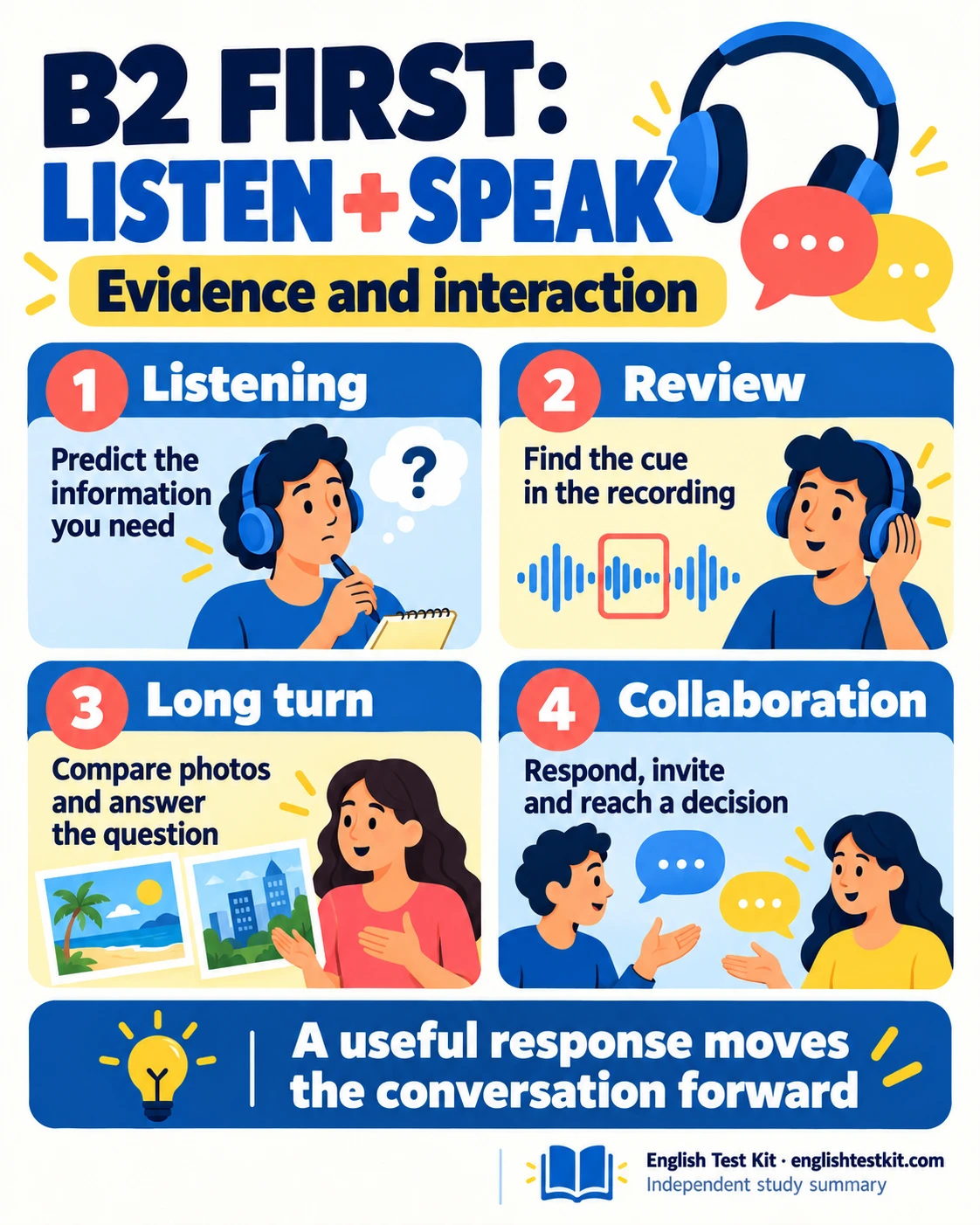
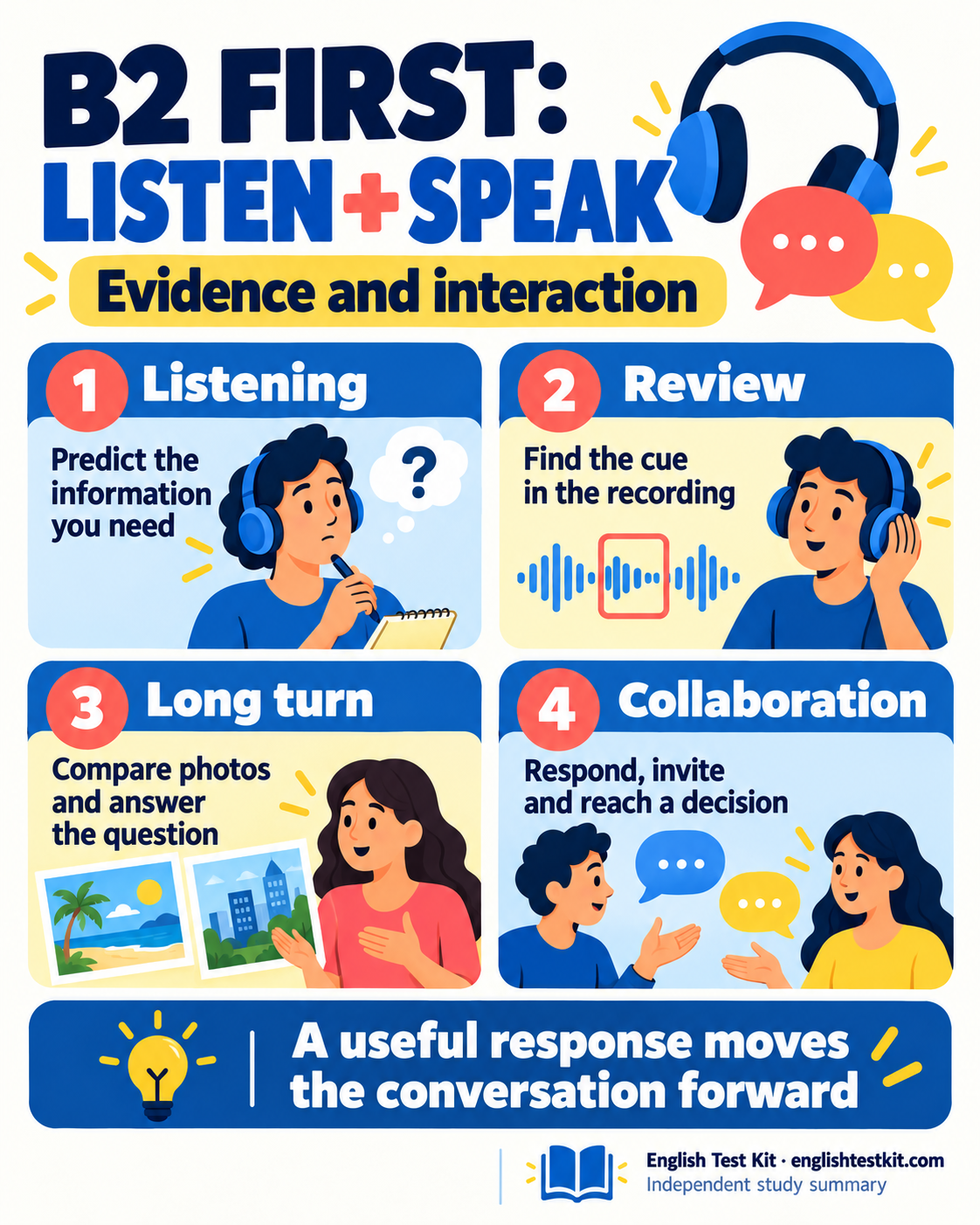
For Listening, do one attempt without pausing; afterwards, replay and note the cue that supports each answer. For Speaking, answer the question directly, develop one point, and make space for your partner in collaborative tasks.
Clear communication is more useful than forcing complicated vocabulary into an answer. Practise extending a response with a reason, example or comparison.
Speaking durations are approximate and can vary with the number of candidates. Confirm arrangements with your centre.
Listening: follow the final meaning
Consider this original transcript demonstration: “I was going to join the painting group, but its meetings clash with my course. I've decided to try photography instead.” If a question asks which activity the speaker chose, the answer is photography. Painting is mentioned as an earlier plan, not the final decision.
During review, identify the cue that changes the meaning and explain why the distractor is attractive. In a longer recording, you may also need to understand opinion, attitude or the purpose of a remark. Hearing a topic word is not enough to settle those questions.
Use the two hearings purposefully
Follow the official directions for the task. In practice, use the first hearing to establish the situation and make supported decisions, then use the next hearing to resolve a specific uncertainty or check a relationship. Avoid spending the whole second hearing mentally replaying one missed phrase while new evidence passes.
After the attempt, use replay and a transcript to diagnose the difficulty. Did you fail to recognise the phrase, misunderstand a contrast or choose an option unsupported by the speaker? A different cause needs a different correction. Keep transcript-supported learning separate from what you understood independently.
Speaking: compare instead of listing
Imagine two original practice photographs: one shows students working quietly in a library, and another shows students discussing a project outdoors. A useful comparison could identify the shared purpose, contrast the working conditions and address the question asked about the pictures. Listing every visible object would not achieve the same purpose.
For example, an excerpt might explain that both groups are studying, while the library may suit concentration and the outdoor setting may encourage discussion. Use cautious language when interpreting a scene and keep the response tied to the prompt. The example is a planning demonstration, not an official photograph task or a scored answer.
Make collaboration responsive
In a paired discussion, listen to the reason your partner gives and respond to it. “That could work because…” develops an idea; “I'm not sure it would help students who…” offers a relevant challenge. Invite a view, compare options and help the discussion move towards its required outcome.
A long prepared speech can prevent meaningful interaction. Practise exchanging shorter developed turns, not simply taking turns to deliver unrelated opinions. The aim is communication with a partner as well as individual language production.
Review the two skills with different questions
For Listening, ask where the evidence is and why each rejected option fails. For Speaking, ask whether you answered, developed, compared and responded appropriately, then inspect pace, intelligibility and language control. Use a fresh recording or prompt to test the next correction. This keeps practice focused on transferable habits rather than remembered answers.
Save your one-page study summary
Continue with related guides
Sources and further information
This guide is an independent explanation. Cambridge English publishes the exam rules and is the final source for current instructions.