

B2 First brings together language knowledge, comprehension and purposeful communication. The component map helps you organise preparation, but each paper contains tasks that need different methods. Learn what you must do, try representative examples and use the evidence to decide where your study time belongs.
The four components at a glance
B2 First targets CEFR B2. Its four components assess reading and language use, writing, listening and speaking.
Current B2 First component overview
Component | Time and structure | What it samples |
|---|---|---|
Reading and Use of English | 1 h 15 min · 7 parts · 52 questions | Read a range of texts; show control of grammar and vocabulary. |
Writing | 1 h 20 min · 2 parts | Write an essay and one text chosen from the task options. |
Listening | About 40 min · 4 parts · 30 questions | Follow short recordings, a monologue and an interview or exchange. |
Speaking | 14 min per pair; 20 min for three · 4 parts | Interview, photo comparison, collaboration and discussion. |
How to read the timetable
Adding the listed component durations gives about 3 hours 30 minutes of component time. This is content time, not a promise about your total time at a test centre; arrival, breaks and local arrangements may add time.
Cambridge states that the exam format is the same for digital and paper-based delivery. The exact date and availability depend on your centre.
Check the official format page and your exam centre's confirmation for current instructions.
A useful first pass
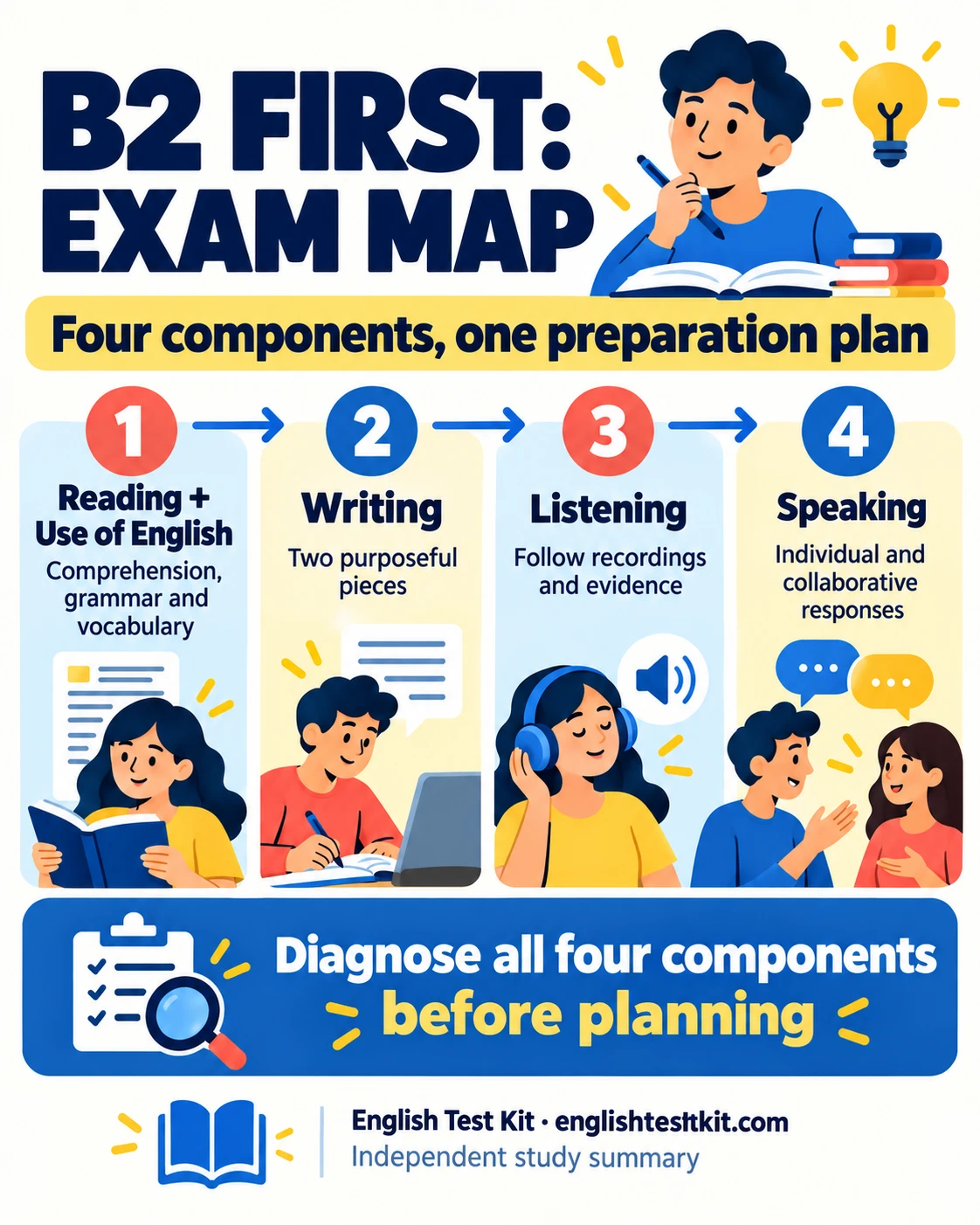
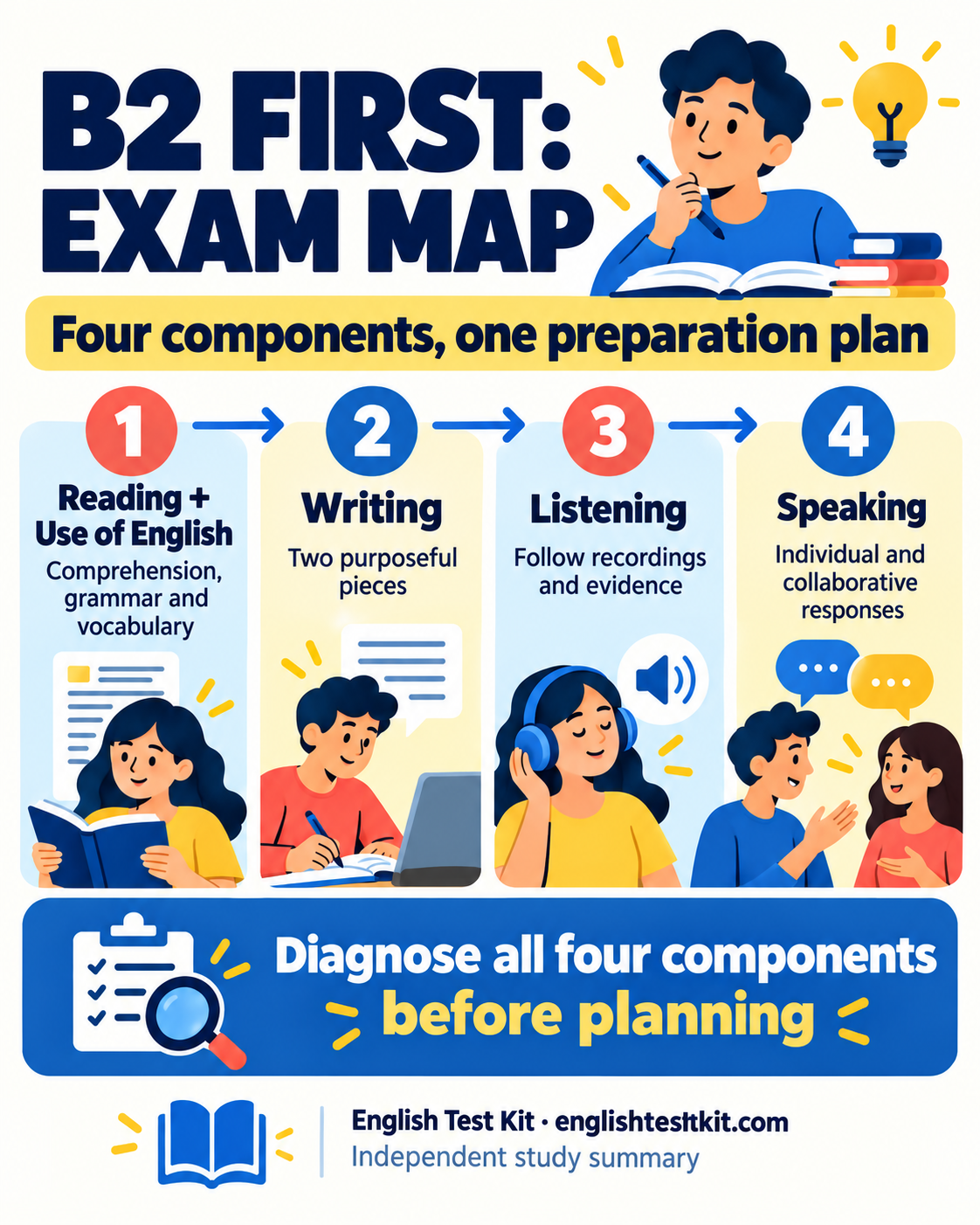
Try one representative task from each component before you plan a study schedule. That first run shows whether the main difficulty is comprehension, language control, writing under time, or responding in real time.
Learn the instructions and task order before attempting a full paper.
Keep an error log by cause: misunderstanding, vocabulary, grammar, timing, planning or interaction.
Use official sample material to confirm the current task wording.
Treat Reading and Use of English as several jobs
Some parts focus on vocabulary and grammar choices; others require understanding detail, text organisation or information across sections. A learner who recognises a passage's general topic can still miss a precise collocation or a reference linking two sentences. Record the part and the cause of an error so these weaknesses do not disappear inside one broad label of “reading”.
For an original practice phrase, “make an effort” demonstrates a collocation that grammar alone does not fully explain. In a gapped text, however, the key clue may be a pronoun referring to an earlier idea. These need different practice even though they appear within the same component.
Prepare purposeful writing and interaction
Writing preparation should begin with the reader, purpose and required points. Practise planning before drafting and checking whether the completed text achieves the task. A well-written paragraph on a neighbouring topic does not replace answering the prompt you receive.
Speaking involves more than producing a memorised monologue. You need to answer questions, develop a short comparison and interact appropriately. In a collaborative practice task, responding to a partner's reason and helping the discussion reach a decision is more useful than delivering an unrelated prepared speech.
A diagnostic week for B2 preparation
Try a small selection from the reading/language parts, one writing task, a listening set and a spoken activity. Keep the first attempts independent so you can see what you can currently do. Then use keys, transcripts, assessment guidance and informed feedback to diagnose the result.
Imagine a learner whose reading evidence is sound but whose writing omits one requested point. More complete reading papers would not address the most visible weakness. A useful next writing session might compare task notes with a plan, draft the missing point and check whether the revised response fulfils the purpose.
Build timing from a reliable method
Learn an unfamiliar task without unnecessary speed pressure, then add a timer once the response method is clear. Periodically combine parts and complete full components to observe pacing and concentration. Leave time to review the rehearsal rather than treating the final submitted answer as the end of the learning process.
For Listening, keep first-attempt conditions separate from replay used for review. For Writing, include planning and checking in the rehearsal. For Speaking, practise aloud so you can observe pace and intelligibility rather than judging a response only from a written script.
Separate paper durations from appointment logistics
The component times explain the assessment structure, not every minute at a centre. Follow the confirmation for arrival, local scheduling, identification and delivery arrangements. Check whether you are taking the standard or Schools version where task options differ. Once those details are clear, preparation can focus on a small number of measurable goals across all four components instead of an unfocused cycle of complete tests.
Save your one-page study summary
Continue with related guides
Sources and further information
This guide is an independent explanation. Cambridge English publishes the exam rules and is the final source for current instructions.