

B2 First Reading and Use of English needs both accurate language choices and careful reading. The most effective review identifies which kind of clue you missed. A collocation, a word-family form and a link between paragraphs can all produce a wrong answer, but they call for different practice.
Paper snapshot
You have 1 hour 15 minutes for 7 parts and 52 questions. The paper combines reading comprehension with control of vocabulary and grammar.
B2 First Reading and Use of English task map
Part | Task type | What to do | Questions |
|---|---|---|---|
1 | Multiple-choice cloze | Choose the word or phrase that fits. | 8 |
2 | Open cloze | Supply one missing word per gap. | 8 |
3 | Word formation | Change a prompt word to fit. | 8 |
4 | Key word transformations | Rewrite a sentence using a given word. | 6 |
5 | Multiple choice | Read for detail, opinion and attitude. | 6 |
6 | Gapped text | Choose sentences that restore the text. | 6 |
7 | Multiple matching | Locate information across text(s). | 10 |
Practise the language and the reading
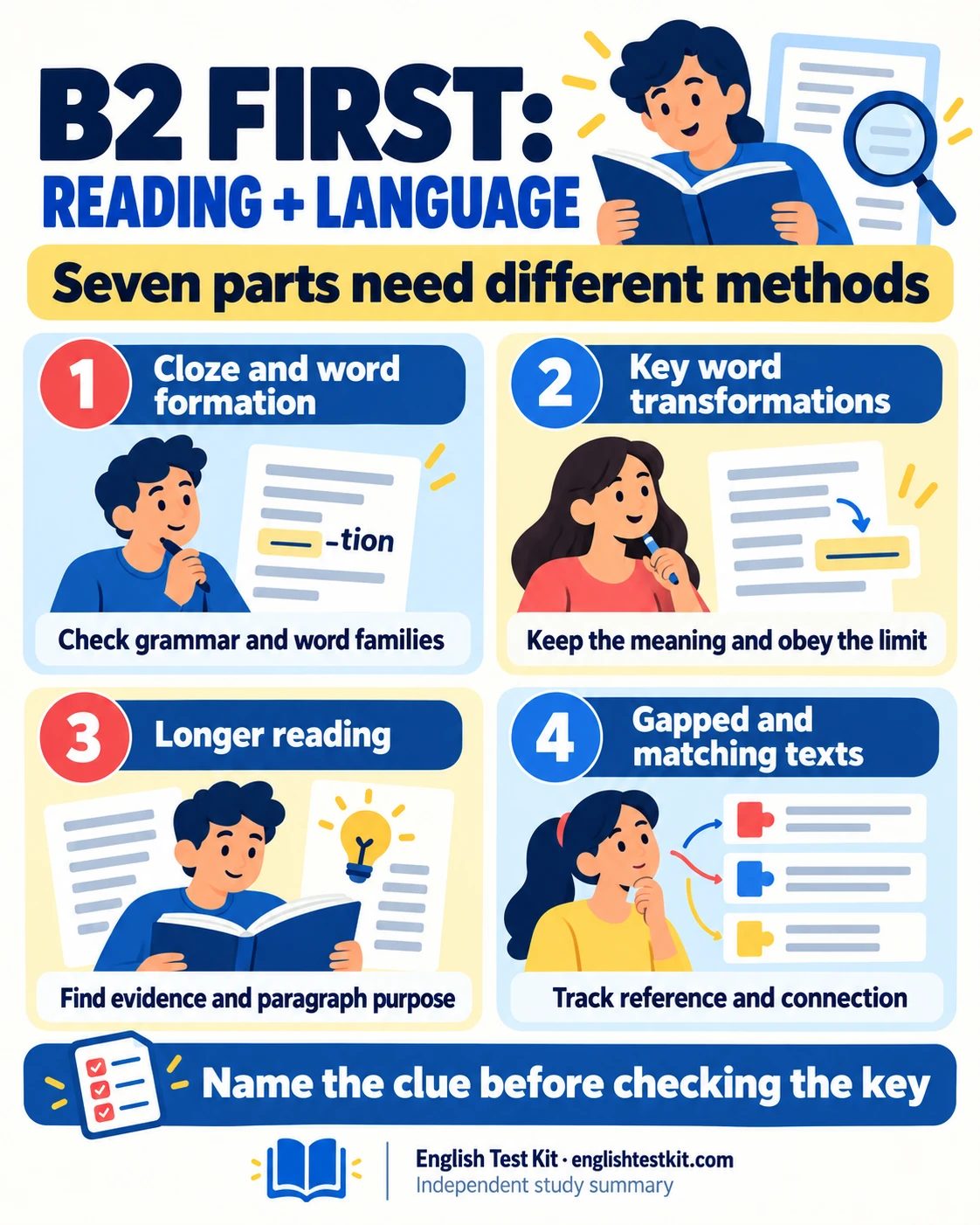
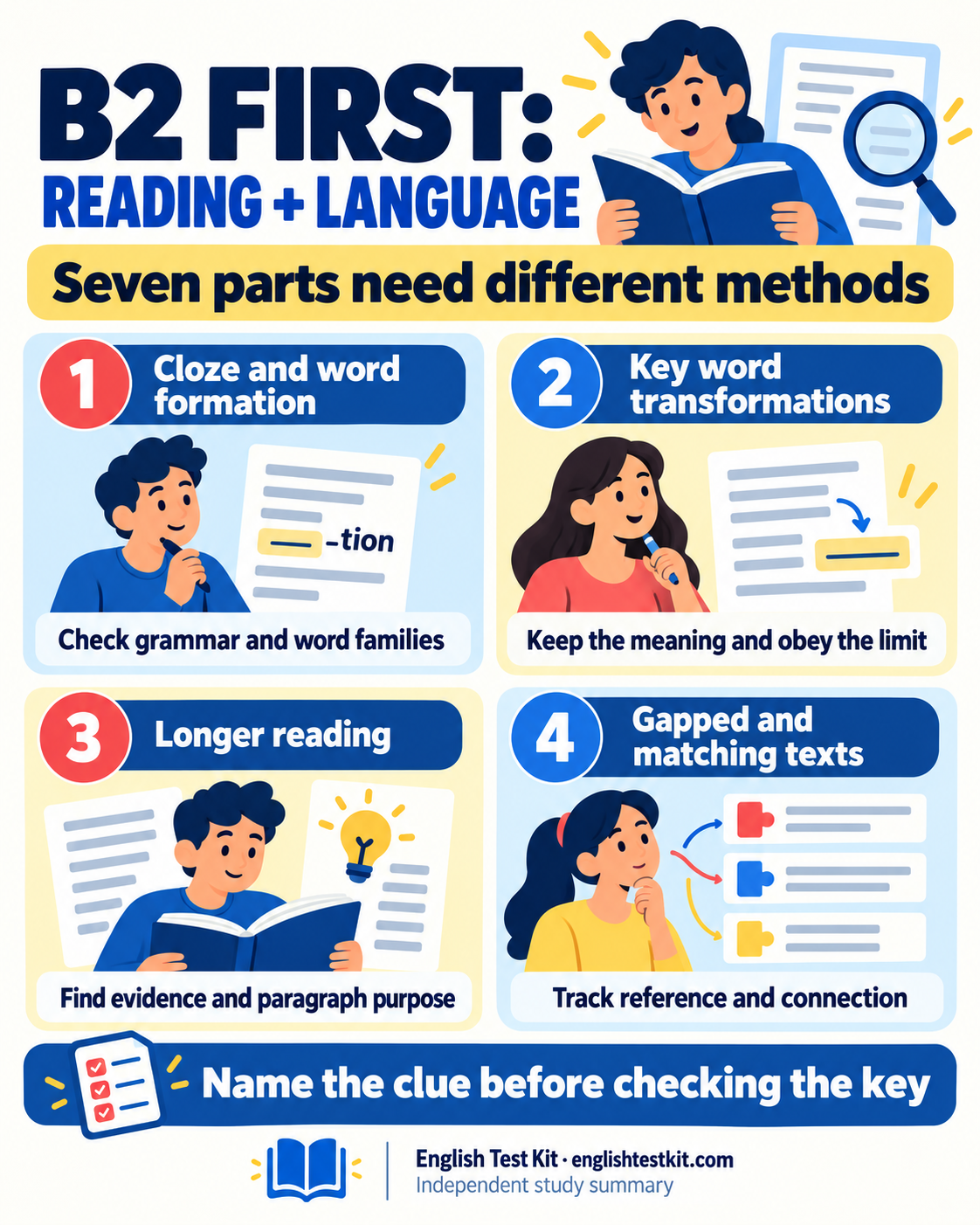
A single strategy will not fit every part. Identify whether the task asks for language knowledge, close reading, text structure or comparison across texts, then choose a matching approach.
Build a notebook for collocations, word families, prefixes and fixed phrases.
For sentence transformations, preserve meaning and obey the word limit.
For longer texts, mark the sentence that proves an answer and explain why a distractor is wrong.
For gapped or matching texts, track reference words, connectors, topic shifts and viewpoint.
The reading load is about 2,200–2,500 words. The paper contributes 40% of the overall result.
Manage time without rushing
Do one timed paper to learn your pace. Then review every uncertain answer and identify the clue you missed. Practise your slowest task type separately before returning to a full-paper run.
Cloze: explain the phrase, not only the letter
In the original practice expression “You need to ___ an effort”, “make” forms the natural phrase “make an effort”. Several alternatives might be base-form verbs, so recognising the grammatical position is not enough. Keep useful combinations together in a vocabulary notebook and add an original sentence that demonstrates the meaning.
For open cloze, read around the gap and ask what grammatical or linking relationship is needed. A missing function word may be small but essential. Check the complete sentence and the paragraph logic before assuming that a longer or more unusual word is better.
Word formation: check meaning and grammatical position
Consider this original example: “The new learning app is especially ___ for young children because its instructions are simple. (SUIT)” “Suitable” supplies an adjective and matches the positive explanation. “Suitability” is a noun, while a negative form would conflict with the context.
Review the whole decision: part of speech, positive or negative meaning, number where relevant and spelling. A list of suffixes can help, but applying the right form in context is the actual skill. Practise a word family across several different sentences so the form does not become tied to one remembered answer.
Key word transformations: preserve the meaning
Take the original sentence “I last saw Amir three months ago.” With the key word FOR, a possible target is “I have not seen Amir ___.” The completion “for three months” preserves the intended time relationship. Check the required word limit and keep the supplied key word unchanged as instructed in the actual task.
Do not focus only on finding a phrase containing the key word. Compare tense, negation, time reference and the complete meaning of the two sentences. A grammatically correct completion can still change what the original says.
Longer texts: distinguish purpose from detail
For a paragraph heading or main-idea decision, ask what the paragraph does as a whole. For matching information, locate the requested fact, example or attitude. In gapped text, examine reference words and the development of ideas on both sides of the gap. A sentence sharing a topic word may still connect badly with its neighbours.
During review, identify the phrase that proves an answer and explain why the nearest distractor fails. Useful labels include wrong scope, reversed relationship, irrelevant detail and unsupported assumption. Apply the same reasoning to uncertain answers you happened to get right.
A balanced practice routine
Alternate short language-focused sets with close reading, then periodically combine the parts under realistic timing. Keep a separate error category for collocation, word form, transformation meaning and text evidence. After identifying a weakness, try a fresh example that uses the same principle. Repeating a familiar paper can support revision, but unfamiliar material is needed to check whether the method transfers.
Save your one-page study summary
Continue with related guides
Sources and further information
This guide is an independent explanation. Cambridge English publishes the exam rules and is the final source for current instructions.