
Lesson
A2 · Elementary
Grammar
Workshop Feedback: Describe the Result and How It Was Made
Use workshop observations to describe actions and finished results accurately. Includes 12 scored checks, four feedback models and a balanced note.
7 min read
1,205 words
Updated Oct 30, 2026

On this page (7 sections)
1. Observe the workshop
Three adults, Lena, Ivo and Noor, take part in a fictional paper-craft workshop. You are helping write useful feedback about their actions and finished objects. Read the observations first. Then ask what each word describes and choose the right form.
A result can look neat while someone works slowly. Someone can work fast and still need to improve an edge. Use the facts in the cards to explain each comment.
2. Read the feedback cards
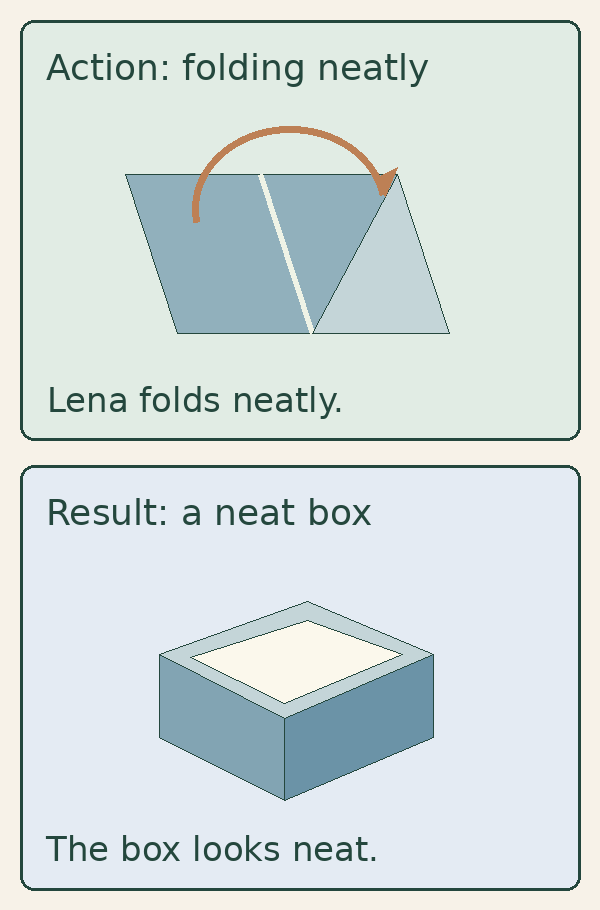
Feedback cards: Lena made a small paper box. Her work was careful, and she folded every edge neatly. The finished box looks neat and stands firmly on the table. She explained the folding steps clearly to a partner. Ivo worked fast because he wanted to finish the first shape before the break. His cutting was quick, but one edge looks rough. He looked carefully at Lena’s example and then tried again more slowly. His second shape looks better. Noor worked hard on a difficult folding pattern. She hardly made any mistakes, although the task took time. Her instructions were clear, and she spoke quietly while another learner was reading. The tutor asked everyone to look at the finished objects and explain the steps. Some comments were about the shapes and edges. Other comments were about how the learners folded, cut or spoke. Everyone can use the examples to write useful, specific feedback about an action or a finished object.
Action and result
Lena
Action: folded neatly
Result: the box looks neat.
Ivo
Action: worked fast, then tried more slowly
Result: one first edge looks rough; the second shape looks better.
Noor
Action: worked hard; hardly made mistakes
Result: the instructions were clear.
3. What does the word describe?
Identify what the quoted word describes.
Answer on paper, then open the explanations below. Enable JavaScript to check answers here.
4. Repair the feedback
Choose four forms and repair four words.
Answer on paper, then open the explanations below. Enable JavaScript to check answers here.
5. Write precise comments
Your turn · self-review
Write precise comments
Write your own answer first. Then compare it with the model and checklist. Natural alternatives are welcome when they preserve the facts.
Practice only. Your writing stays on this page; it is not submitted or saved.
-
Model answer and explanation
Lena folded the edges neatly. Her box looks neat. Ivo looked carefully at the example, and his second shape looks better. Noor worked hard on the difficult pattern.
-
Model answer and explanation
You worked fast on the first shape, but one edge looks rough. You then looked carefully at the example and tried again more slowly. Your second shape looks better. Keep checking the edges before you finish. Use the same slower approach for the next shape, and compare each edge with the example.
Self-check: base each comment on the cards; identify the noun or action described; use adjectives after linking looks when describing a result; keep fast and hard without -ly for these meanings; place manner adverbs naturally; include the observed improvement. Different wording is acceptable if it preserves the facts and grammar.
6. Explain the grammar
Key 1–4: Lena’s work; the action of folding; the edge; the action of speaking. Key 5–8: clearly; neat; fast; hard. Key 9–12: carefully; neat; fast; hardly. In each answer, ask what the word describes to explain your choice.
Compare worked hard with hardly made any mistakes. The first describes effort; the second means that mistakes were almost absent. You cannot swap the words just because both have the letters hard. In looks neat, neat describes the object. In looked carefully at the example, carefully describes the action of looking.
A model is one possible answer. “Lena’s folding was neat” is a natural alternative to “Lena folded neatly.” The first uses an adjective to describe the noun folding; the second uses an adverb to describe the verb folded. Both can match the observation.
7. Transfer without judging people
Transfer to instructions for a fictional paper envelope: “Fold the paper slowly. Check that the edge looks straight. Press it firmly.” Slowly and firmly describe actions; straight describes the edge. Use the same test when writing your own three-step instructions.
Use clear comments about actions and results. “The edge looks rough” shows what can be improved. “You folded the edge neatly” explains what worked well.
Related Lessons






Continue learning this topic
Review an explanation, study examples or try a related practice test.
- Practice test Places Around Town Words — A1 English Vocabulary Practice Test
- Practice test Clothes and Weather Words — A1 English Vocabulary Practice Test
- Practice test Finding the Library on Green Street — A1 English Listening Practice Test
- Course lesson Present perfect simple or continuous: Result or duration? – B1–B2: Grammar in Context
- Course lesson Passive voice: Is made, was built and can be done – B1–B2: Grammar in Context
- Course lesson Mixed conditionals: Past causes and present results – B1–B2: Grammar in Context