The latest in space science: We look back at the Big Bang
 By Emma Carter
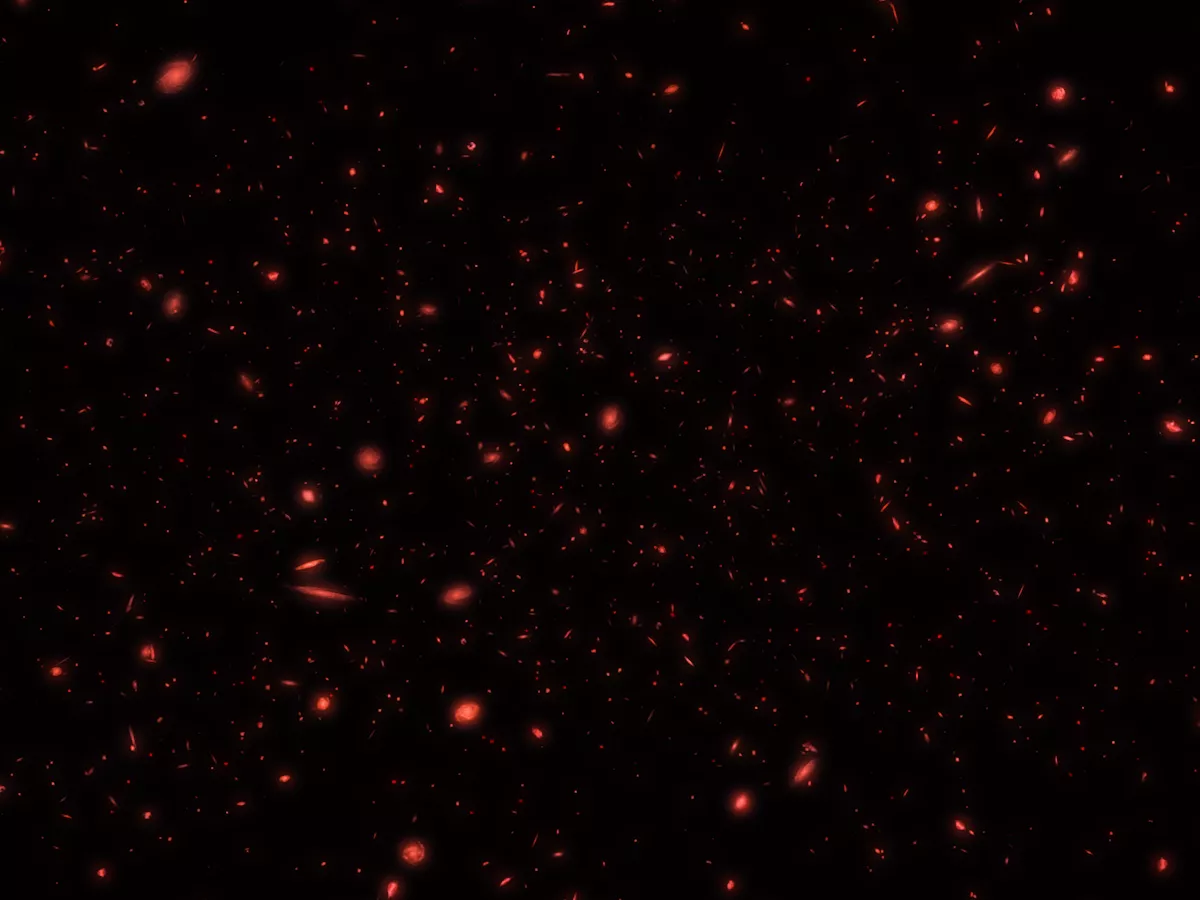
Image information
This is a representative image for this Daily News lesson.
Intro
The latest edition of NPR’s Spacing Out examines developments in space science while returning to a fundamental question: why is the universe made of matter?
Vocabulary
| Word | Part of speech | Meaning | Example |
|---|---|---|---|
| fundamental adjective | adjective | Meaning: forming the essential basis of something; central to its nature or understanding | Example: Understanding evidence is fundamental to evaluating scientific claims. |
| profound adjective | adjective | Meaning: extremely significant, deep, or intellectually demanding | Example: The discovery had a profound effect on contemporary physics. |
| converted verb | verb | Meaning: changed from one form, substance, or state into another | Example: The device converted solar energy into usable electricity. |
| requires verb | verb | Meaning: needs something as necessary or essential | Example: A convincing explanation requires reliable evidence. |
| extremely adverb | adverb | Meaning: to a very high or exceptional degree | Example: The instrument operates in an extremely demanding environment. |
| refined verb | verb | Meaning: improved an explanation or method by making it more precise or effective | Example: Researchers refined the model after identifying a limitation in its assumptions. |
| reconstruction noun | noun | Meaning: the process of forming an account of something past from available evidence | Example: The reconstruction of the settlement relied on fragmentary archaeological evidence. |
The story
A new edition of NPR’s Spacing Out turns its attention to the latest developments in space science, while also looking back toward the universe’s earliest moments. Presented by the Short Wave team, the episode explores a theory concerning one of cosmology’s most fundamental questions: why is the universe made of matter?
The question may sound simple, but it points to a profound imbalance in the structure of reality. Matter is the substance associated with stars, planets, and living organisms. In ordinary discussions of the universe, it is often considered alongside antimatter, which has related properties but opposite electrical charges. When matter and antimatter meet, they can be converted into energy. As a result, the existence of a matter-dominated universe requires explanation.
The Big Bang is the scientific model describing the universe’s early expansion from an extremely hot and dense state. It does not merely refer to a conventional explosion in empty space; rather, it describes the expansion of space itself. Scientists use observations and theoretical models to investigate how the early universe developed into the cosmos observed today.
Within that broader effort, theories about the origin of matter connect abstract physics to evidence gathered from the universe. They address conditions that could have existed shortly after the universe began expanding and consider how those conditions may have shaped everything that followed. Such theories remain part of an active scientific conversation, in which explanations are assessed against observations and refined when necessary.
By placing a current space-science development alongside a look back at the Big Bang, the edition presents cosmology as both an investigation of the present and a reconstruction of the past. Its central theme is not only how the universe evolved, but also why the material world exists in the form we recognize.
Warm-up questions
- What questions about the universe do you consider genuinely fundamental, and why?
- How might scientists reconstruct events that occurred billions of years ago?
Comprehension questions
- What central question does the episode investigate?
- Why does the article say that a matter-dominated universe requires explanation?
- How does the article characterize the Big Bang model?
- How are theories about matter’s origin evaluated?
- What broader perspective does the episode offer on cosmology?
Opinion questions
- Should scientific explanations remain provisional even when they are strongly supported? Explain your position.
- Does linking current discoveries to cosmic origins make science more meaningful to the public? Why or why not?
Further discussion
- What kinds of observations could distinguish competing theories about the universe’s matter–antimatter imbalance?
- How does the article balance accessible explanation with the complexity of cosmological research?
Writing prompt
- Write a structured 220–280-word response explaining why the matter–antimatter imbalance is scientifically significant and how evidence can refine cosmological theories.