
NASA Adds a New Antenna to Its Deep-Space Network
 By Emma Carter
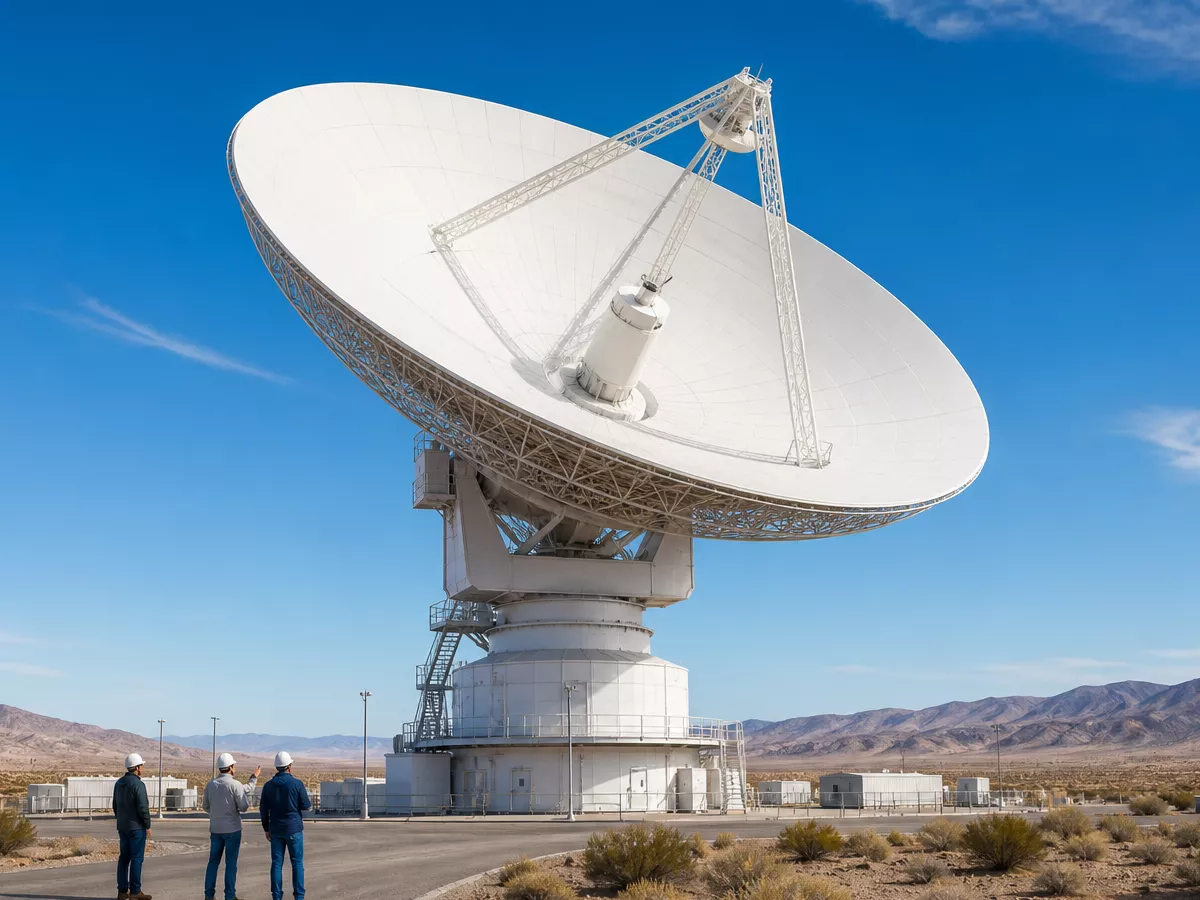
Image information
This is a representative image for this Daily News lesson.
Intro
NASA has completed a new radio antenna in the United States. The antenna will help the agency communicate with spacecraft far from Earth.
Vocabulary
| Word | Part of speech | Meaning | Example |
|---|---|---|---|
| antenna noun | noun | Meaning: A device that sends or receives radio signals. | Example: The antenna receives signals from a spacecraft. |
| track verb | verb | Meaning: To follow the position or movement of something. | Example: The station can track a spacecraft during its journey. |
| mission noun | noun | Meaning: A planned journey or operation with a special purpose. | Example: The mission collected information about a distant object. |
| framework noun | noun | Meaning: The basic structure that supports something. | Example: Workers built a metal framework for the roof. |
| calibrate verb | verb | Meaning: To adjust equipment so it works accurately. | Example: Technicians calibrate the machine before using it. |
| sensitive adjective | adjective | Meaning: Easily affected or damaged by changes or rough conditions. | Example: Sensitive instruments need protection from heat. |
| reliable adjective | adjective | Meaning: Working well and consistently. | Example: The team needs a reliable way to receive data. |
| investment noun | noun | Meaning: The use of money, time, or effort for a future benefit. | Example: The new laboratory is an investment in science. |
The story
NASA has completed a new radio antenna at its Goldstone Deep Space Communications Complex near Barstow, California. Called Deep Space Station 23, or DSS-23, the antenna is now part of NASA’s Deep Space Network.
The Deep Space Network is a group of large antennas that helps NASA communicate with spacecraft far from Earth. It tracks spacecraft, sends commands, and receives science data. DSS-23 is a 34-meter antenna that can work with more than one radio frequency.
DSS-23 began operations on August 3, 2026, after engineers tested it from May through July. Its first tracking work involved the Chandra X-ray Observatory. Later, it communicated with other missions, including Mars Reconnaissance Orbiter, Psyche, Juno, and Voyager 1.
The project took several years. Construction began in February 2020. In December 2024, engineers installed the antenna’s 133-ton reflector framework. Workers then added panels and calibrated the system so it could send and receive signals correctly.
DSS-23 uses a beam-waveguide design. In this system, signals travel from the dish to equipment in a climate-controlled room underground. This arrangement puts much of the sensitive equipment in a protected place. It can also make the instruments easier to maintain and upgrade.
The antenna is part of a six-antenna expansion project that began in 2009. NASA held a ribbon-cutting ceremony for DSS-23 on August 25, 2026. The new station gives the network more room to support spacecraft and future missions.
Deep-space missions can last many years, so reliable communication is important. A spacecraft may be collecting scientific information while it is millions of miles from Earth. Antennas such as DSS-23 help teams receive that information and guide missions from the ground.
NASA’s new station is therefore both a working communications tool and a long-term investment. Its design gives engineers a practical way to care for important equipment while the Deep Space Network continues supporting space exploration.
Warm-up questions
- What kinds of information might a spacecraft send to Earth?
- Why might a space agency need large antennas?
Comprehension questions
- Where is DSS-23 located?
- When did DSS-23 begin operations?
- Which spacecraft did DSS-23 track first?
- What happened in December 2024?
- How can the beam-waveguide design help engineers?
Opinion questions
- Would you like to work on a project that takes several years to complete? Why or why not?
- Do you think reliable communication is as important for space missions as scientific instruments? Explain.
Further discussion
- What challenges might engineers face when maintaining equipment for a mission that lasts many years?
- How could better communication systems affect future space exploration?
Writing prompt
- Write 80–100 words explaining why a new communications antenna could be useful for space exploration.
Sources
Topics
-

Science & Technology
New Civil Servants Sworn In at NASA Ames
Aug 30, 2026 2 min read B1 -

Science & Technology
NASA Awards First Prize in LunaRecycle Challenge
Aug 29, 2026 3 min read B1 -

Science & Technology
A fossil feather from the age of dinosaurs may explain why only some birds survived
Sep 11, 2026 2 min read B1 -
Science & Technology
John Coltrane’s Philadelphia home is planned as a cultural heritage and community space
Sep 6, 2026 2 min read B1 -
![Representative image: Title: Tech High School students, [Washington, D.C.], c.1936 Abstract/medium: 1 negative : safety film ; 5 x 7 in. or smaller Oral history interview with Philip Fletcher Bell, circa 1963, conducted by Harlan B. Phillips](https://cdn.englishtestkit.com/302/conversions/daily-news-13-tech-high-school-students-washington-dc-c1936-lccn2016851281-card.webp)
Science & Technology
Technology Is Reshaping Education. But Is It Helping Students Learn?
Sep 5, 2026 2 min read B1 -

Science & Technology
‘Fire amoeba’ sets a new thermal limit for complex life
Sep 23, 2026 2 min read C2