A Jurassic fossil offers clues about when mammals learned to chew
 By Emma Carter
Image information
This is a representative image for this Daily News lesson.
Intro
New evidence from a fossil found in Inner Mongolia suggests that mammals may have been chewing at least 165 million years ago.
Vocabulary
| Word | Part of speech | Meaning | Example |
|---|---|---|---|
| preserved adjective | adjective | Meaning: kept in good condition for people to study | Example: The preserved letter showed how people lived long ago. |
| specimen noun | noun | Meaning: a plant, animal, or object studied as an example | Example: The museum displayed a rare bird specimen. |
| delicate adjective | adjective | Meaning: easily damaged because it is thin or fragile | Example: Please carry the delicate glass carefully. |
| reconstruct verb | verb | Meaning: to build or understand something again from available information | Example: Scientists used old maps to reconstruct the village. |
| machinery noun | noun | Meaning: a system of parts that works together for a purpose | Example: The factory uses modern machinery to make cars. |
The story
Chewing may be much older than scientists once understood. New evidence from a fossil found in Inner Mongolia, China, suggests that mammals had this ability at least by the middle Jurassic period, when dinosaurs still ruled much of Earth.
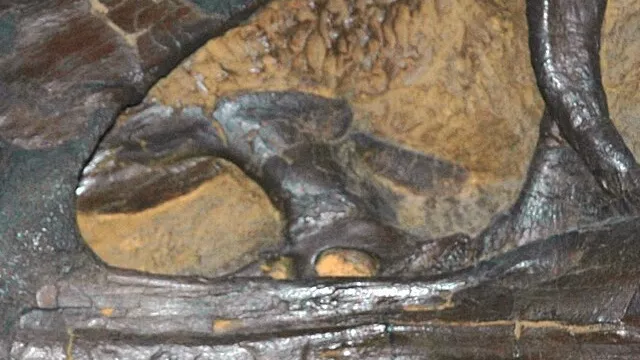
The fossil belonged to a small ancient mammal that lived roughly 165 million years ago. It was about the size of a Chihuahua and was preserved in a thick slab of shale. The specimen included bones and fur, but it was difficult to see clearly against the rock.
A colleague of University of Chicago paleontologist Zhe-Xi Luo used X-rays to make the bones easier to study. The image showed an unusual mix of features. The animal’s back end looked similar to that of a modern platypus, suggesting that it may have spent time in water. However, its teeth and jaw looked very different from a platypus. Its head appeared to be built for hunting.
The fossil also preserved tiny hyoid bones. In people, the hyoid bone is in the throat and helps support the back of the tongue. Scientists later used CT scans to study the underside of the animal’s skull. They found a delicate roof of the mouth and other small bones and ridges.
Together, these features gave the researchers a way to reconstruct parts of the animal’s mouth and throat. The results point to an early form of the machinery needed for chewing and swallowing. Because early mammal fossils are rare, this specimen offers an important look at how a basic part of eating developed long before modern mammals appeared.
Warm-up questions
- What do you know about mammals and how they eat?
- Why might scientists study a very old fossil?
Comprehension questions
- Where was the fossil found?
- How old was the ancient mammal?
- How did the researchers make the bones easier to study?
- What suggested that the animal may have spent time in water?
- Why is this fossil important?
Opinion questions
- Would you enjoy studying fossils? Why or why not?
- Which tool mentioned in the article would you most like to use: X-rays or CT scans?
Further discussion
- Why can one fossil give scientists useful information about animal evolution?
- What other evidence could help scientists understand how ancient mammals lived?
Writing prompt
- Write a short paragraph explaining what this fossil taught scientists and why the discovery matters.