
NASA Awards First Prize in LunaRecycle Challenge
 By Emma Carter
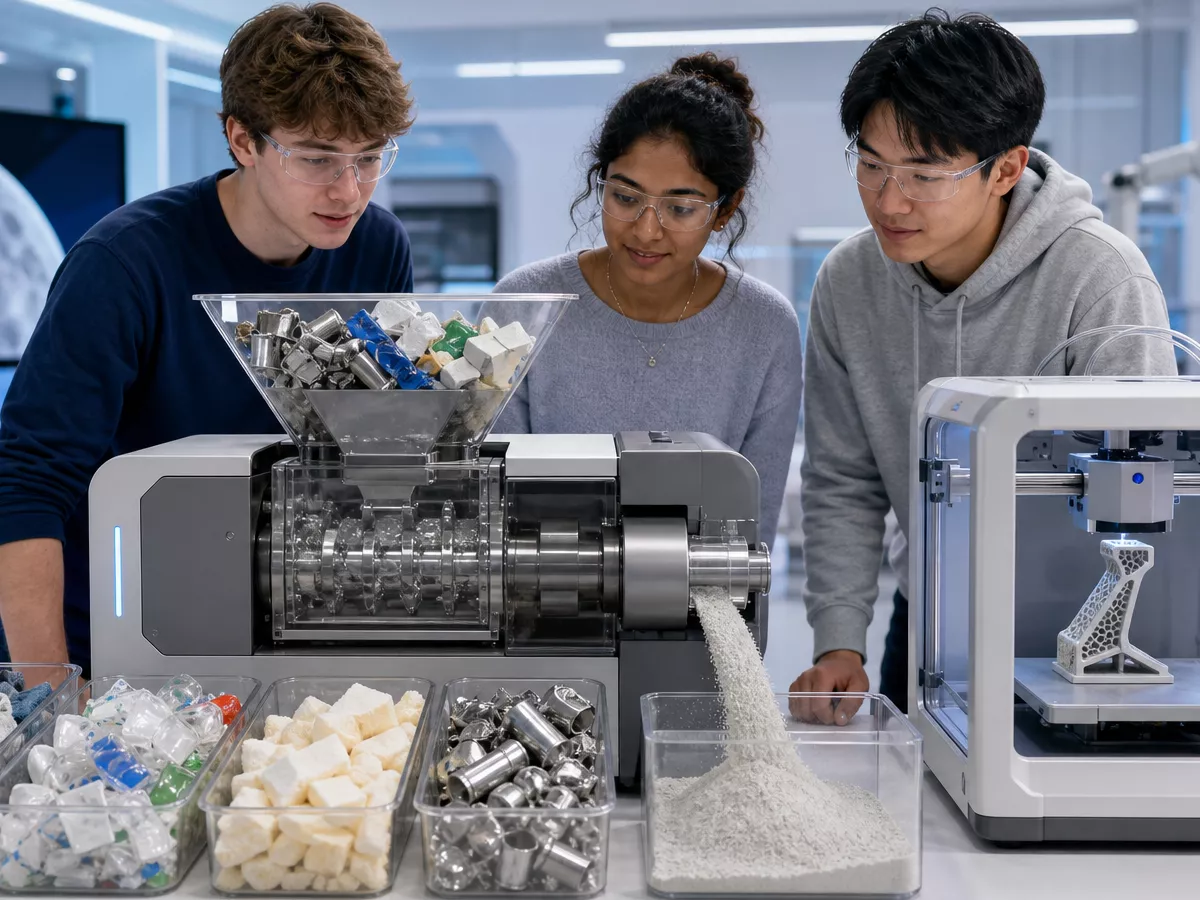
Image information
This is a representative image for this Daily News lesson.
Intro
NASA has chosen an MIT student team as the first-prize winner in Phase 2 of its LunaRecycle Challenge. The team’s system could help recycle waste during space missions and also offer useful ideas for Earth.
Vocabulary
| Word | Part of speech | Meaning | Example |
|---|---|---|---|
| prototype noun | noun | Meaning: an early model built to test an idea | Example: The engineers tested a prototype before building the final machine. |
| mixed adjective | adjective | Meaning: made from different kinds of things | Example: The bin contained mixed materials, including paper and plastic. |
| filament noun | noun | Meaning: a thin material used by some 3D printers | Example: The printer needs a new roll of filament. |
| track noun | noun | Meaning: one part or area of a competition or project | Example: She entered the design track of the competition. |
| reuse verb | verb | Meaning: to use something again | Example: We can reuse the container instead of buying a new one. |
| limited adjective | adjective | Meaning: not large or plentiful | Example: The hikers had limited water for the long walk. |
The story
The MIT student group CERBERUZ won the top Phase 2 award in NASA’s LunaRecycle Challenge. The challenge asks teams to create ways to recycle waste during Moon and deep-space missions.
The CERBERUZ system begins by grinding mixed mission waste into powder. The powder can then be used in injection molding systems to make shaped parts. It can also be used to produce filament for 3D printers. Filament is the thin material that a 3D printer uses to build an object.
NASA says the team received $775,000 in awards across two tracks. One track focused on developing a working prototype. The other focused on a digital twin, or a computer model that represents how a real system works. Together, these awards recognized the team’s work in both physical design and digital planning.
The challenge included several kinds of waste that could be produced during a mission. These materials included fabrics, plastics, foam, and metals. On a long mission, carrying new supplies for every repair could take up valuable space. A recycling system could help a crew reuse some materials instead of throwing them away.
Fourteen finalist teams demonstrated their prototypes in Alabama from August 24 through August 28, 2026. Their demonstrations gave NASA a chance to examine different ideas for dealing with mission waste. The teams worked on technology that could be useful in difficult space environments.
The challenge is aimed at space travel, but its possible value is not limited to space. NASA encouraged the teams to consider how their recycling technology might be used on Earth as well. For example, a system that separates or reuses several materials could support work in places where storage and supplies are limited.
The first prize does not mean that CERBERUZ’s system is ready for immediate use on a space mission. The challenge recognized the team’s design and development work. Further development would be needed before NASA could use the technology during a real mission.
The LunaRecycle Challenge shows how space research can focus on a practical problem: what to do with waste. By turning mixed waste into powder and then into new products, the CERBERUZ system offers one possible path toward more efficient missions.
Warm-up questions
- What kinds of waste might people need to manage during a long space mission?
- Why might recycling be useful when storage space is limited?
Comprehension questions
- Which team won first prize in Phase 2 of the challenge?
- What does the CERBERUZ system do first?
- What were the two award tracks about?
- Where and when did the finalist teams demonstrate their prototypes?
- Why is the system not ready for immediate use on a space mission?
Opinion questions
- Would you want to work on a recycling project for space travel? Why or why not?
- Which possible Earth use for this technology seems most valuable to you?
Further discussion
- What problems could astronauts face if they cannot recycle mission waste?
- What other materials might people try to recycle on Earth?
Writing prompt
- Write a short paragraph explaining how recycling could help a future space mission.
Sources
Topics
-
Science & Technology
NASA Adds a New Antenna to Its Deep-Space Network
Aug 31, 2026 2 min read B1 -
Science & Technology
New Civil Servants Sworn In at NASA Ames
Aug 30, 2026 2 min read B1 -
Science & Technology
A fossil feather from the age of dinosaurs may explain why only some birds survived
Sep 11, 2026 2 min read B1 -
Science & Technology
John Coltrane’s Philadelphia home is planned as a cultural heritage and community space
Sep 6, 2026 2 min read B1 -
![Representative image: Title: Tech High School students, [Washington, D.C.], c.1936 Abstract/medium: 1 negative : safety film ; 5 x 7 in. or smaller Oral history interview with Philip Fletcher Bell, circa 1963, conducted by Harlan B. Phillips](https://cdn.englishtestkit.com/302/conversions/daily-news-13-tech-high-school-students-washington-dc-c1936-lccn2016851281-card.webp)
Science & Technology
Technology Is Reshaping Education. But Is It Helping Students Learn?
Sep 5, 2026 2 min read B1 -

Science & Technology
‘Fire amoeba’ sets a new thermal limit for complex life
Sep 23, 2026 2 min read C2