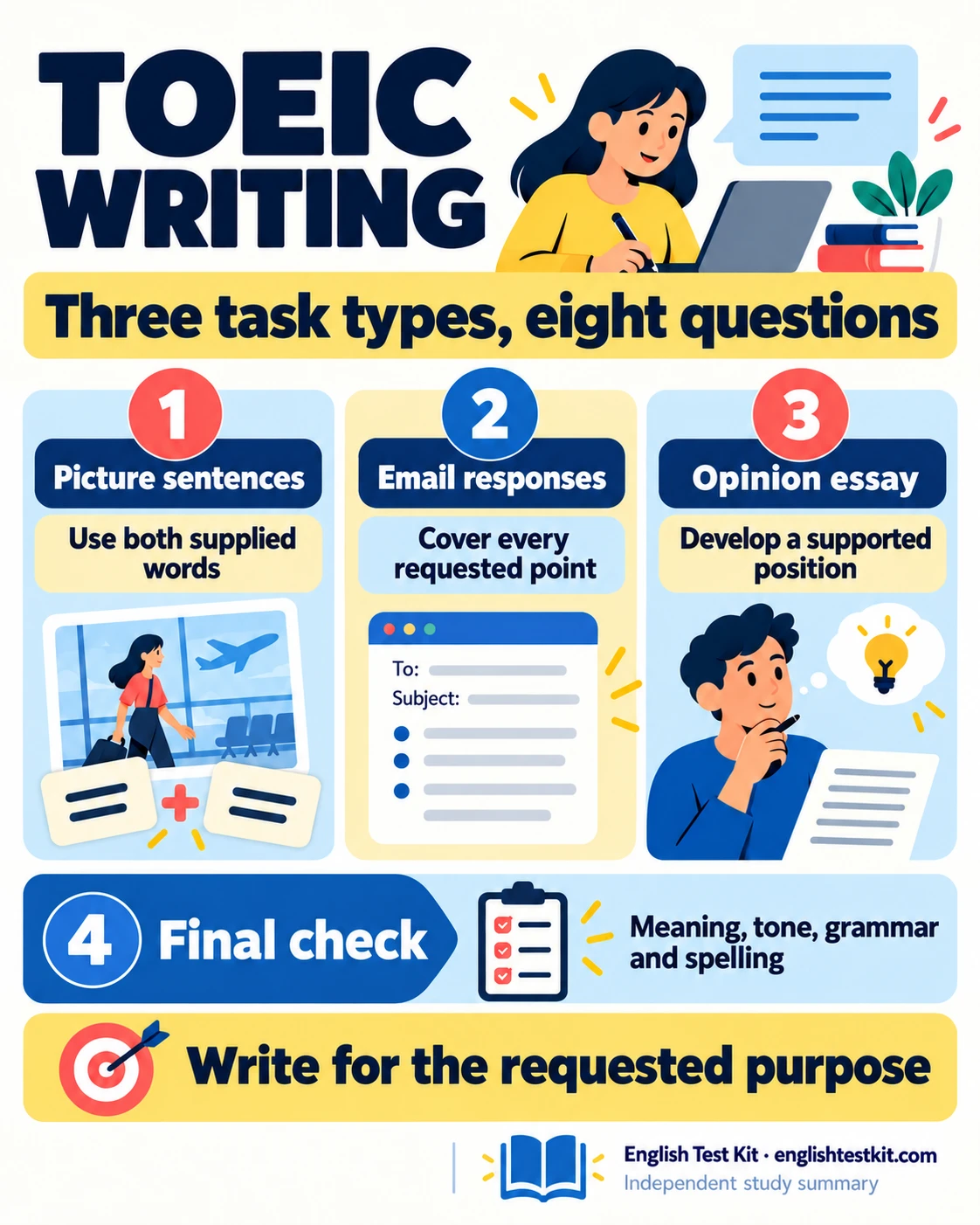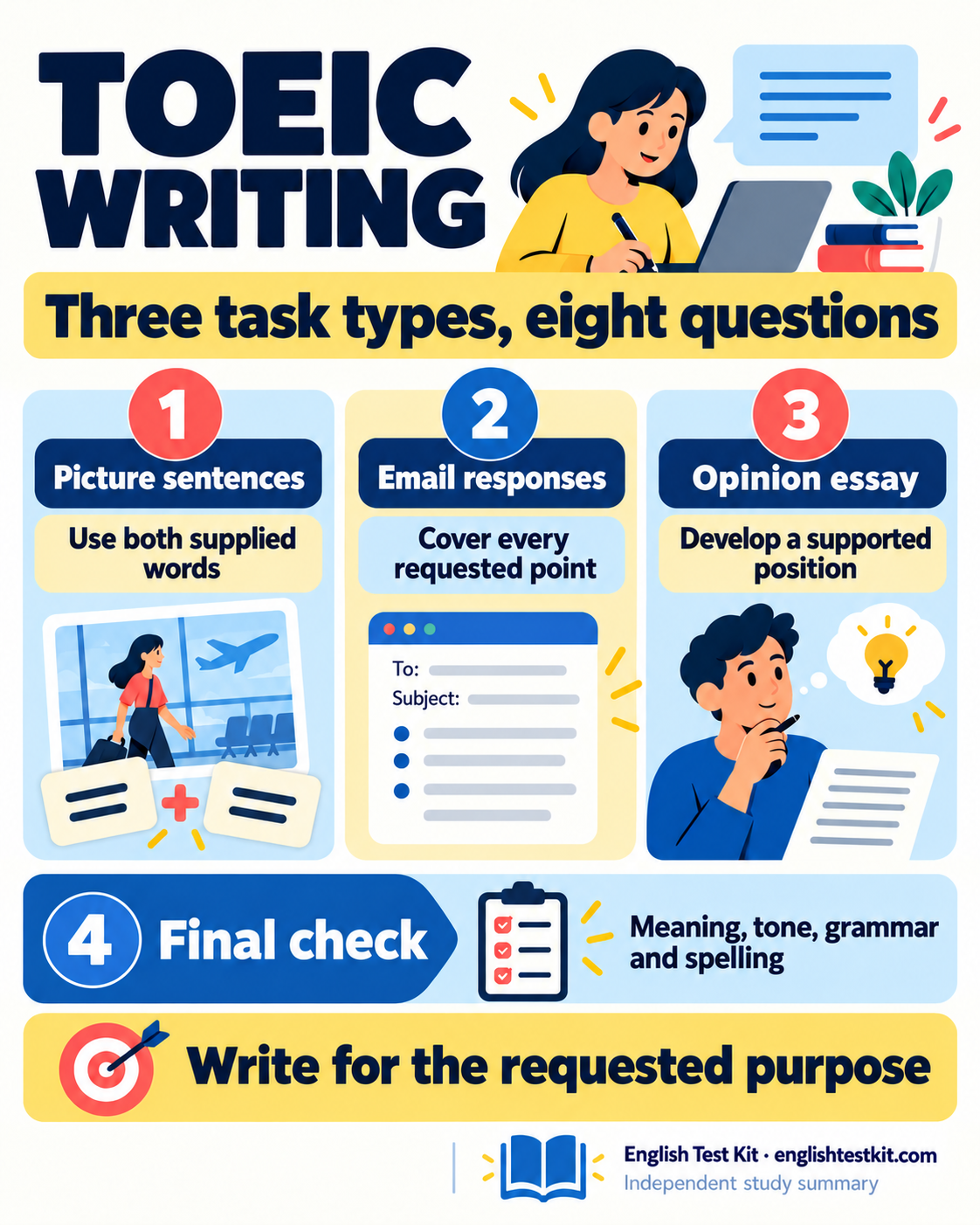
TOEIC Writing moves from controlled sentence construction to purposeful longer responses. Preparation should therefore include both accurate language and decisions about what a reader needs to know. Learn each task's instructions, plan the required content and practise checking the answer for meaning before polishing individual words.
Eight questions in about 60 minutes
The TOEIC Writing test has eight questions and takes about an hour. It moves from sentence-level accuracy to longer workplace writing. Each response is scored as part of the Writing test, which has its own 0–200 scale.
Three kinds of writing task
The question sequence changes the amount of language and planning each response needs.
Writing question sequence
Questions | Task | Main focus |
|---|---|---|
1–5 | Write one sentence based on a picture, using two supplied words or phrases | Accurate, natural sentence construction |
6–7 | Respond to a written request with an email | Relevant details, tone, and a complete response |
8 | Write an opinion essay | A clear position supported with reasons and examples |
Respect the time and purpose
ETS allots 10 minutes for each email response. The opinion essay is the longest task; ETS notes that an effective response will typically contain at least 300 words. Check the current instructions and respond to every part of the prompt.
The picture questions supply two words or phrases. You may change their forms and use them in any order, but both must appear appropriately in your sentence.
A practical review checklist
Before submitting a practice response, check that you answered the requested task, included the required details or words, and used a suitable tone. Then scan sentence boundaries, verb forms, agreement, spelling, and punctuation.
For email and essay tasks, make the connection between ideas easy to follow. Clear organisation helps a reader understand your answer without guessing what you mean.
Picture sentences: satisfy the constraints naturally
Imagine an original practice picture of a man carrying a box into an office, with the supplied words “carry” and “door”. A sentence such as “The man is carrying a box through the door” uses both words appropriately and describes a plausible visible relationship. “The door is carrying a man” contains the vocabulary but fails to communicate a sensible description.
Check that your sentence relates to the actual picture, includes both supplied words in permitted forms and is grammatically complete. Useful review targets include subject–verb agreement, verb tense, articles and prepositions. A long sentence is not automatically better: extra clauses can introduce errors without adding useful information.
Email responses: cover every requested point
Consider this original practice request: a customer asks whether a workshop has space, what materials are included and how to register. An incomplete reply might say, “Thank you for your interest. We hope to see you soon.” The tone is polite, but none of the practical questions has been answered.
A more useful short reply could say, “There are places available in the Saturday workshop. The fee includes a workbook and the materials used in class. To register, please complete the form on our booking page.” In a real task, use the details provided by the prompt and invent only what the task permits. The improvement comes from task coverage and clarity, not from a complicated greeting.
Before drafting, turn each requested point into a small checklist. Arrange the reply so the recipient can find the answer or next action easily. Choose a tone that fits the relationship, and include a clear request when the situation needs one.
Opinion essays: make the reasoning visible
For a practice topic about whether companies should provide staff training, a plan might contain a position, two developed reasons and an appropriate qualification. One paragraph could explain how training improves the use of new equipment, with a hypothetical example of avoiding repeated operational mistakes. Another could consider the time and scheduling needed to make training effective.
Avoid presenting several unsupported claims in place of an argument. “Training is useful, important and necessary” repeats a judgement without explaining it. A stronger paragraph connects a claim with a reason, shows how the reason works and makes its relevance to the question clear. Select language you can use accurately rather than forcing memorised expressions into every response.
Use a checking sequence
First check the task: are all requested points or supplied words present? Next check organisation: can the reader follow the message without guessing the connection between sentences? Then inspect sentence boundaries, verb forms, agreement, spelling and punctuation. This order prevents you from perfecting a sentence in an answer that still misses the main purpose.
During practice, keep the draft and a revised version. Mark which change improves content, which improves organisation and which repairs language. A revision such as adding a missing registration step does a different job from correcting a verb ending. Understanding that difference helps you choose the next exercise instead of treating every weakness as a grammar problem.
Save your one-page study summary