TOEIC Listening and Reading combines a recording-controlled section with a reading section in which you manage your own pace. Understanding that difference is essential. The seven parts ask for different kinds of evidence, so a preparation plan should rehearse the response method as well as the vocabulary and grammar.
Two sections, each with 100 questions
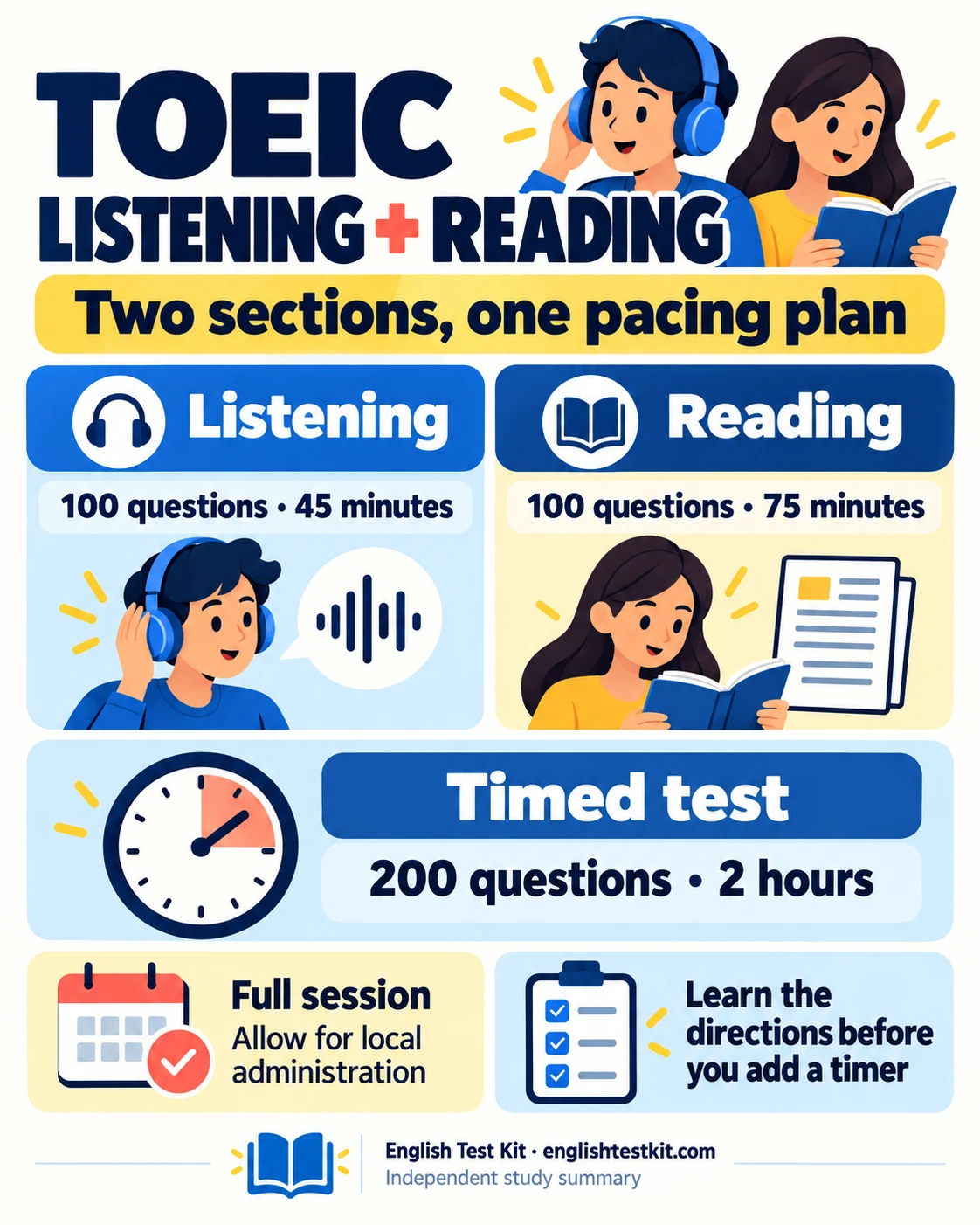
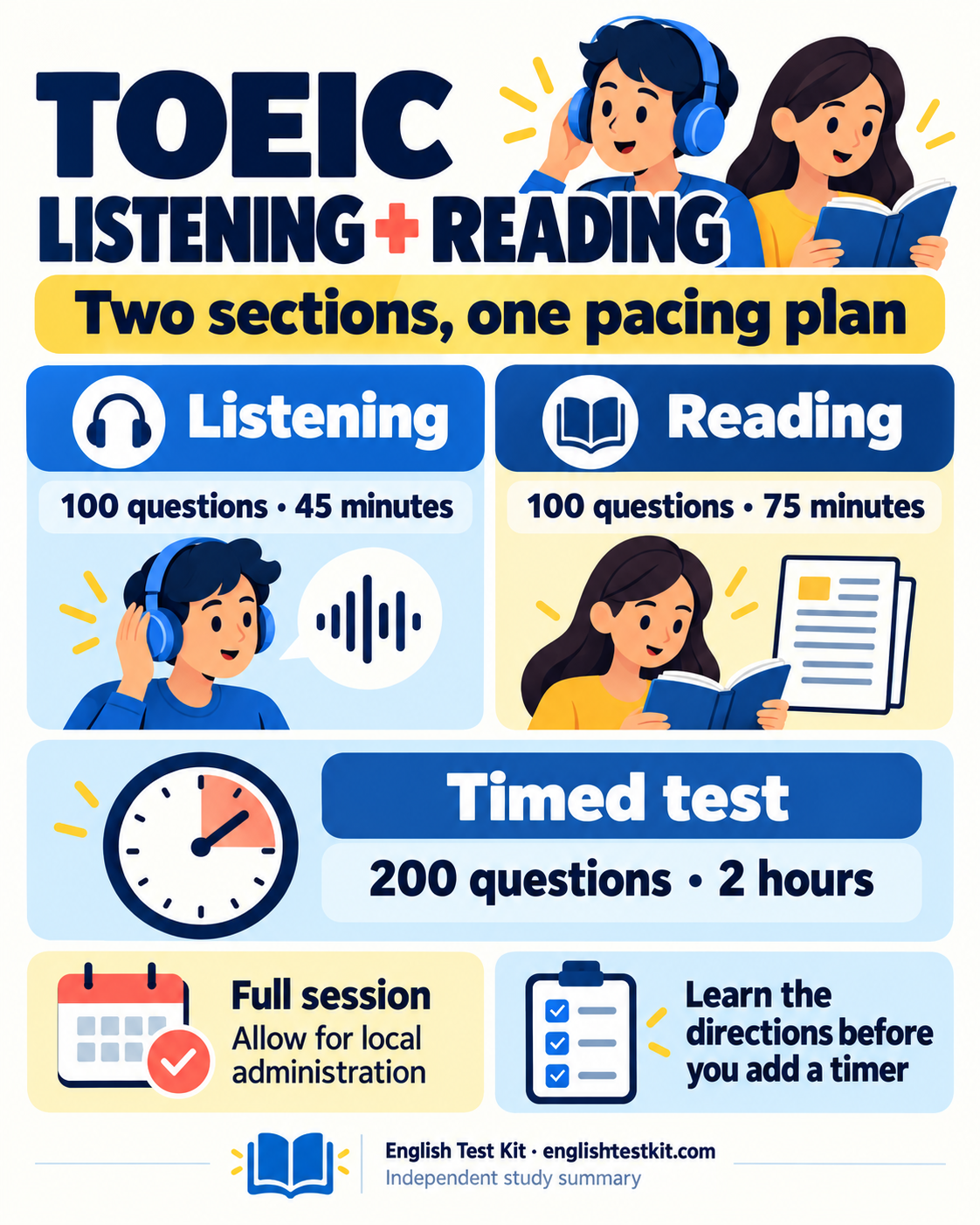
TOEIC Listening and Reading is a multiple-choice test with two separately timed sections. Listening comes first and uses recorded English; Reading follows and lets you work through written material at your own pace within its fixed time.
Test-day structure
Section | Questions | Time |
|---|---|---|
Listening | 100 | 45 minutes |
Reading | 100 | 75 minutes |
Biographical questions and administration | Not part of the 200 scored questions | About 30 additional minutes |
Plan for the full session
Allow about two and a half hours for the complete session, including the time used for biographical questions and administration. The two timed test sections themselves total two hours.
Use the appointment confirmation for your arrival time, identification rules, permitted belongings, and delivery format. Those practical details are set by the local test session.
What the sections cover
Listening has four parts: Photographs, Question–Response, Conversations, and Talks. Reading has three: Incomplete Sentences, Text Completion, and Reading Comprehension. The task types range from short language choices to understanding connected workplace-style messages.
Practise the clock as well as the questions
For Listening, preview each question when the recording and directions allow, then follow the audio rather than trying to replay it mentally. For Reading, avoid spending too long on one item: reserve enough attention for longer texts near the end.
Use official sample materials to learn the directions and response method before you begin timed sets. Familiarity with the format leaves more attention for the English itself.
Understand where you control the pace
In Listening, the recording moves forward. Spending too long thinking about one missed item can cost attention needed for several later questions. Practise making the best supported selection you can and returning your focus to the current audio. Use any preview opportunities according to the directions instead of trying to remember an earlier exchange while a new one is playing.
In Reading, you distribute the fixed section time across short language questions and longer texts. A sentence gap and a multi-document question do not usually require the same amount of work. During practice, measure where time goes rather than following an untested universal rule about seconds per question.
See how a workplace clue supports an answer
Read this original practice notice: “The afternoon safety briefing has moved from Room 4 to the training hall. Staff who have already registered do not need to register again.” If a question asks what registered staff should do, the evidence supports attending at the new location without repeating registration.
An option saying “complete a new registration form” might sound relevant because registration is mentioned, but it contradicts the notice. Another option retaining Room 4 ignores the location change. This is the same reasoning you should practise across the test: compare the whole meaning of an option with the information, not just a repeated word.
Prepare short questions and connected texts differently
For Incomplete Sentences, identify whether the gap is mainly about a word form, grammar relationship or vocabulary meaning. Read the finished sentence to confirm that the choice fits. For Text Completion, use the surrounding paragraph as well as the sentence. A grammatically possible option can still break the message's logic.
For Reading Comprehension, identify each document's purpose before connecting details. An email may announce a change, while an attached schedule supplies the date or price needed to interpret it. Mark which source provides each clue during review. This makes a mistake easier to diagnose than simply labelling the entire passage difficult.
Rehearse the full sequence gradually
Begin with short sets that let you understand the directions and review every answer. Next, combine different parts so you practise changing methods. Only then use full timed sections often enough to check stamina and pacing. After a long attempt, reserve time for review; completing another test immediately can leave the same errors unexamined.
Keep a record of unanswered Reading items and the point where attention dropped in Listening. These observations help distinguish a language problem from pacing or concentration. An improvement target might be finishing the final reading set with time to answer each item, or staying with the recording after an uncertain response.
Include the appointment in your preparation
The two timed sections are not the entire visit. Follow the local confirmation for arrival, identification, administration and permitted belongings. Read the official directions in advance so these practical steps are familiar. Your goal is a predictable routine: understand the task, find evidence, answer within the conditions and use review to choose the next practice focus.
Save your one-page study summary