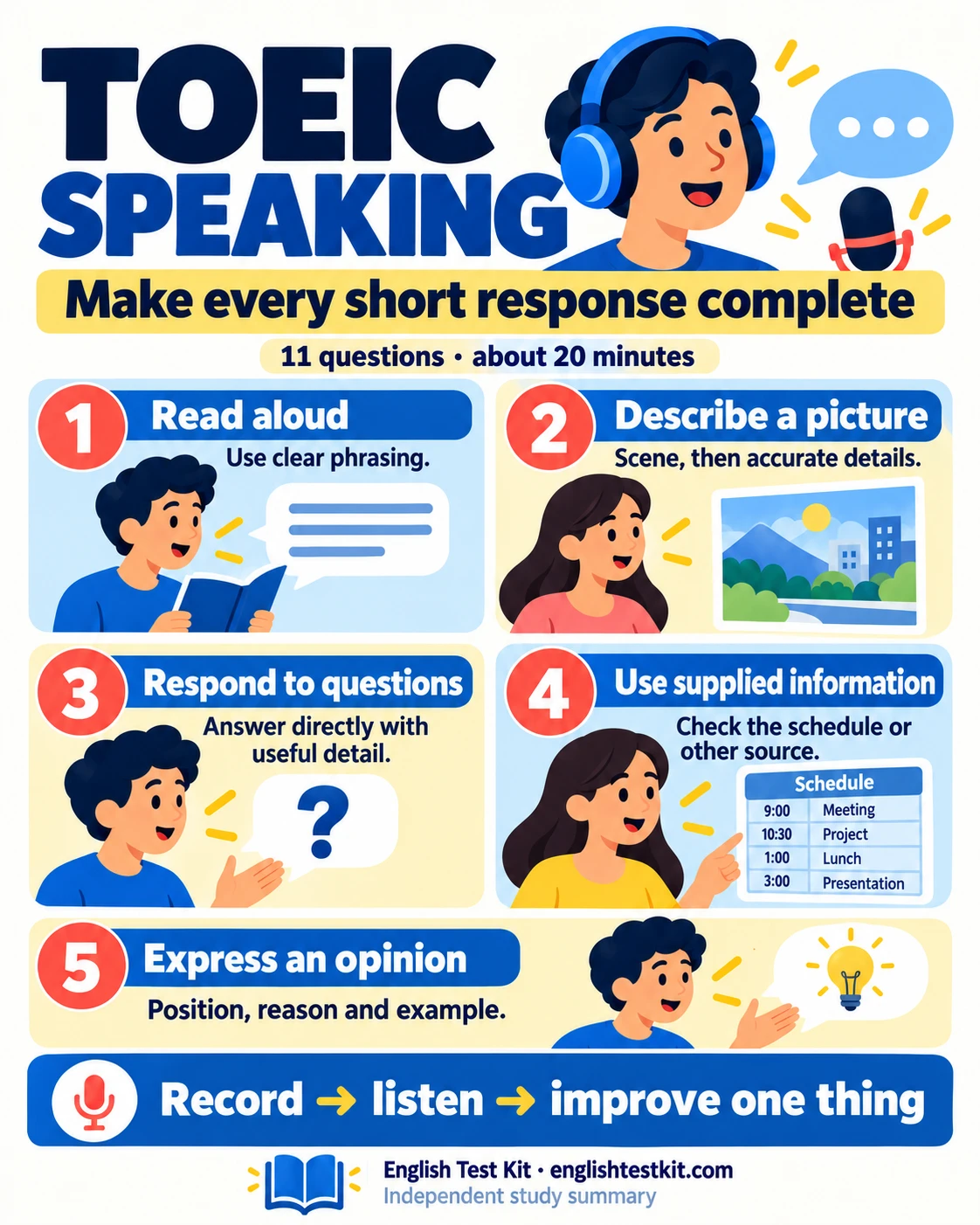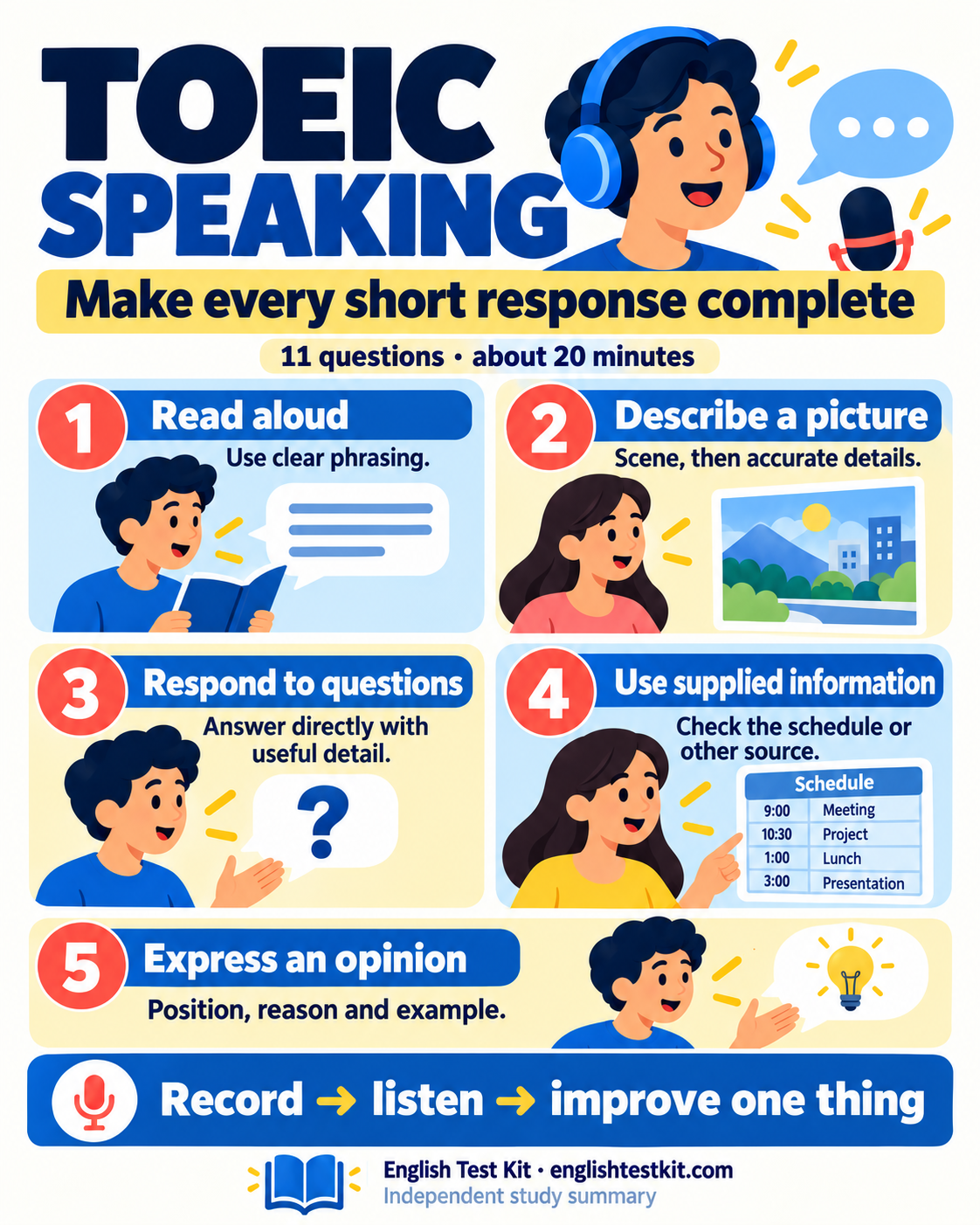
TOEIC Speaking requires recorded responses that fulfil different communication purposes. Reading a text aloud, describing a scene and giving an opinion need different preparation habits, even though all benefit from clear pronunciation and a steady pace. Practise responding to the actual prompt before trying to make the answer sound impressive.
Eleven timed questions in about 20 minutes
The TOEIC Speaking test uses recorded, task-based prompts rather than a live interview. Its 11 questions move from reading aloud to describing, responding to information, and giving an opinion. The reported Speaking score has its own 0–200 scale.
How the tasks unfold
The sequence builds from controlled speech to more independent responses.
Speaking question sequence
Questions | Task | What it asks of you |
|---|---|---|
1–2 | Read a text aloud | Use clear pronunciation and phrasing |
3–4 | Describe a picture | Organise visible details into a coherent description |
5–7 | Respond to questions | Answer directly within short response windows |
8–10 | Use information provided | Read a schedule or other information and answer related questions |
11 | Express an opinion | State a position and support it with reasons |
Timing is part of the task
Preparation and response windows vary. For example, the final opinion question gives 45 seconds to prepare and 60 seconds to speak. Some earlier answers allow only a few seconds of preparation, so a simple structure is more useful than memorising a long script.
Follow each prompt closely: a clear answer to a different question does not meet the task.
Practise with a short response plan
For a description, move from the overall scene to a few accurate details. For a question, answer first and add one relevant reason or fact. For an opinion, state your view, give a reason, and illustrate it briefly.
Record practice responses using the official sample test. Listen for intelligibility, relevance, pace, and whether each answer finishes inside the allotted time.
Read aloud for phrasing and intelligibility
Before speaking, notice punctuation, word groups and any numbers or names that may interrupt your flow. In a practice sentence such as “Please collect your visitor pass before entering the training room”, useful phrasing keeps “visitor pass” and “training room” together. Rushing through every word at the same speed can make the message harder to understand.
Record a short passage, listen without looking at the text, and mark places where a listener could lose the meaning. Then compare with the text for omitted words or endings. Review accuracy and delivery separately: saying every word is one goal, while making the words easy to follow is another.
Describe a picture from the general scene to useful details
Imagine an original practice image showing two colleagues preparing a meeting room. A connected description could begin, “Two people are getting a meeting room ready. One is arranging chairs while the other is placing papers on a table.” It gives an overall scene and then observable actions.
Avoid filling the response with uncertain stories about who the people are or why the meeting matters. You can describe what is visible and use cautious language where an interpretation is necessary. A simple organised description usually communicates more than a long list of objects without relationships.
Answer questions with the required information
For short responses, begin with the answer. If asked when a workshop starts, give the start time before adding another detail. When the task provides a schedule or other information, use that source rather than inventing a plausible arrangement. Check dates, conditions and the difference between a start time and a registration time.
An original example schedule might list registration at 8:30 and a presentation at 9:00. “The presentation begins at nine” answers a question about the presentation. Giving 8:30 because it is the first time shown would confuse two different events. In practice, underline the exact information each question requests.
Develop an opinion with a clear line of thought
For the original practice topic “Should a workplace offer flexible starting times?”, choose a position you can support. A short plan might be “yes — commuting — example — coordination”. A response can explain that flexible starts help some employees avoid heavy traffic, give a hypothetical example, and acknowledge the need for agreed meeting times.
The point is not to memorise that opinion. Practise adapting a structure—position, reason and illustration—to different prompts. A relevant example develops the answer; an unrelated story consumes time without supporting it. Keep an eye on whether the response reaches a complete point within the task's actual window.
Make self-review specific
After recording, ask whether the answer is accurate, relevant, sufficiently developed and understandable. Listen for missing endings, repeated fillers, long restarts and a pace that obscures words. Choose one correction for the next attempt and use a fresh prompt. These examples illustrate useful habits; they are not official scored samples or a promise of a particular Speaking score.
Save your one-page study summary