Reading a TOEIC report starts with identifying which assessment produced each number. The next step is comparing the report with every part of the receiving organisation's requirement. Worked examples can clarify that process, but they cannot convert a practice percentage into an official scaled result or predict an employment decision.
Start with the exact test on your report
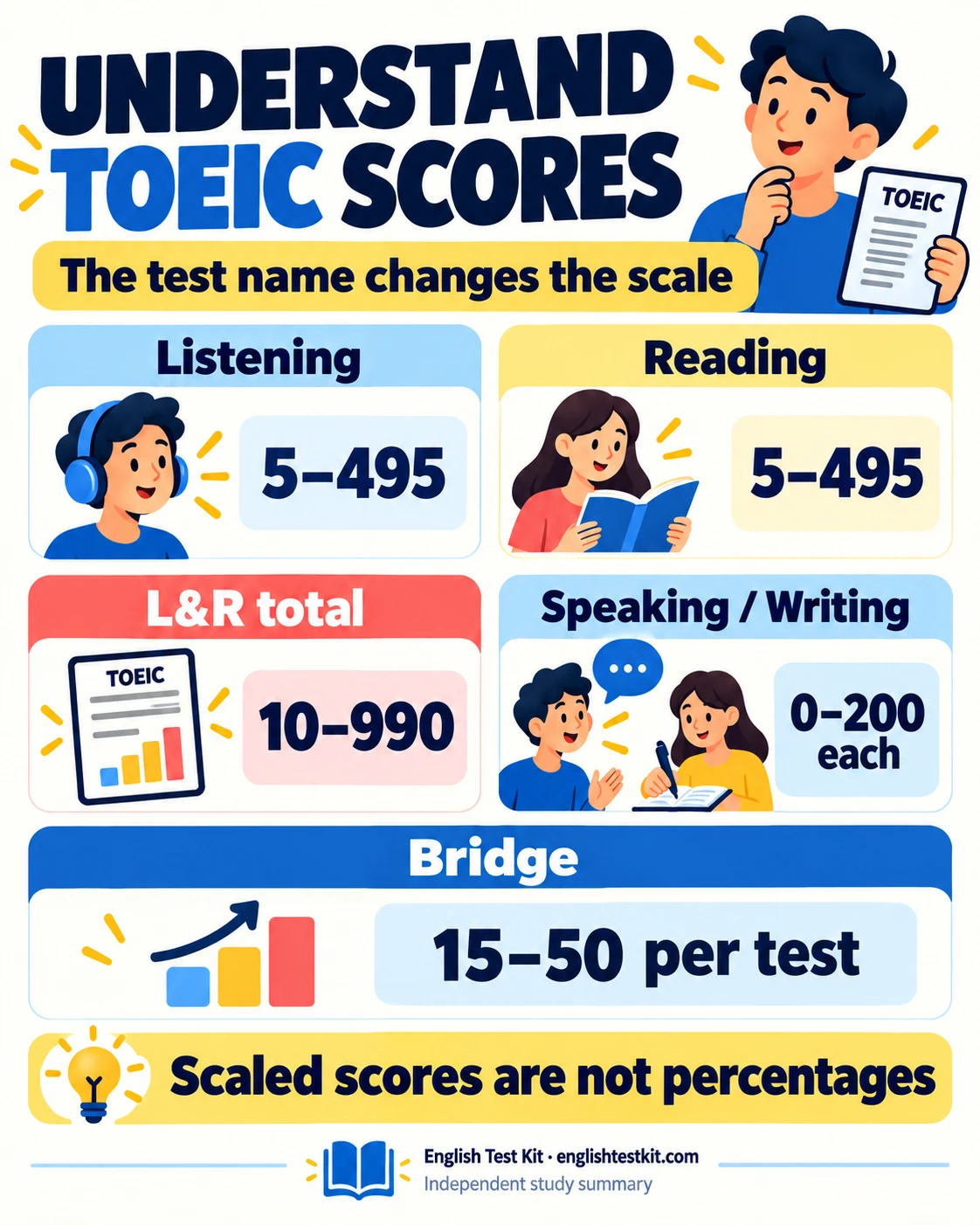
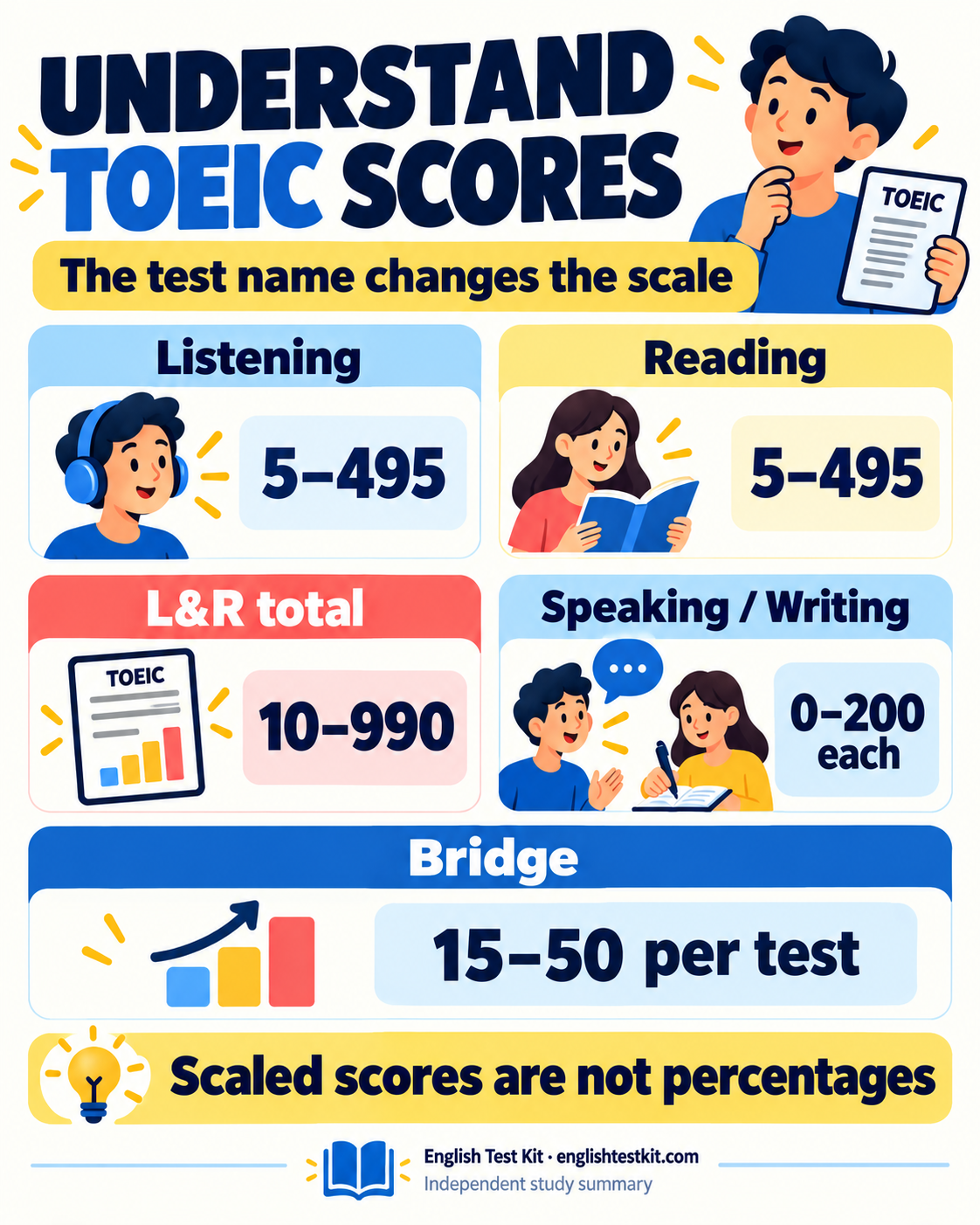
“TOEIC score” can refer to different tests. Listening and Reading, Speaking, Writing, and TOEIC Bridge use different score scales. Keep the test name beside the number whenever you compare results.
How the Listening and Reading total is built
Listening and Reading each receive a scaled score from 5 to 495. The total, from 10 to 990, is the sum of those two section scores. For example, Listening 425 plus Reading 390 gives an L&R total of 815. The example shows the arithmetic only; it does not predict how many questions a person answered correctly.
Common TOEIC score scales
Test or result | Reported scale | How to read it |
|---|---|---|
Listening section | 5–495 | A separate scaled score for understanding spoken English |
Reading section | 5–495 | A separate scaled score for understanding written English |
Listening and Reading total | 10–990 | Listening score plus Reading score |
Speaking test | 0–200 | A separate score for spoken communication |
Writing test | 0–200 | A separate score for written communication |
NOTE
These are scaled scores, not percentages or raw counts of correct answers. ETS statistically equates scores across forms so that results can be compared more fairly.
Speaking and Writing are separate results
The standard Speaking and Writing tests each use a 0–200 scale, and each score describes one productive skill. They do not add to the Listening and Reading total; if an organisation needs all four skills, it will specify which tests and reports it accepts.
ETS also provides proficiency descriptors that explain typical performance at different levels. Read those descriptors for the test you took instead of treating an isolated number as a complete description of your English.
A score is evidence, not a universal pass mark
TOEIC does not set one passing score for every job, school, or course. The organisation using the result sets its own requirement, which may include a total score, separate section minimums, a particular test, or a recent test date.
A high total can still hide an uneven profile. If a role depends heavily on understanding meetings, for example, its decision-maker may care about the Listening score as well as the total. Check the actual rule rather than guessing from a score chart.
Validity and score-report delivery
ETS says TOEIC scores measure proficiency at the time of testing and are valid for two years. Public-session test takers receive scores through the local ETS Preferred Network office. In an institutional session arranged by a school or employer, results go to the sponsoring organisation and are not globally portable.
Confirm the recipient and reporting route before booking. If you believe a score does not reflect your ability, ETS advises contacting the local EPN office within one month of the test date to ask about a score review.
What to check before you rely on the number
Match the report to the exact test: L&R, Speaking, Writing, or Bridge.
Check whether the receiver requires a total, a minimum in one section, or a separate productive-skill score.
Read ETS score descriptors or Can-Do guidance for the same test rather than applying another test’s scale.
Confirm the report is recent enough and will be sent through an accepted testing session.
Compare two fictional score profiles
Imagine an organisation requiring a Listening and Reading total of at least 740 and a Listening score of at least 380. These are invented conditions for illustration. Candidate A has Listening 390 and Reading 360: the total is 750, so both illustrated conditions are met. Candidate B has Listening 350 and Reading 420: the total is 770, but the Listening condition is not met.
The higher total does not settle the second candidate's case because the organisation has specified a separate skill threshold. A useful comparison therefore shows the total and each named component. Replace these example conditions with the actual published requirement and keep the test name, date and reporting arrangement alongside the scores.
Keep productive-skill results separate
A learner might also have Speaking 140 and Writing 150. Those are results on their own test scales; adding them to the Listening and Reading total would create a number with no defined reporting meaning. Likewise, the same numerical value on a Bridge report and a standard TOEIC report does not describe an equivalent position on the same scale.
When discussing a result, use complete labels such as “TOEIC Speaking” or “TOEIC Listening and Reading total”. This prevents a receiver or study partner from interpreting a number as the wrong kind of evidence. If a requirement simply lists “TOEIC 750”, ask which test and additional conditions it means rather than assuming.
Use practice results without inventing conversions
A practice set can show which items you answered correctly and which tasks caused difficulty. Its percentage may be useful for tracking your performance on comparable material. It is not automatically an official TOEIC scaled score: difficulty, coverage, form construction and scoring procedures matter.
Instead of asking a small set to predict a final number, use it to identify an action. Repeated Part 5 word-form errors suggest reviewing grammatical positions and word families. Difficulty connecting dates across messages suggests a connected-text reading activity. Missing an indirect response suggests listening for communicative purpose. These decisions are useful even when a practice set cannot supply a trustworthy scaled-score estimate.
Make the report part of a learning record
Keep the official skill scores beside a short record of recent practice. Note the task, the cause of difficulty and a specific correction to test. After several fresh sets, check whether the error pattern changes. This combines broad score evidence with the more detailed observations needed to choose practice.
Finally, confirm validity, accepted reporting route and recipient instructions before relying on a result. A score can be useful evidence of ability while still failing an administrative condition. The organisation receiving the report decides how it uses the result; the arithmetic alone does not establish acceptance.
Save your one-page study summary