TOEIC Reading combines sentence-level language choices with understanding connected workplace documents. A useful method changes with the task: analyse a gap carefully in Part 5, use paragraph meaning in Part 6, and connect evidence across texts in Part 7. Speed becomes valuable when it supports accurate decisions rather than replacing them.
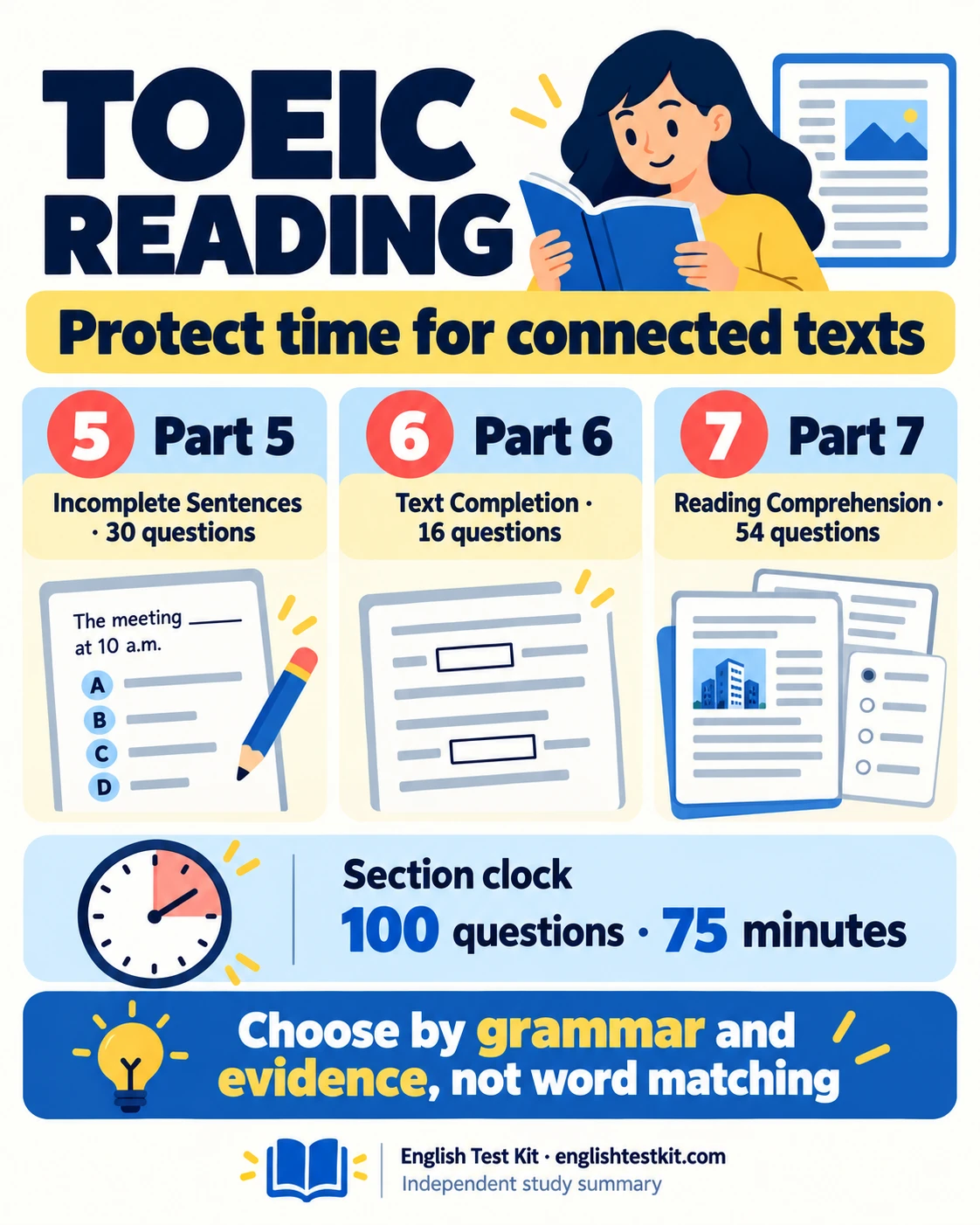
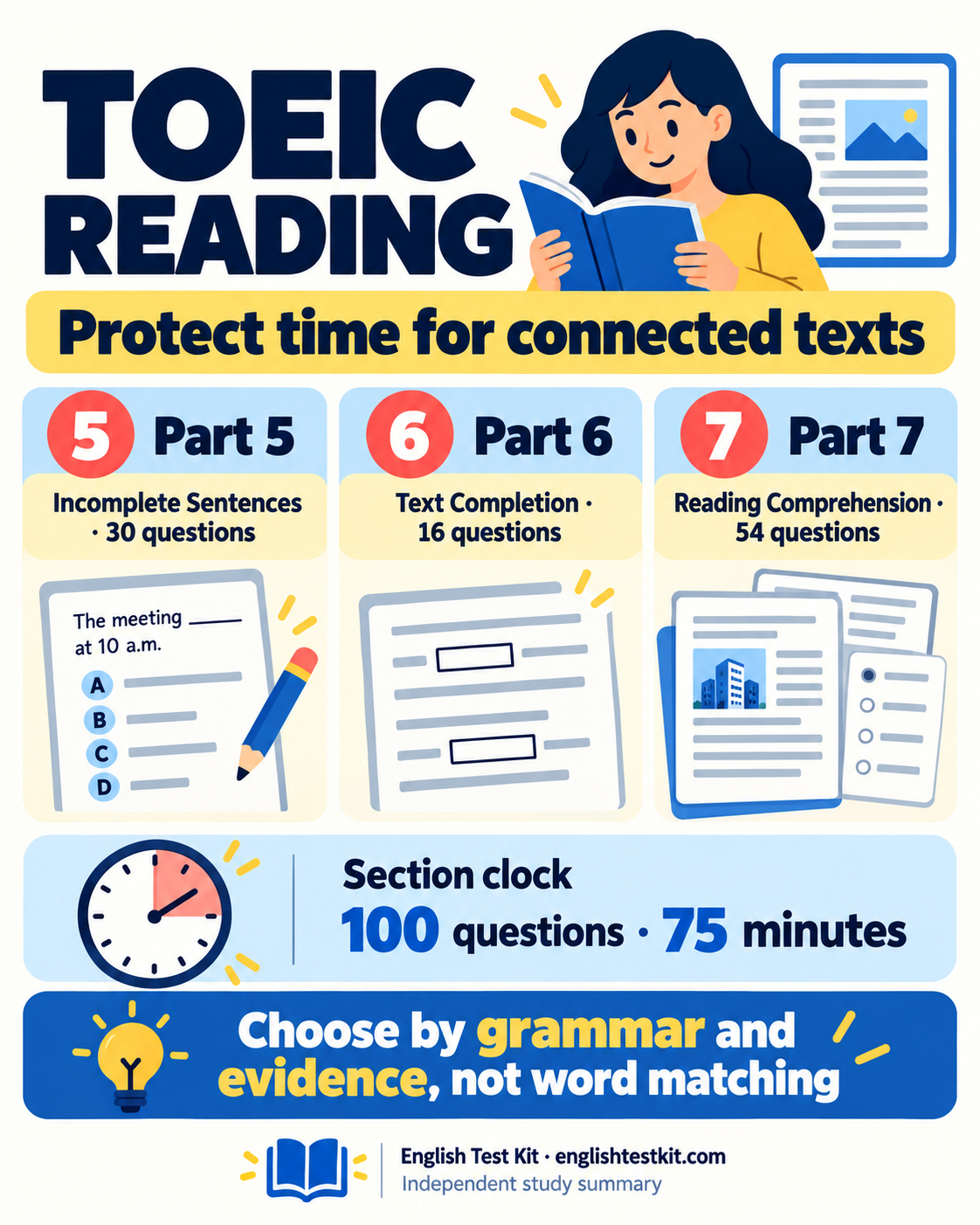
One hundred questions in 75 minutes
Reading is a fixed 75-minute section. It contains 100 questions, and you decide how to distribute your time across them. Later questions include longer texts and sets of related messages, so a pace that leaves time for those matters.
Three parts, from sentences to documents
The current TOEIC Listening and Reading score guide lists the question mix below. Part 7 accounts for single and multiple-passage reading.
Reading task mix
Part | Questions | What you do |
|---|---|---|
5 · Incomplete Sentences | 30 | Choose the word or phrase that completes a sentence |
6 · Text Completion | 16 | Complete a short text by choosing the best words or sentences |
7 · Reading Comprehension | 54 | Answer questions about single and multiple passages |
Read for meaning as well as grammar
Parts 5 and 6 reward vocabulary, grammar, and attention to how ideas fit together. Part 7 asks you to locate facts, understand a message’s purpose, and connect information across emails, notices, schedules, or related texts.
For a multi-passage question, identify which document contains each clue before choosing. A fast answer that is not supported by the text is still a guess.
Manage the section without racing blindly
Practise with a timer and mark questions that are taking unusually long. Move on when you have eliminated plausible choices and can make a reasoned selection; keep enough time to work through the later passages.
After practice, review the evidence in the text for each missed answer. Separate vocabulary gaps from misread relationships, missed details, and time-pressure errors.
Part 5: identify what the gap requires
Consider this original sentence: “The revised report must be submitted ___ Friday.” The options might include “by”, “during”, “since” and “until”. “By Friday” expresses a deadline. The other choices fail to express the intended relationship in this sentence. Knowing what the message means helps you choose the preposition instead of relying on how familiar an option looks.
For a word-family question, inspect the grammatical position. In “Please complete the form ___”, an adverb such as “carefully” can describe the action, whereas the adjective “careful” cannot fill the same position naturally. During review, name the pattern and write a fresh example. Memorising only the correct letter gives you little to transfer to another sentence.
Part 6: use the whole message
A sentence can be grammatically correct and still fit poorly in a paragraph. Read enough surrounding text to understand the purpose, sequence and reference words. If a notice first announces a service change, the missing sentence might explain the consequence or the action customers should take. A sentence introducing an unrelated topic would disrupt the message even if its grammar were flawless.
Watch words such as “however”, “therefore”, “this” and “those”. They create relationships that should make sense on both sides of a gap. Ask what the sentence connects to, not merely whether it could appear somewhere in a business document.
Part 7: combine clues from the right documents
Imagine an original email saying, “Please book the first available training session after 3 June.” An attached schedule lists sessions on 2 June, 5 June and 10 June. The answer is 5 June: it is the earliest listed option after the requested date. Choosing 2 June would ignore the condition, while choosing 10 June would ignore “first available”.
This small example demonstrates a common connected-text move. One document supplies a condition and another supplies the matching detail. In review, label which source contributes each clue. It becomes easier to distinguish a vocabulary problem from overlooking a date, a restriction or the relationship between documents.
Test a pacing plan with your own evidence
During timed practice, note where you become slow and which items remain unanswered. If sentence questions consume most of the section, practise recognising recurring grammar and vocabulary patterns without guessing blindly. If longer passages are the main difficulty, work on document purpose, targeted rereading and keeping related sources separate.
Use a reasonable stopping point for an uncertain item and continue before returning when possible. The exact balance should come from your practice performance, not an untested claim that every candidate needs identical minutes for each part. Review whether the plan leaves enough attention for the final reading sets.
Review every uncertain answer
A guessed correct answer can conceal the same weakness as a wrong answer. Explain the supporting text or language rule before moving on. Keep a compact error log with a cause—word form, vocabulary, reference, inference, missed condition or time—and one change to test in the next fresh set. This makes practice cumulative instead of a series of unrelated scores.
Save your one-page study summary