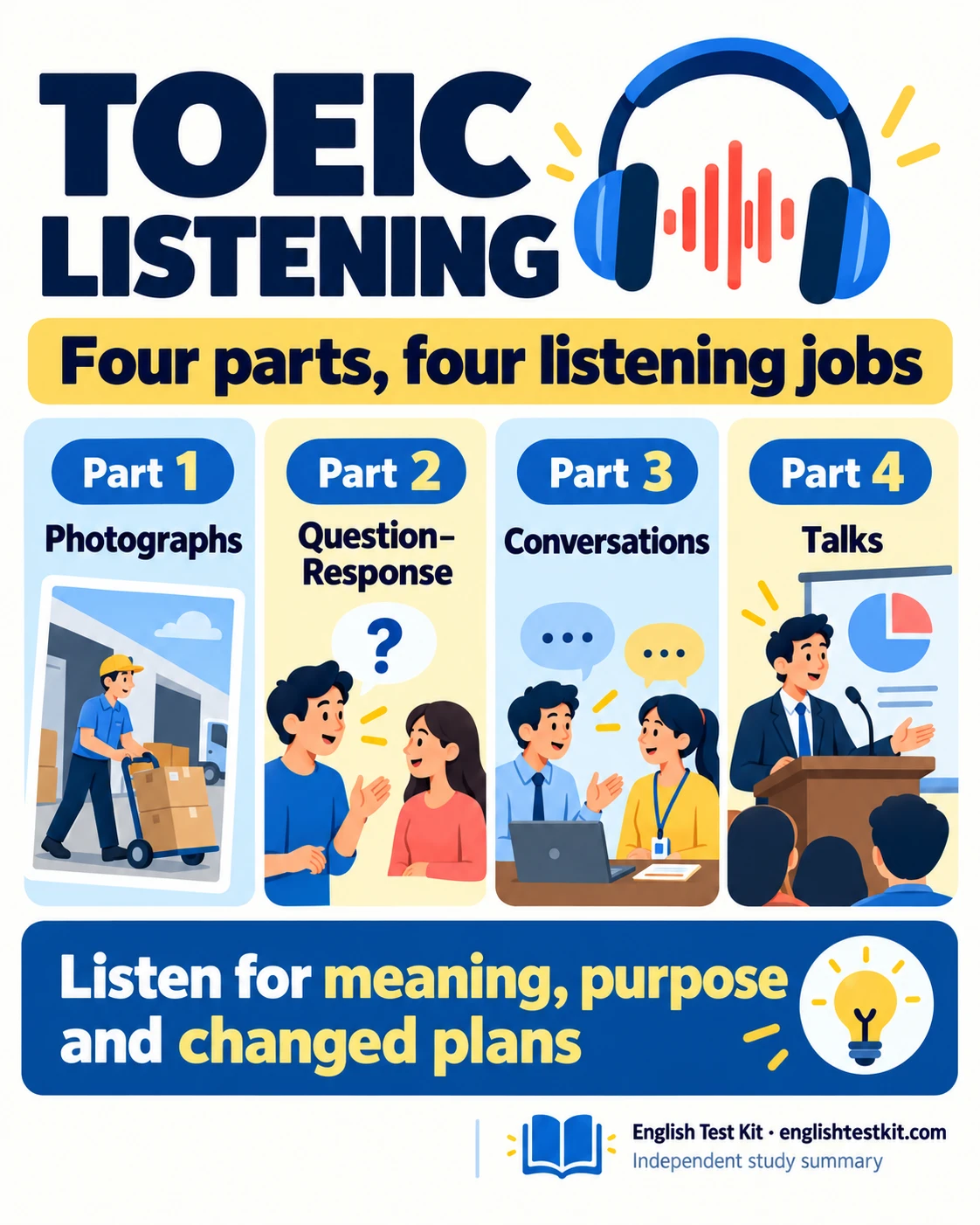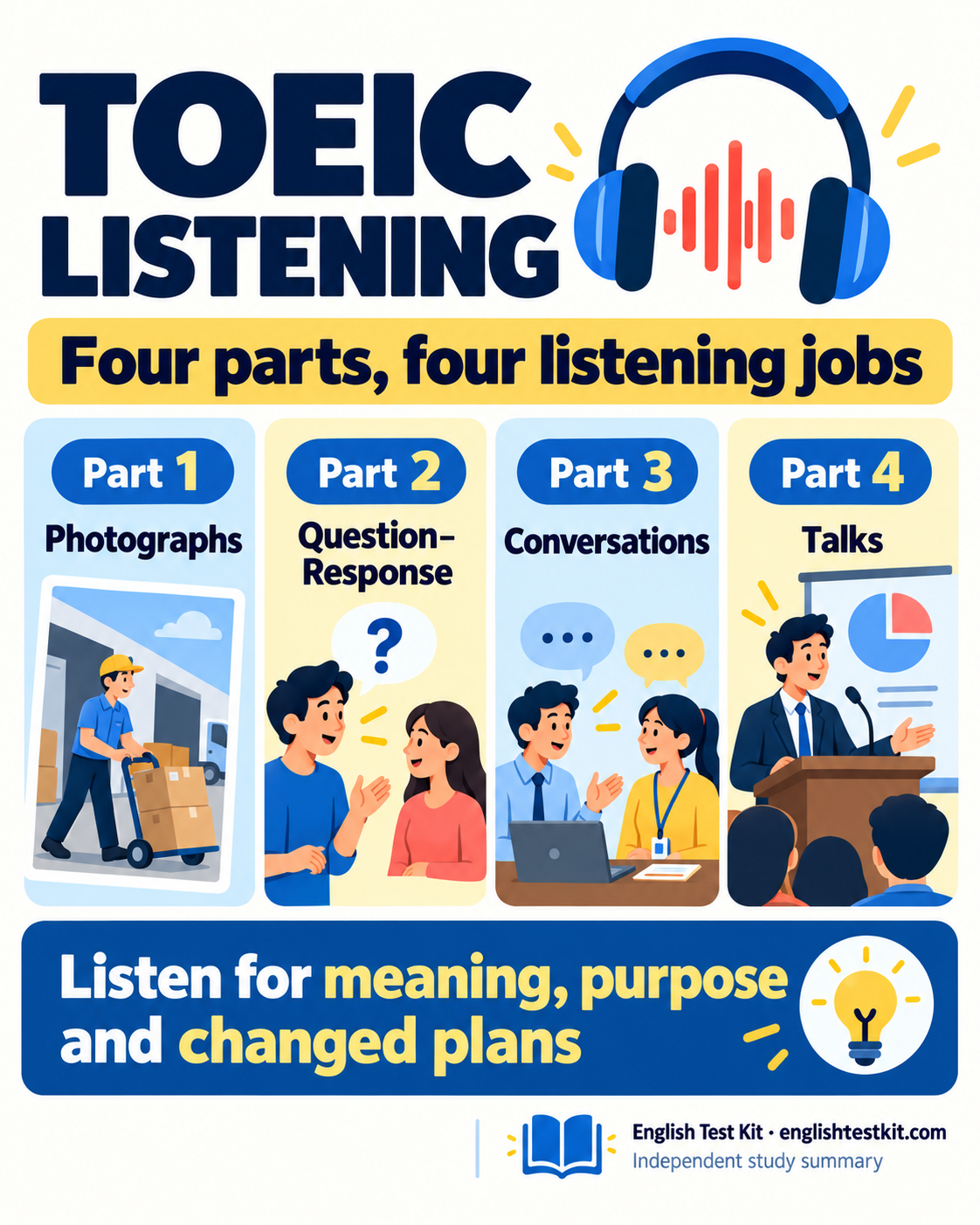
TOEIC Listening asks you to connect what you hear with a picture, a natural response or information in a longer exchange. The recording controls the pace, so preparation should build both understanding and recovery after an uncertain answer. Learn the job each part requires, then review the exact cue that supports a choice.
One recorded 45-minute section
The Listening section contains 100 questions across four parts. You hear English statements, questions, conversations, and talks, then choose an answer based on what you heard. The recording controls the pace, so you cannot spend extra time on an earlier question.
Four parts, four listening moves
The question mix moves from a single visual prompt to longer recorded exchanges. The current TOEIC Listening and Reading score guide lists these counts:
Listening task mix
Part | Questions | What you do |
|---|---|---|
1 · Photographs | 6 | Match a spoken statement to the picture |
2 · Question–Response | 25 | Choose a natural response to a spoken question or statement |
3 · Conversations | 39 | Follow 13 conversations and answer 3 questions about each |
4 · Talks | 30 | Follow 10 talks and answer 3 questions about each |
Listen for purpose, detail, and connection
Questions can ask for a main idea, a specific detail, a speaker’s purpose, or an implied next step. Conversations and talks may connect information across several lines, so listen for who is speaking, why, and what changes.
In the conversation and talk parts, read the available question prompts during the permitted preview time. This gives you a target for listening; it does not replace listening to the full recording.
Build a useful practice routine
Practise with official sample audio and follow the same one-play conditions described in your test materials. After each set, note whether a missed answer came from unfamiliar vocabulary, losing track of a speaker, missing a detail, or making an unsupported guess.
Review the reason for the miss, then try another set. Repeating a memorised answer is less useful than improving the listening move that caused the error.
Part 1: describe only what the photograph supports
In photograph questions, a familiar noun can make a statement sound attractive even when the action or relationship is wrong. Imagine an original practice picture of a worker placing folders on a shelf. “The worker is arranging documents” fits that visible action. “The worker is repairing the shelf” introduces an activity the picture does not support.
When reviewing a picture question, separate people, objects, actions and positions. Ask which part of a rejected statement conflicts with the image. This produces a useful learning point, such as confusing “placing” with “replacing”, instead of the vague conclusion that the whole question was difficult.
Part 2: respond to the purpose, not an echoed word
Consider this original written demonstration of a spoken exchange: “Could you send the updated schedule this afternoon?” A natural response is “Yes, I'll email it after lunch.” A distractor such as “The station is near the office” might contain a familiar workplace word, but it does not answer the request.
Responses do not always repeat the question's vocabulary or begin with a simple yes or no. “I'm still waiting for the manager's changes” can also be a meaningful response to a schedule request. Practise recognising requests, offers, questions, suggestions and statements as communication acts. During review, explain what the speaker is trying to achieve.
Parts 3 and 4: follow the changing situation
For conversations and talks, keep track of the participants, purpose and outcome. A question may ask about a detail, an implied next action or why a speaker says something. Read any available prompts when the directions permit, then listen to the exchange as a whole. Predicting a topic is useful; deciding the answer before the audio is not.
Imagine a conversation in which a delivery was expected on Monday but is delayed until Tuesday. A later sentence may explain that a technician must therefore return on Wednesday. Different questions could target the delivery date or the technician's action. Keep the people and events distinct so one correct detail does not become an answer to the wrong question.
Rehearse the one-play condition
Use a fresh short set and listen once for the first attempt. If you miss an item, make the best supported choice available and return your attention to the current recording. The skill of recovering matters because replaying a lost sentence mentally can make you miss the next exchange as well.
Afterwards, use a transcript and replay to diagnose the error. Mark the actual answer cue and identify the distractor's problem: wrong person, changed time, reversed relationship, irrelevant detail or unsupported assumption. Then try another item that uses the same listening skill. Repeating a memorised recording can help sound recognition, but it does not by itself demonstrate improved comprehension of unfamiliar material.
A focused review checklist
Ask whether you understood the speaker's purpose, followed corrections, identified the right person or event, and distinguished a stated fact from an inference. If you recognised the words only after reading the transcript, practise hearing the phrase at natural speed. If you heard every word but chose the wrong option, work on meaning and task focus rather than replay alone.
Save your one-page study summary