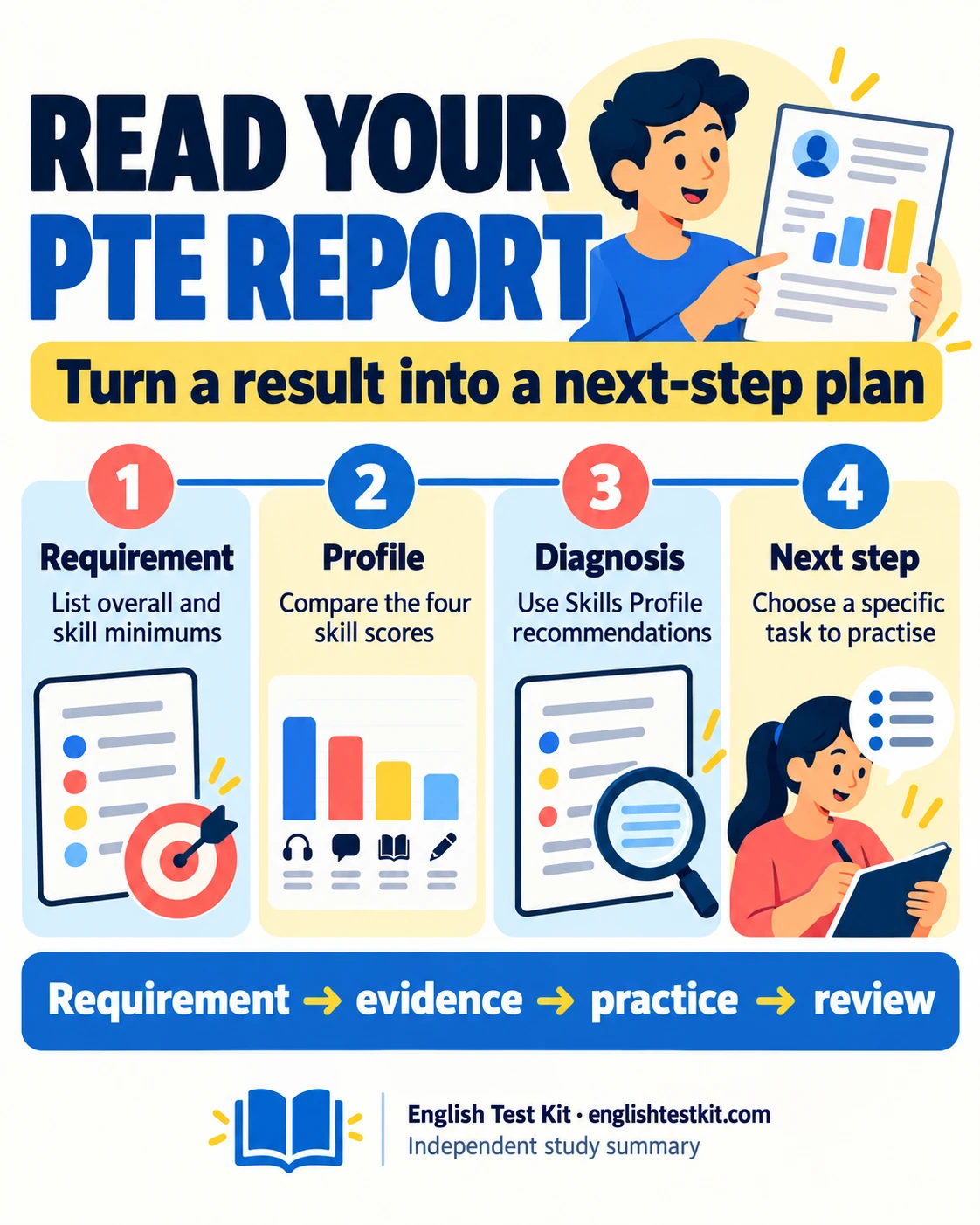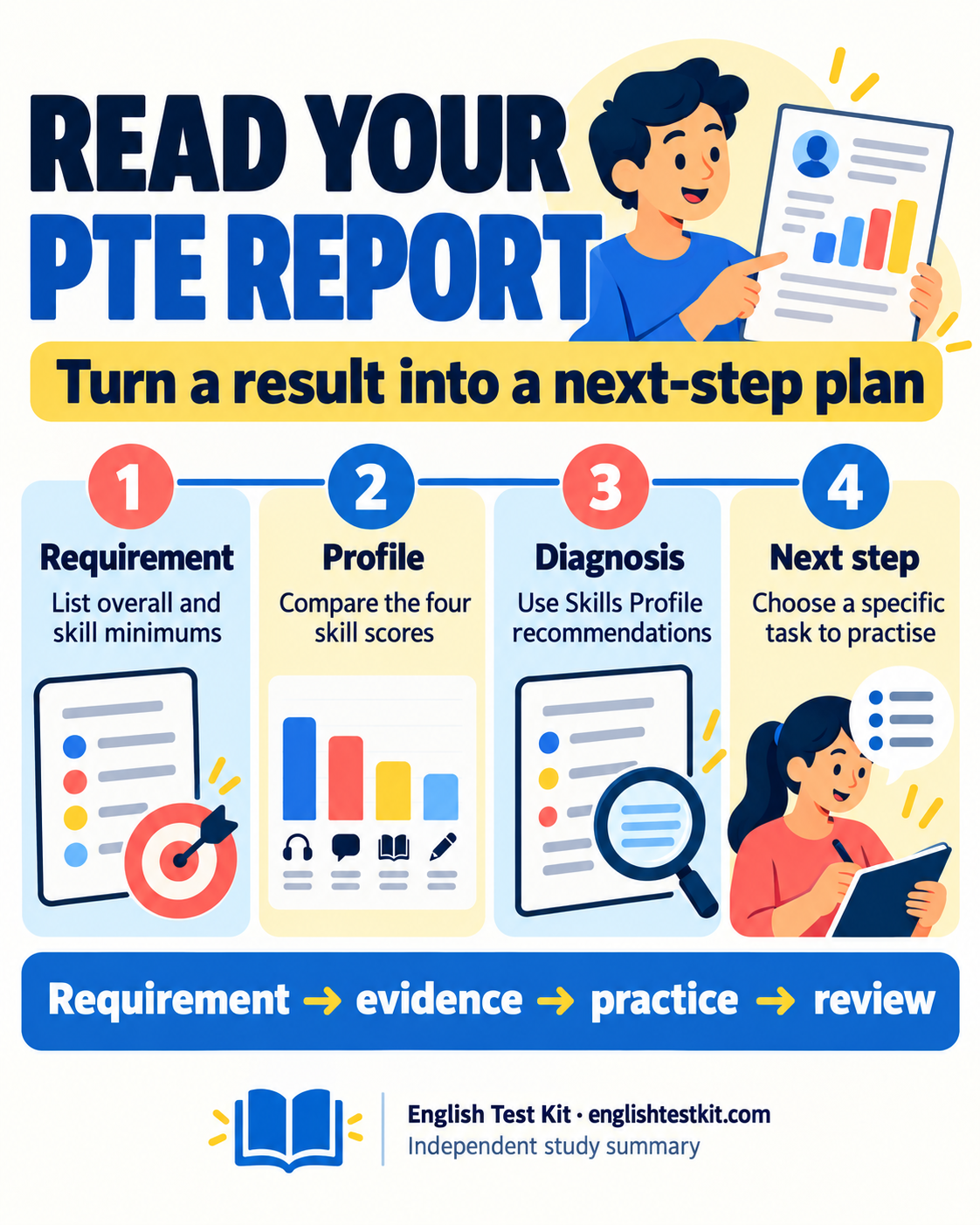
A PTE report becomes more useful when you connect its numbers with a requirement and with examples of your own work. Read the overall result and the four skill scores first, then use the Skills Profile and practice history to decide what needs attention. The report identifies a performance profile; it does not choose a complete study plan on its own.
Start with the requirement you must meet
Before interpreting a score, write down the exact requirement from the organisation receiving it. Some applications require a minimum overall score; others also set a minimum for one or more communicative skills. A result that clears the overall threshold may still miss a skill threshold.
Read the four communicative-skill scores
The Score Report gives a score for listening, reading, speaking, and writing. Each skill score ranges from 10 to 90. Tasks can be integrated, so a skill score may draw on several types of questions rather than one isolated section.
Use the Skills Profile to choose practice
Pearson’s Score Report includes a Skills Profile and recommendations alongside the overall and communicative-skill scores. The profile summarises performance across eight language-skill areas, such as open responses, reproducing language, and extended or short responses. Treat it as a diagnostic aid: compare the recommendations with your answer patterns and practice history.
When is a score report valid?
Pearson’s general score-report validity is two years from the test date. The institution or authority receiving the report may set a different rule, so confirm its policy for your particular application. The score report itself does not guarantee acceptance, admission, or visa approval.
Compare each score with the official requirement, not a general chart.
Look for the weakest skill and the Skills Profile area that may explain it.
Check the result date and score-validity rule before submitting an application.
Put the requirement beside the report
Create a comparison with the accepted test, required overall score, each named skill minimum and the date policy. Use the receiving organisation's current wording. Do not assume that a general target found online applies to every course, role or application route, even when the institution's name is the same.
For an invented example, suppose a recipient asks for overall 60 and at least 55 in every skill. A fictional learner has overall 63 but Speaking 52. The overall result meets one condition while the Speaking result misses another. This is an illustration of checking a profile, not a real admissions policy or an explanation of Pearson's overall-score calculation.
Use profile feedback as a diagnostic lead
The Skills Profile can help identify broad areas to investigate. Read its descriptions and recommendations, then compare them with actual responses from suitable practice. A broad weakness in reproducing language, for example, could involve listening accuracy, memory for word groups, grammatical endings or spoken delivery. You need a few observed attempts to distinguish those possibilities.
Avoid treating one label as proof that every task in the category needs the same correction. A learner who omits key information may need source selection; a learner who includes the information but speaks unclearly may need delivery practice. Both could find the same task difficult for different reasons.
Work through a response, not only a number
Imagine an original practice sentence, “The research meeting has been postponed until Tuesday.” If the learner reproduces “The meeting is on Tuesday”, some meaning is retained but language and detail are lost. Review whether the difficulty began with hearing the phrase, holding its structure or speaking it clearly. Practise the specific stage that failed and then try a fresh sentence.
For a written summary, compare the source's main claim and support with the response. If the summary invents a cause, correct the content selection. If it breaks the required form, correct the instruction habit. A better score target should lead to one of these concrete actions rather than the vague instruction to “study harder”.
Decide what evidence would show progress
Choose a small, observable goal for the next few sessions: preserve more grammatical words in fresh repetitions, include the main reason in summaries, or support every selected reading option with text evidence. Keep a short before-and-after record. Once the habit improves, combine it with realistic timing and other task types.
If you plan another test, consider the deadline, reporting arrangements and realistic preparation time. A retake is an opportunity to demonstrate current ability, not a guarantee that the same routine will produce a higher result. Use the first report to change the preparation, not merely repeat it.
Check the administrative details
Confirm the test date, personal details, accepted assessment and recipient's submission instructions. Read the current provider validity rules alongside the receiving organisation's date policy. Use the official report for an application and keep practice estimates clearly labelled. When a requirement is ambiguous, ask the recipient which condition applies to your specific purpose before making a booking decision.
Save your one-page study summary