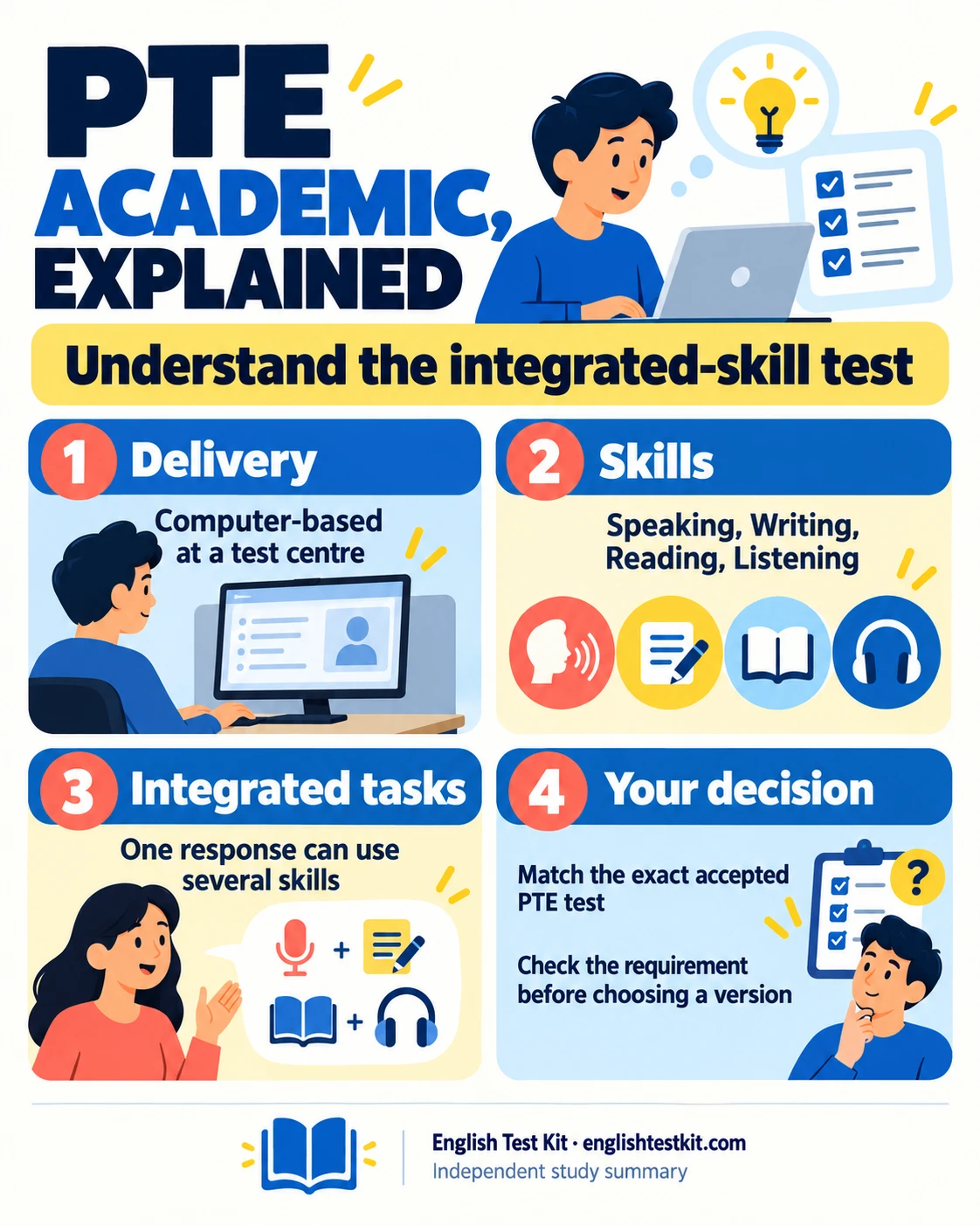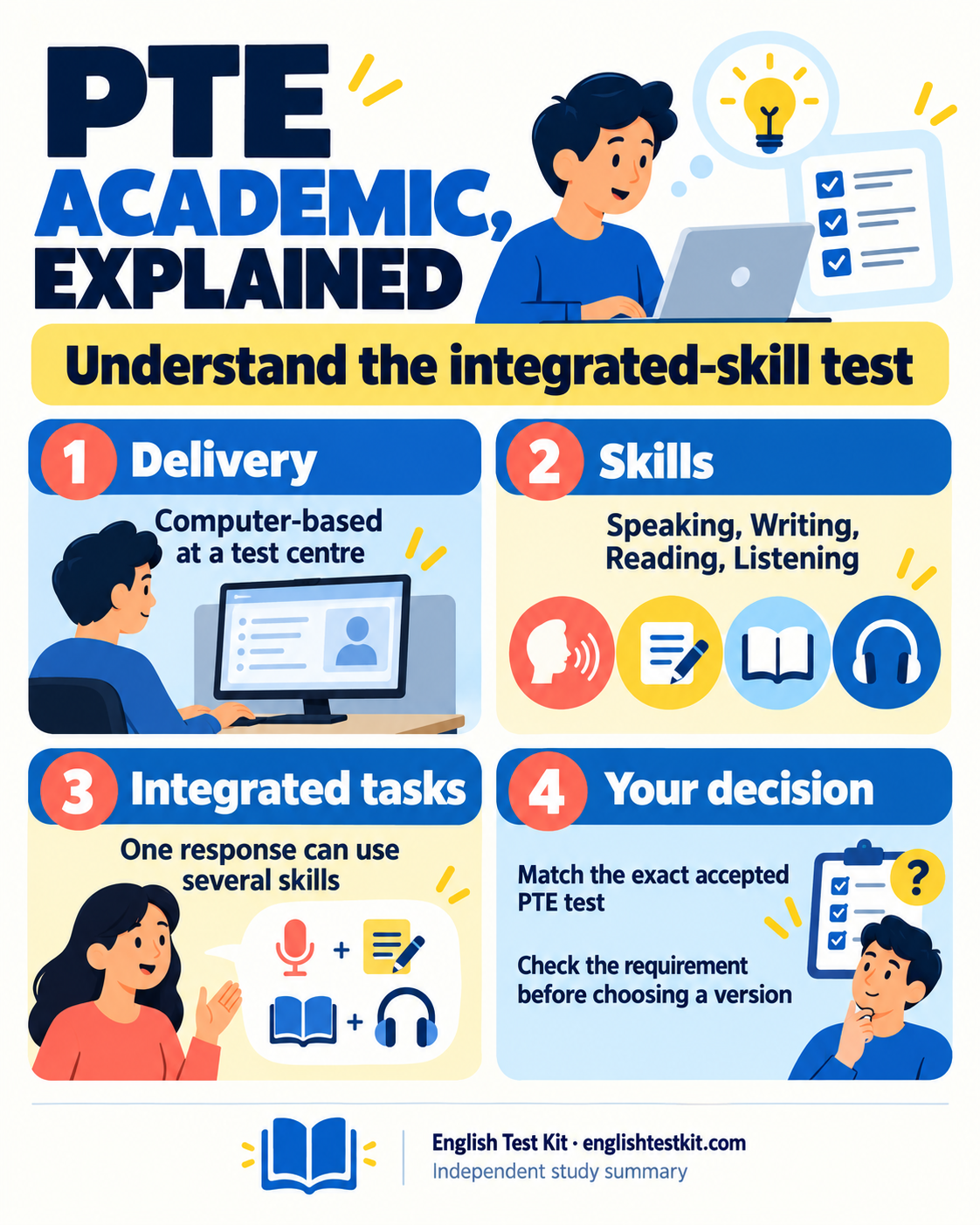
PTE Academic asks you to understand and produce English through a computer-based sequence of tasks. Knowing the section names helps you navigate the test, but preparation becomes more useful when you understand what each response requires. Some tasks involve several language processes, so a weakness in listening, spelling or organisation can affect how well you complete a spoken or written response.
An English test for academic goals
PTE Academic is Pearson’s computer-based English test for people who need to demonstrate English ability for study and other accepted purposes. It assesses speaking, writing, reading, and listening in one test session at a secure Pearson test centre.
The test uses academic and student-life material. You listen to recordings, read prompts, speak into a microphone, and type written answers. Some tasks bring skills together: a listening task may also require a spoken or written response.
A test result is evidence, not an admission decision
PTE Academic reports an overall score and separate scores for listening, reading, speaking, and writing. A receiving university, employer, professional body, or government decides whether that result meets its rules. The required test, minimum overall score, minimum skill scores, and score-validity policy can vary.
Before booking, confirm the exact test name and score requirements on the official page of the institution or authority receiving your application.
Check that you need Academic
PTE Academic and PTE Academic UKVI use the same test format, but UKVI provides a reference needed for certain UK visa routes. PTE Core serves different Canadian immigration purposes. Do not choose from a general description alone: match the test to the application you are making.
For a university application, look up its accepted tests and score table.
For a visa or migration route, follow the government’s current test instructions.
Use Pearson’s test selector when you are unsure which PTE test applies.
A useful place to begin
Start with the test-format overview, then read the guide for the section you find hardest. Once you know the current tasks, try a timed practice set and review both accuracy and response quality. That gives your preparation a clear target instead of turning it into a collection of templates.
Start with the accepted test and result
Before choosing materials, record the exact test name accepted for your purpose. PTE Academic, Academic UKVI and Core are not interchangeable labels. Check the overall score, individual-skill minimums, result-date policy and submission instructions on the receiving organisation's official page. If anything is unclear, ask about your specific application before booking.
Imagine a fictional course that accepts PTE Academic and sets both an overall minimum and a Writing minimum. A learner who reaches the overall target but misses Writing still needs to address that condition. This example is about reading requirements accurately; it does not represent a real institution's admission policy.
See how a task can combine processes
In an original practice summary activity, you might listen to a short explanation of why a campus library is extending its opening hours, then write the central point and key support. Success requires understanding the recording, selecting relevant information and expressing it clearly. Copying isolated words without preserving the relationship between ideas would not communicate the same message.
A repetition activity has a different demand. If you hear “The workshop has been moved to the east building”, repeating only “workshop east building” loses grammatical information. During practice, compare the words you reproduced, the order and endings, and how intelligible the response sounds. These examples illustrate language processes, not official scored questions.
Build a useful starting diagnostic
Try representative current tasks across Speaking and Writing, Reading and Listening. Record what you can do independently and where the response breaks down. For reading gaps, identify whether the problem is grammar, vocabulary or the connection between sentences. For spoken responses, distinguish understanding the source from organising and delivering the answer.
A learner who understands a lecture but struggles to summarise it may need selection and organisation practice. Another learner may need work recognising the words in the first place. Giving both learners the same memorised summary structure would not address their different starting points.
Choose feedback that explains a cause
A useful practice comment names what happened and what to change. “You omitted the reason for the timetable change” gives a content target. “Several word endings were unclear” gives a delivery target. “Your sentence does not meet the required form” gives an instruction target. A number without explanation can be much less useful for deciding what to practise next.
Use official preparation to understand directions and current criteria, then supplement it with original targeted activities. Keep practice estimates separate from an official result, and avoid assuming that a small set or an unofficial weighting chart predicts your final score.
Establish a repeatable first-week routine
Confirm the test and requirement, try a short diagnostic, select two recurring weaknesses and practise them with fresh material. End each session by recording one observation and one adjustment. Keep the other skills active while prioritising the largest gaps. Once task instructions are familiar, combine activities under realistic timing so you can practise switching response methods without losing focus.
Save your one-page study summary