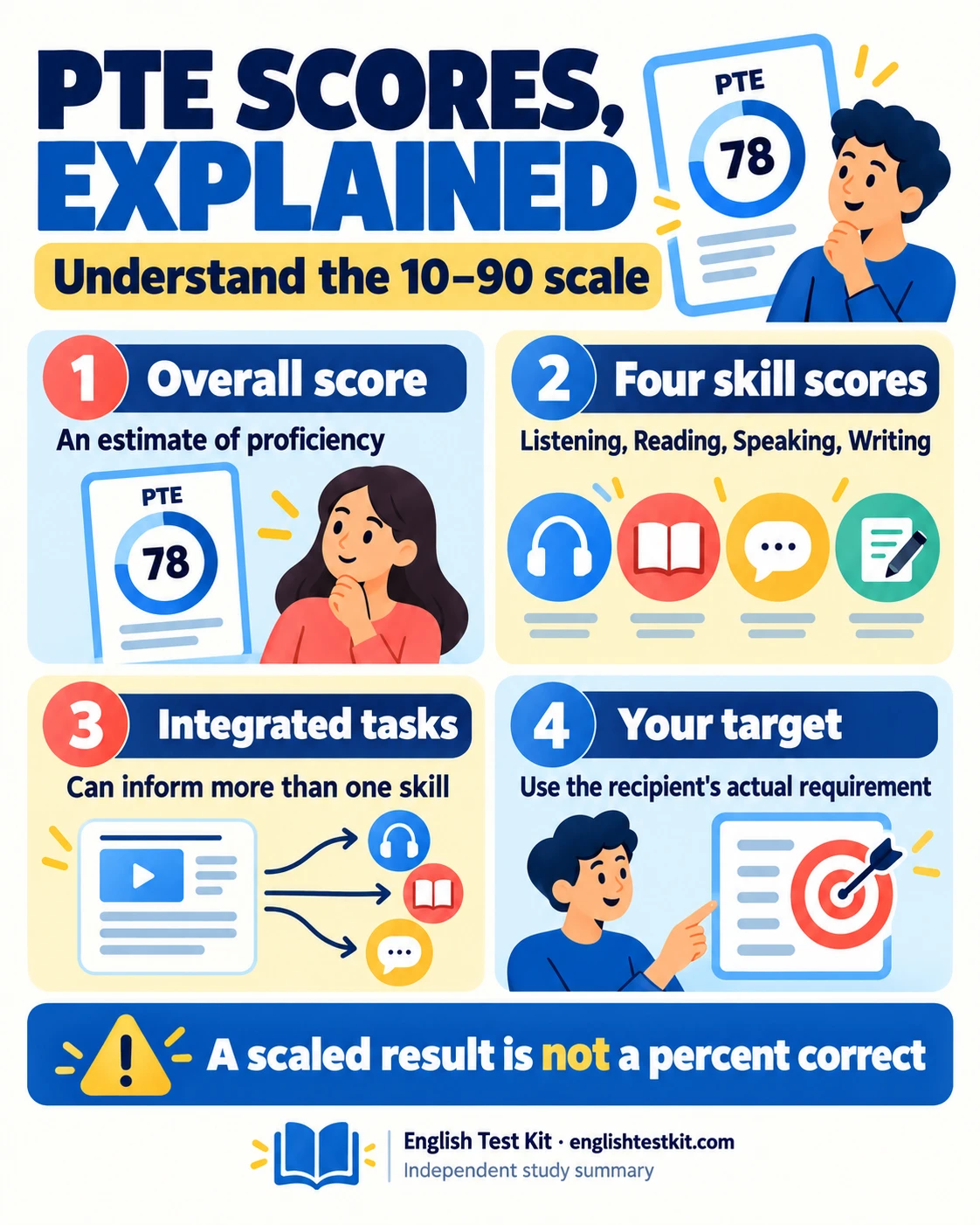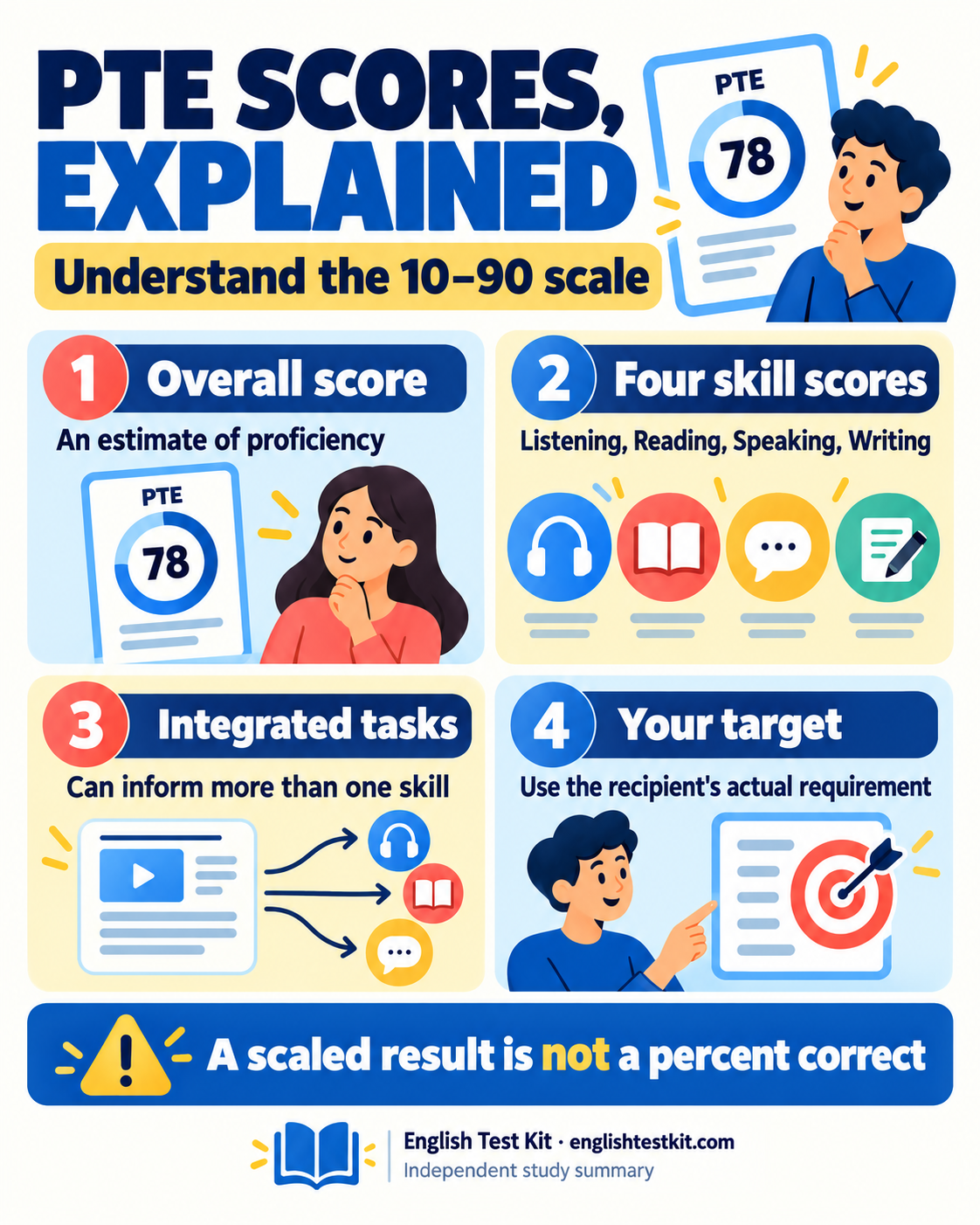
PTE Academic scores summarise language performance on a scale, not a percentage of questions answered correctly. The most useful interpretation combines the overall result, the four skill scores and the requirement you need to meet. Use the current official Score Guide for task contributions and criteria instead of assuming that every task has a fixed unofficial weight.
A proficiency scale, not a percentage
PTE Academic reports scores from 10 to 90 using the Global Scale of English. The overall score reflects performance across the test. The report also gives a separate score for listening, reading, speaking, and writing, each on the same 10–90 range.
Why a task can affect more than one skill
PTE Academic includes integrated tasks. A response to audio may be spoken, written, or selected from options. Pearson uses the skills needed for each task when calculating communicative-skill scores, so a single task can inform more than one skill score. The overall result is not simply a percentage of correct answers.
AI scoring and expert review
Pearson describes its scoring as automated, with some response traits also reviewed by a human expert after the 2025 update. The traits and scoring rules depend on the question type. For example, a speaking task may evaluate content as well as oral fluency and pronunciation; a multiple-choice item may be scored against an answer key.
There is no universal “good score”
A score is useful only in relation to the requirement you need to meet. Universities and authorities can set an overall minimum, minimums for individual skills, or both. Pearson’s published comparison with the CEFR is an alignment guide, not a guarantee of admission or visa eligibility.
Find the required test and score on the receiving institution’s current official page. If its rules are unclear, ask the institution directly.
Read a fictional profile against a requirement
Imagine a fictional course asking for an overall 65 and at least 60 in every skill. A hypothetical report shows overall 65, Reading 72, Listening 68, Speaking 66 and Writing 58. The overall condition is met, but the Writing condition is not. These invented values demonstrate report interpretation, not Pearson's score calculation or a real institution's admission policy.
Write each required condition on a separate line and compare it with the corresponding reported value. Keep the accepted test version and date policy beside the scores. If a requirement names a particular skill minimum, a stronger score elsewhere should not be assumed to compensate unless the receiving organisation explicitly says so.
Avoid inventing the overall calculation
The overall result is not a simple percentage or a classroom-style total of marks you can reproduce from a few practice answers. Integrated tasks and task-specific assessment mean that an intuitive arithmetic shortcut can misrepresent the official report. Do not average selected task estimates or apply a popular online weighting table as if it were Pearson's reporting rule.
For preparation, a small task set is still useful. It can show repeated omissions, unclear spoken delivery, weak grammatical control or unsupported choices. Use that evidence to choose practice even when the set cannot provide a reliable overall-score prediction.
Separate content, form and language feedback
A response can be fluent yet omit the central point of the source. Another can contain accurate information but fail a required form, such as the single-sentence condition in a summary task. A third can meet the task's purpose but be difficult to understand because of language control. These problems should lead to different corrections.
For an original practice example, imagine a summary of a proposed library timetable trial. Calling the proposal a permanent decision would be a content error; writing several separate sentences in a one-sentence task would be a form error. Reviewing these dimensions separately is more productive than labelling every weak result “not enough vocabulary”.
Use the result to set a specific next goal
If Writing is below the required level, review representative written work and the related task criteria. Look for evidence of incomplete task coverage, inaccurate summarising, poor organisation or recurring grammar and spelling errors. Then choose a measurable practice goal, such as preserving the main claim and reason in a summary while meeting its required form.
For Speaking, inspect both what you said and how clearly it was delivered. For Reading and Listening, explain the evidence behind missed selections or completions. Keep the target tied to fresh work so improvement is not confused with remembering an answer.
Check administrative conditions too
Confirm the accepted PTE assessment, score-date policy and submission process with the recipient. Use the official report for an actual application and distinguish it from a practice estimate. Current provider guidance explains scoring; the receiving organisation determines whether the result satisfies its own conditions.
Save your one-page study summary