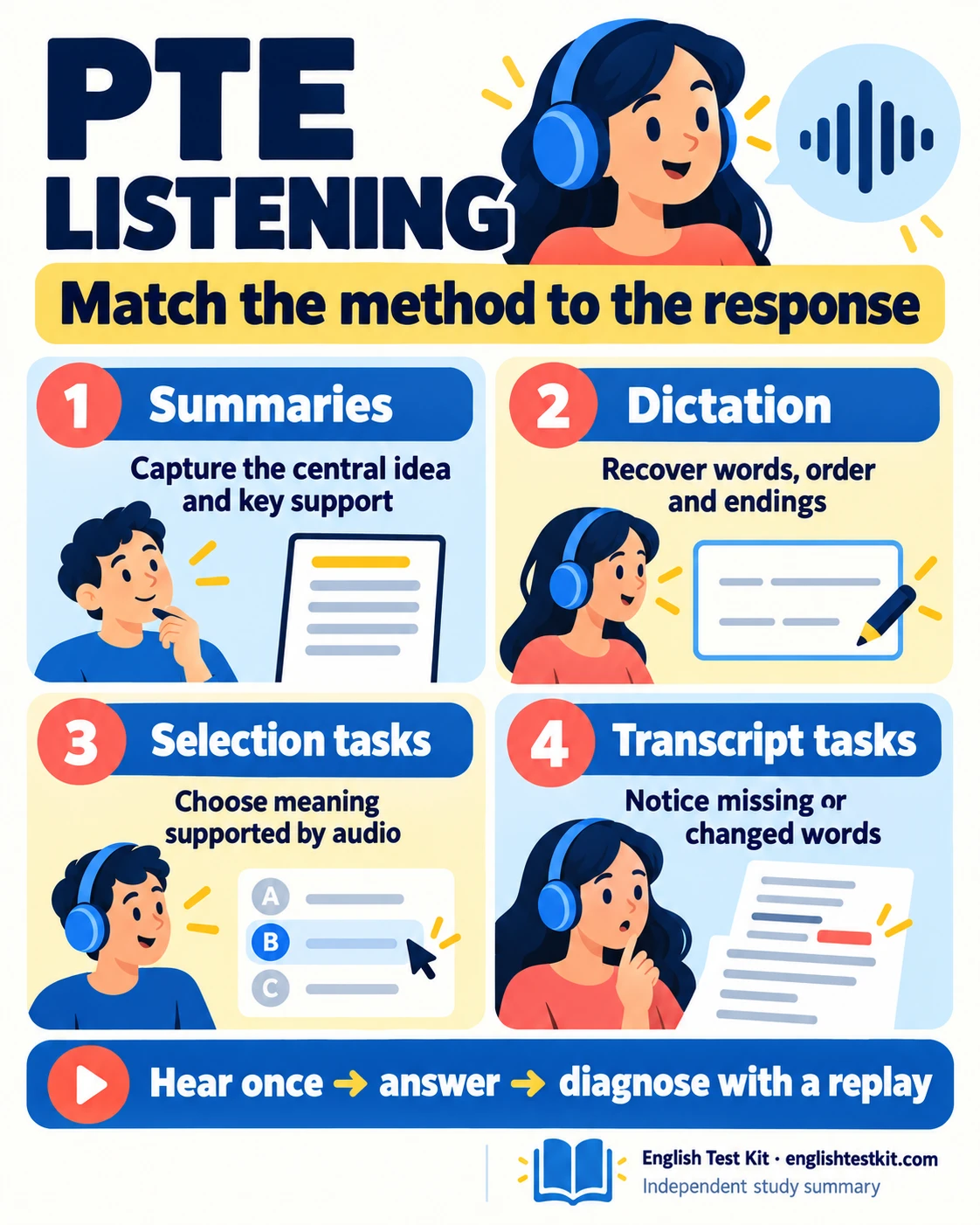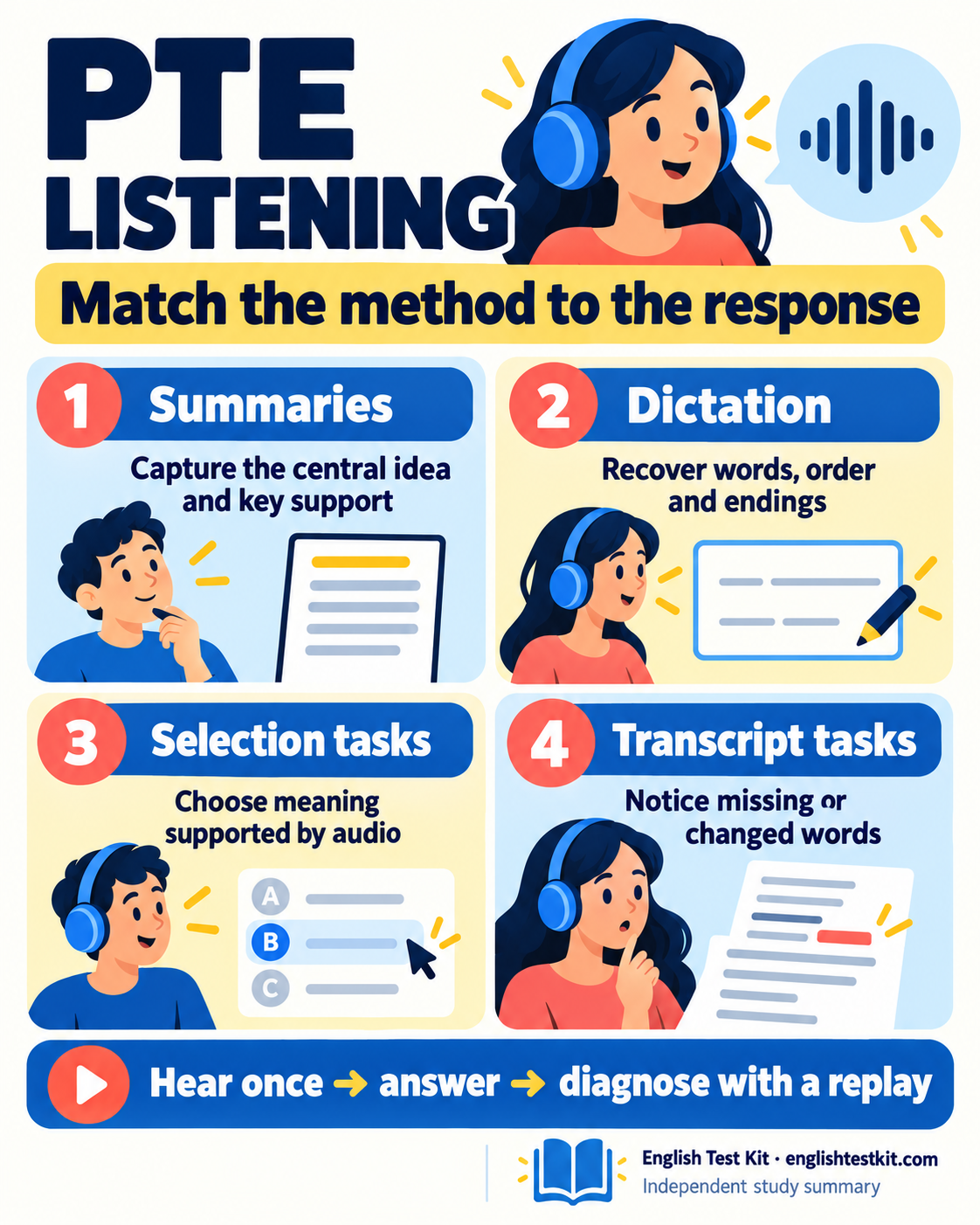
PTE Listening tasks use spoken input in different ways. A summary requires selecting and organising meaning; dictation requires accurate reproduction; other activities ask you to select, complete or compare information. Learn the response action before choosing how much to note and what to listen for.
Eight tasks built around audio or video
The Listening part contains eight task types. Pearson says recordings start automatically, are played once, and allow you to take notes. The section is listed as 31–39 minutes, with timing varying across tests.
Summarize Spoken Text
Multiple Choice, Multiple Answers
Fill in the Blanks (Type In)
Highlight Correct Summary
Multiple Choice, Single Answer
Select Missing Word
Highlight Incorrect Words
Write from Dictation
Listen for the structure, not every word
For longer recordings, note the topic, the speaker’s main point, and a few supporting details. Brief notes are easier to use than attempting to write down every sentence. Watch for examples, contrasts, causes, and conclusions that show how the ideas fit together.
Match the strategy to the response
Summarize Spoken Text requires a written summary, while Write from Dictation asks you to reproduce a short sentence. Other tasks ask you to select a meaning, complete a transcript, or notice differences between audio and text. Some tasks also contribute to reading or writing scores.
For summaries, identify the central point before adding supporting details.
For dictation, practise sound-to-spelling links, word order, and sentence endings.
For multi-select tasks, choose only options you can support from the recording.
Practise with one replay
Use practice recordings that you hear once, then compare your notes with the key points. Replay can help you diagnose mistakes afterward, but avoid using repeated listening during the first attempt if the goal is to build test-day habits.
Match your notes to the task
For a longer explanation, a useful note captures relationships: the topic, main claim, supporting reason, example or change. Writing every word can leave too little attention for the next idea. For a short dictation sentence, by contrast, the words and their order are central. The same note-taking style is not equally useful for both purposes.
Practise noting a few meaningful cues, then reconstruct the main point without looking at a transcript. If the notes preserve several details but not the conclusion, change what you select next time. Notes should help you answer the task, not merely prove that you wrote something while listening.
Worked demonstration: summarising meaning
This original transcript is a written teaching example, not playable audio: “The university will extend the evening bus route for one month. Students using the late library service reported difficulty getting home. The trial will show whether demand is high enough for a permanent service.”
A concise practice summary could explain that the university is testing a longer evening bus route because late-library users need transport, and the trial will inform a permanent decision. Saying “A permanent bus service has been approved” would overstate the source. It is a trial, and approval depends on the evidence collected. During review, compare the decision, reason and condition in the response with the original information.
Worked demonstration: dictation accuracy
Use the original practice sentence “Students must submit their assignments before Friday.” Omitting “their” or changing “assignments” to “assignment” alters the language reproduced. After a listening attempt with suitable audio, check small grammatical words, plural endings and word order as well as the content words you remember most easily.
The sentence here demonstrates what to inspect; reading it silently is not equivalent to a listening attempt. Use a fresh recording for first-attempt listening practice, then a transcript to diagnose the error. Work from short sentences to longer ones while maintaining accuracy and intelligibility in any spoken rehearsal.
Selection and transcript-comparison tasks
For multiple-choice responses or summary selection, compare the complete meaning with the audio. A distractor can repeat a prominent word while reversing a cause or overstating a result. For a task that compares audio with written text, keep your place in both and notice the precise difference instead of relying on a general impression.
In multiple-answer tasks, follow the task-specific scoring instructions and select supported options. Extra unsupported selections can be harmful where the published rules apply deductions. The strategy is evidence-based selection, not a universal rule to choose either the fewest or most answers.
Use replay for diagnosis after the first attempt
Begin a practice set under the intended one-play conditions. Afterwards, compare the response with the key or source, then replay the difficult section and identify what happened. Was a phrase unrecognised, a relationship misunderstood, a word ending missed or an instruction overlooked? Practise that weakness with fresh material and record one change. Repeated replay can help learning, but keep it separate from the initial attempt used to assess your listening under test-like conditions.
Save your one-page study summary