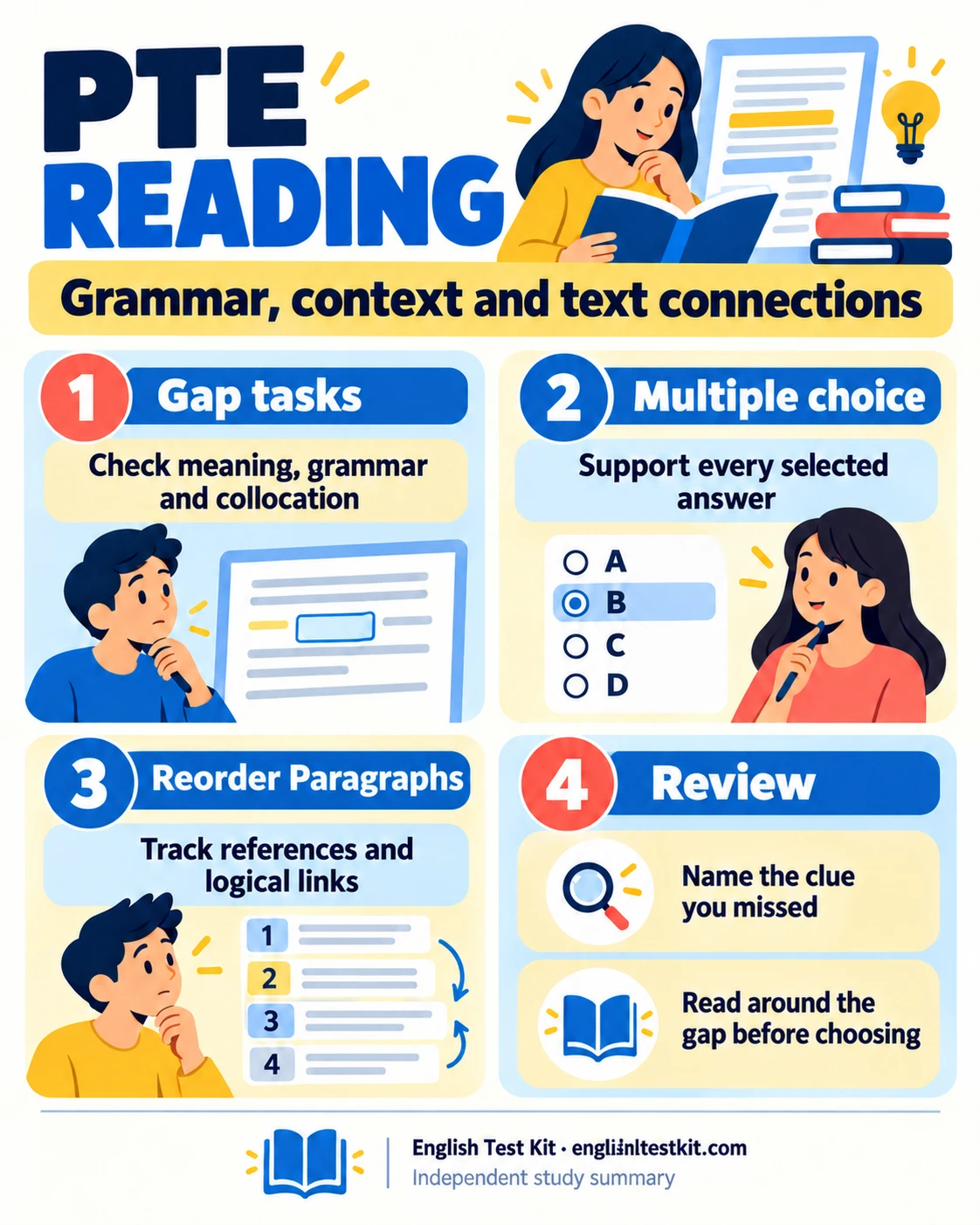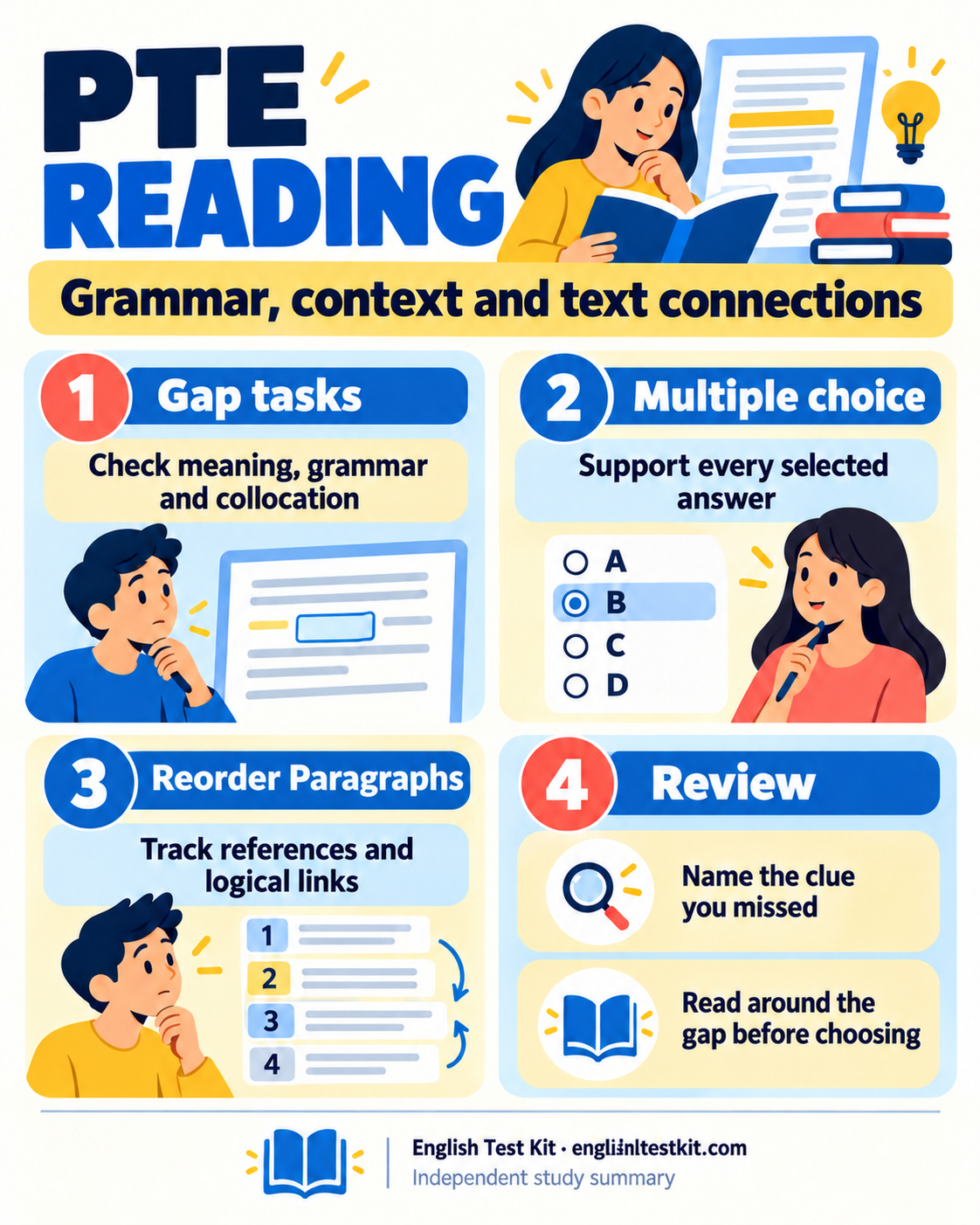
PTE Reading requires several different decisions: selecting a word, identifying supported meanings and reconstructing a text's order. A single shortcut will not work equally well for all five task types. Use the task instruction to choose a method, then explain the clue that makes the answer fit.
Five task types in about 23–30 minutes
Pearson lists five question types in the Reading part. Check the current task-specific Score Guide for the skills each task contributes to. The section timing can vary by test form.
Fill in the Blanks (Dropdown)
Multiple Choice, Multiple Answers
Reorder Paragraph
Fill in the Blanks (Drag and Drop)
Multiple Choice, Single Answer
Use context before choosing a word
For gap tasks, read a little before and after each blank. Check meaning, grammar, collocation, and the relationship between sentences. A word may look plausible by itself but fail to fit the sentence or passage.
Use the sentence grammar to predict the kind of word needed.
Look for repeated ideas and linking words across the passage.
For paragraph order, find references and transitions that connect one paragraph to another.
Treat multi-select questions carefully
Some Multiple Choice, Multiple Answers items use partial-credit scoring and can deduct points for incorrect selections. Do not select an option just because it repeats a word from the passage. Confirm that the meaning is supported before clicking.
The exact task instructions and scoring details can change. Use Pearson’s current task guide as the source of truth.
A focused practice loop
Practise one task type at a time, then review why an answer fits. Keep a small error log for vocabulary, grammar, reference words, and timing. After a few focused sessions, mix task types so you practise switching approaches under a clock.
Gap tasks: combine grammar with meaning
Consider this original sentence: “The researchers reached a ___ after comparing the results.” With options such as “conclusion”, “conclude” and “conclusive”, the position after “a” calls for an appropriate noun. “Reached a conclusion” also forms a natural expression and matches the meaning of the action. Both grammar and usage support the choice.
Now consider a gap where several options have the same grammatical form. You need the wider context and the relationship between ideas. A word related to the topic may still express the wrong attitude or result. Read before and after the blank, complete the sentence mentally and check that the paragraph remains coherent.
Reorder Paragraph: prove the connections
Here are three original practice sentences: A, “These findings encouraged the council to expand the trial.” B, “A town tested a new evening bus service.” C, “During the trial, more residents travelled to local jobs by bus.” The logical order is B, C, A. B introduces the service and trial, C reports an observation, and A refers back to those findings.
Do not rely only on spotting a possible opening sentence. Explain the links between the remaining pieces. Pronouns, repeated ideas, cause and effect, chronology and general-to-specific development can all help. A sentence beginning with “these findings” normally needs the findings to have been introduced; that reference is a stronger clue than a shared topic word alone.
Multiple-answer questions: support each selection
Imagine a short original notice saying a museum is open Tuesday to Sunday and offers free admission on Wednesday. “The museum is closed on Monday” and “Visitors can enter free on Wednesday” are supported. “The museum opens at eight” is not supported because no opening hour is given.
For a multiple-answer task, evaluate each option against the text instead of assuming that choosing more must be safer. Pearson's task directions explain when incorrect selections can reduce points. Use that rule as a reason to read carefully, not as a reason to leave supported answers unselected. Confirm the current scoring details in the task-specific guidance.
Manage attention across the section
Read enough to understand what the text is doing, then focus on the information needed for the question. Some gaps need a sentence-level decision; others depend on a paragraph connection. For reordering, hold the topic and the sentence relationships in mind. For selection, distinguish a fact the writer states from a plausible idea you have supplied yourself.
During timed practice, note tasks that consume disproportionate time and review why. Slow reading caused by unfamiliar vocabulary needs different work from repeatedly reconsidering an answer that already has clear evidence. Practise the weak process separately before testing it again under a clock.
Keep an explanation-based error log
Record the task family, the missed clue and a new example demonstrating the correction. A useful note might say “pronoun referred to the previous study, so this sentence could not open the paragraph”. For vocabulary, keep the surrounding phrase and meaning rather than a bare translation. For grammar, write a sentence using the pattern accurately. Then return to fresh material to check whether you can apply the same reasoning independently.
Save your one-page study summary