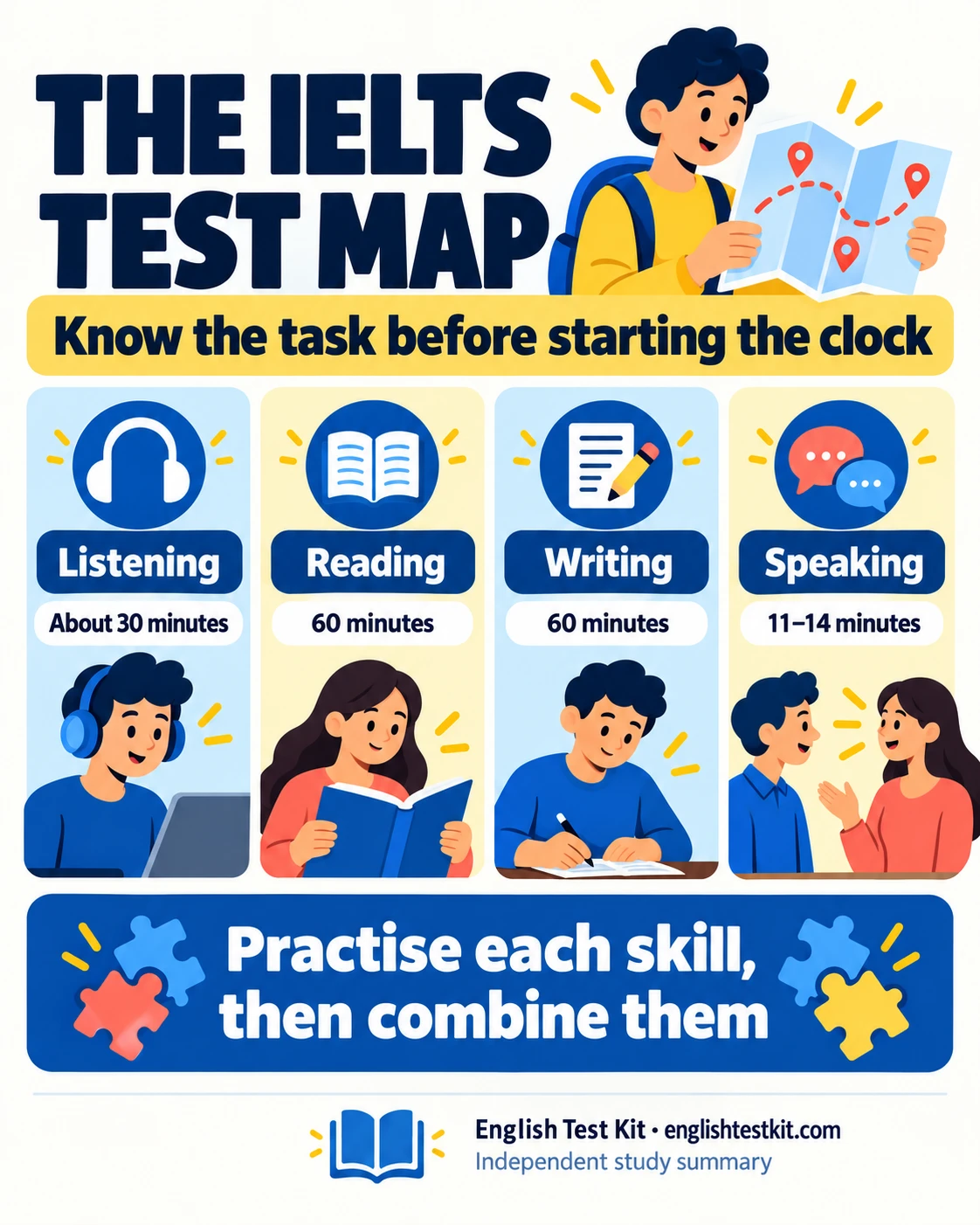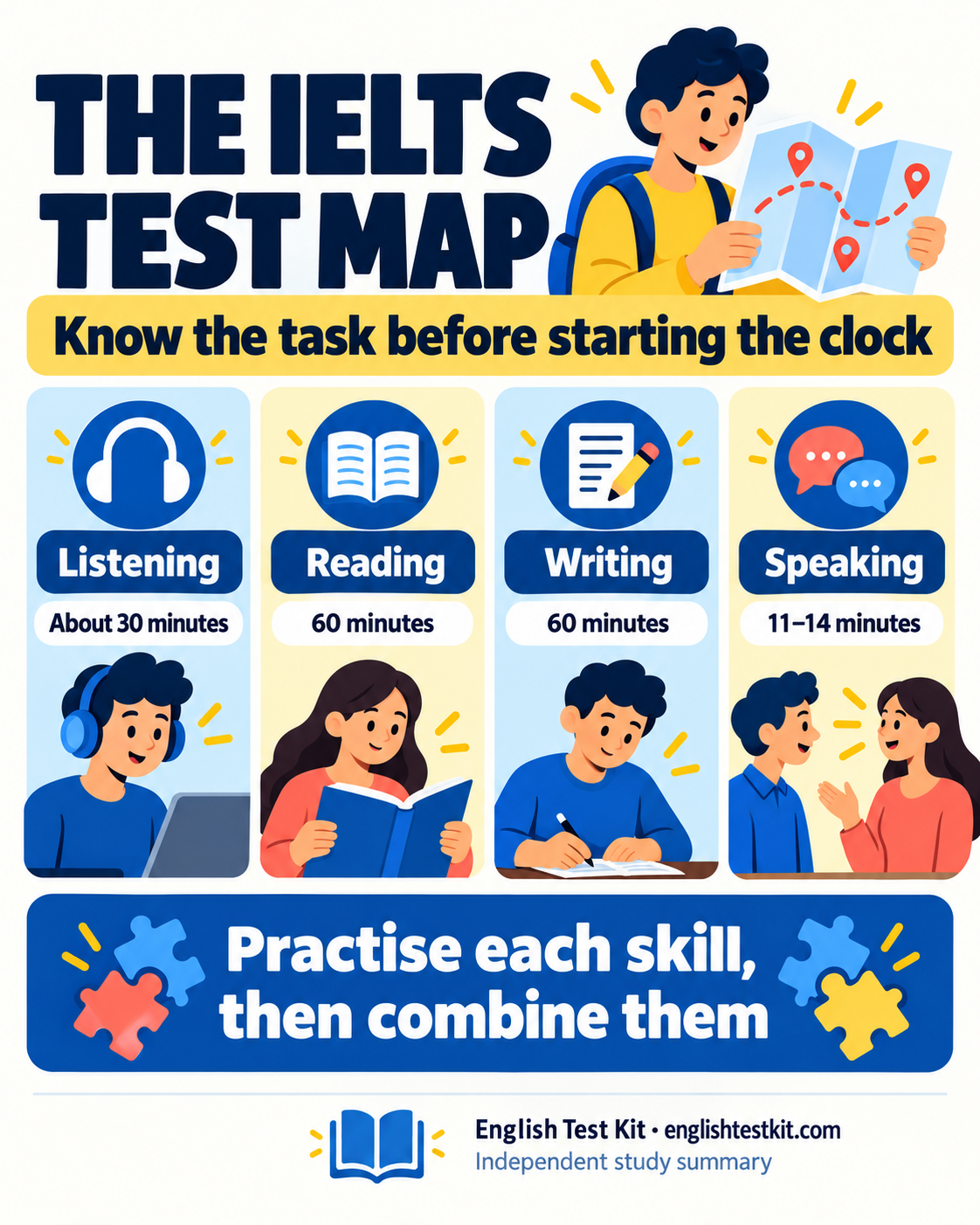
The IELTS format becomes useful when you connect each section with the work it requires. Listening asks you to stay with recorded information; Reading demands evidence and time control; Writing needs two purposeful responses; Speaking requires clear ideas in a live exchange. Learn the structure first, then rehearse the actions that can otherwise consume attention on test day.
The four sections
The main Academic and General Training tests assess four skills: Listening, Reading, Writing, and Speaking. The Academic test information lists a total test time of 2 hours and 45 minutes.
Listening: about 30 minutes
Reading: 60 minutes
Writing: 60 minutes
Speaking: 11–14 minutes
Two sections depend on your test choice
Listening and Speaking use the same test format in Academic and General Training. Reading and Writing are different, so it is important to select the version required by the organisation you are applying to.
Check the local test details
The test structure stays focused on the same four skills, but delivery options and scheduling details can vary. Read the instructions for your test centre or online test before booking.
Use the timing as a preparation tool
A section time tells you the available working window, not how long to spend equally on every item. In Reading, a difficult question may need a second look while an obvious detail may take little time. In Writing, the two tasks have different weight and length demands. Practise making these decisions deliberately rather than dividing minutes mechanically by question count.
Your appointment may include instructions, identity checks and arrangements outside the main working times. Speaking scheduling and delivery details depend on the booking. Keep the distinction between a test-format overview and your own confirmation: one describes the assessment, while the other tells you where and when to attend and which procedures apply.
A four-skill diagnostic you can actually review
Choose representative, current-format tasks for your version of IELTS. Complete a short Listening set once, answer Reading questions from a fresh passage, write a planned response and record a Speaking answer. For each skill, note what caused difficulty. Did you miss a word, misunderstand the question, lose time, or fail to develop an idea?
Imagine that a learner answers most Reading questions correctly when untimed, but leaves several unanswered during a timed attempt. That pattern suggests a pacing or search-method problem alongside any language gaps. By contrast, a learner who cannot explain why the answer is correct even without a timer needs closer work on meaning and evidence. These learners should not receive identical study plans.
Practise the transitions, not only isolated questions
After learning a task, rehearse moving to the next one without repeatedly reading familiar directions. Listening practice should include recovering after a missed answer. Reading practice should include moving on from a slow item. Writing practice should include switching from planning to drafting and checking. Speaking practice should include listening to the examiner's new question instead of continuing a prepared response.
These transitions are small, but they affect how much attention remains for the language. Use a short mixed session occasionally so you learn to reset your focus. Keep most early practice targeted enough that you can still identify the reason for an error.
Build a balanced sample week
One possible week includes a Listening session focused on corrections and completion limits, a Reading session focused on evidence, a Writing session focused on planning, and a Speaking session focused on developed answers. Add a mixed or timed session when you are ready, followed by review. The exact number of sessions should fit your starting point and available time.
Give weaker areas extra attention without removing stronger skills entirely. For example, if Writing needs the most work, keep shorter Listening and Reading maintenance activities while devoting longer sessions to a task plan, a paragraph, feedback and revision. A balanced plan is adjustable; it is not a promise that every learner needs the same timetable.
A final format checklist
Confirm Academic or General Training and practise the appropriate Reading and Writing tasks.
Know the four section names and the main response actions.
Read task-specific limits and required numbers of answers.
Rehearse entering, checking and moving between answers using suitable practice material.
Review the actual appointment instructions for timing, delivery, identification and Speaking arrangements.
The goal is to make the format familiar enough that your attention can stay on understanding and communicating English.
Save your one-page study summary