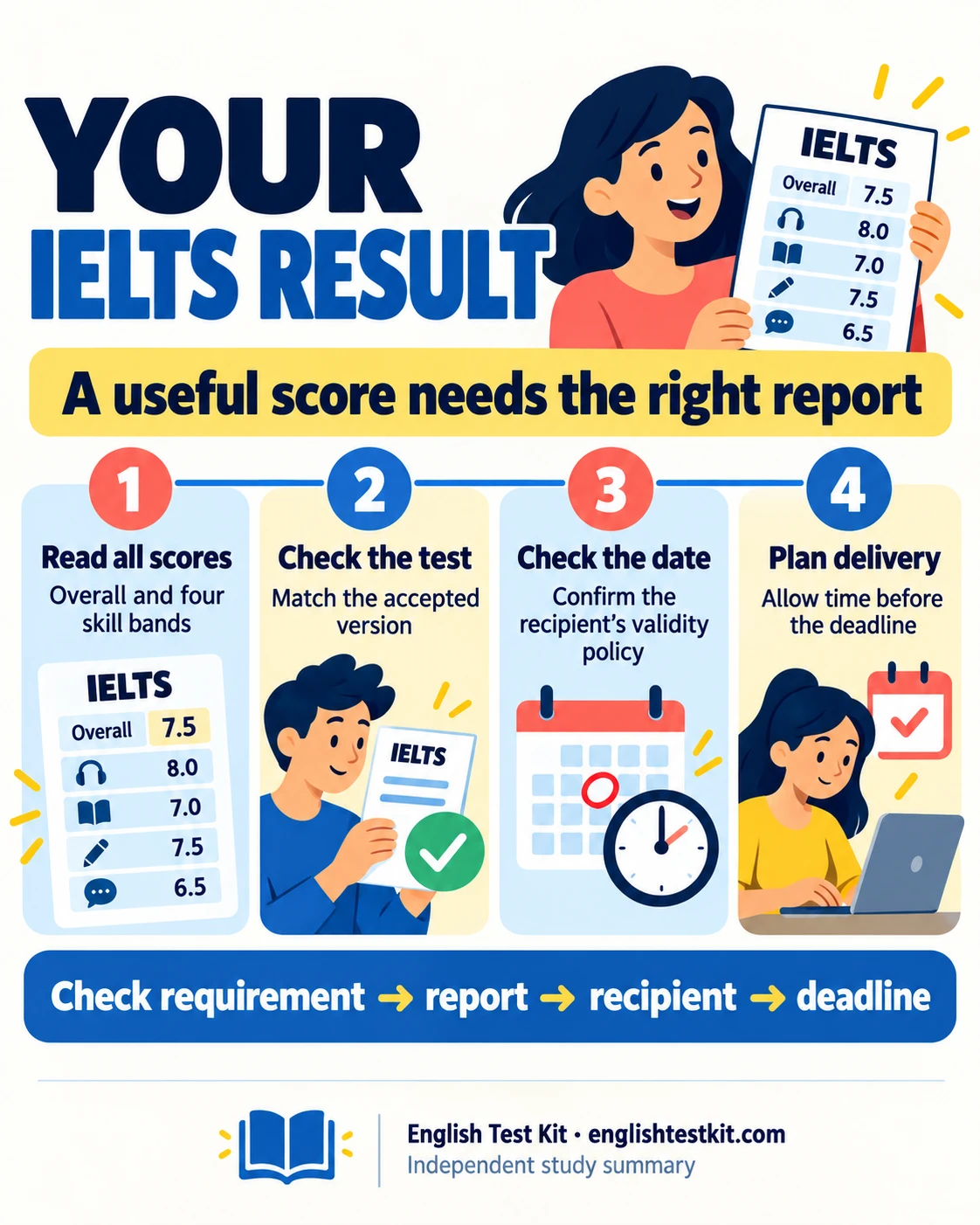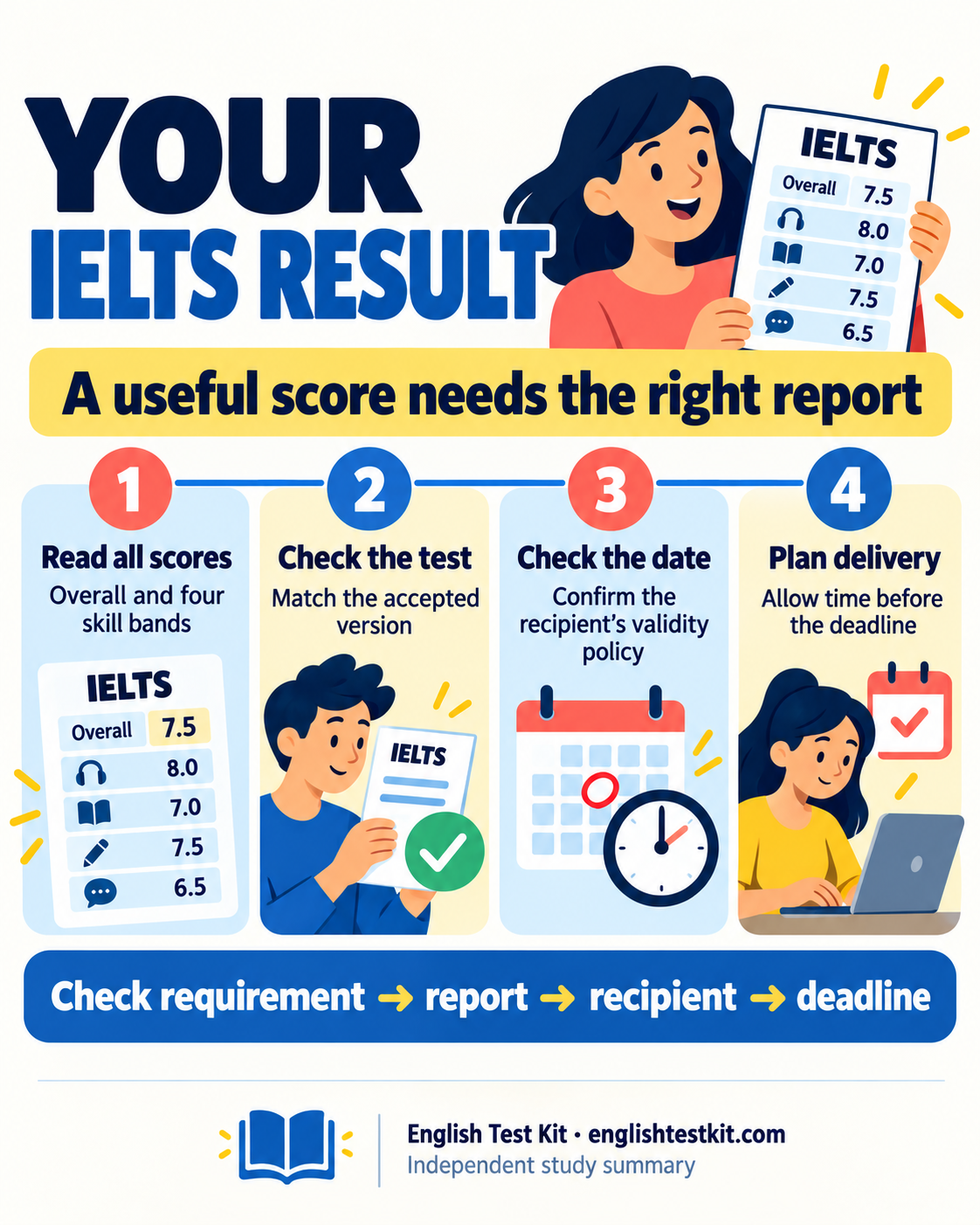
Receiving an IELTS result is one step in using it. You also need to check that the report matches the accepted test, satisfies every score condition and reaches the right recipient in time. A careful report-and-requirement comparison is more useful than deciding whether a number sounds generally impressive.
What you receive
Your IELTS Test Report Form shows an overall band score and separate Listening, Reading, Writing, and Speaking scores. There is no single universal pass mark: each organisation decides which score it accepts for a particular course, role, registration, or visa route.
Check the exact requirement before you apply
Look at the organisation's current instructions for the test type it accepts, the minimum overall score, any minimum section scores, and the deadline by which results must be available. A score that meets one requirement may not meet another.
How long results are considered valid
IELTS recommends that results be considered valid for two years after the test. An organisation may choose to accept results for longer, so confirm its policy directly rather than assuming the recommendation is an automatic expiry rule.
Read the report as a profile
Look at Listening, Reading, Writing and Speaking separately before considering the overall band. A strong average can sit beside a weaker skill. If the receiving organisation names a minimum for that skill, the overall result does not replace the condition. Keep the exact test version visible too: a result in one version should not be assumed acceptable where a different version is specified.
Use the official report as the record of your result. A remembered score, a screenshot of a practice activity or a third-party calculator is not a substitute. Check the personal details and test date, and follow the official process if something appears wrong rather than editing a copy yourself.
A worked application checklist
Suppose a fictional course requires IELTS Academic, overall 6.5, no skill below 6.0, and a result that meets its published date policy. A learner receives Listening 7.0, Reading 6.5, Writing 5.5 and Speaking 6.5. Even if the overall band reaches 6.5, the Writing condition still needs attention. This invented example shows why the checklist should include each requirement on its own line.
A second learner may meet the score thresholds but discover that the recipient needs the result by an earlier deadline than expected. The language achievement and the administrative outcome are different issues. Planning should therefore include both preparation and the steps needed to submit an accepted report.
Understand validity without guessing the recipient's rule
IELTS recommends a two-year period for considering results valid, while organisations may choose their own acceptance policies. Read the wording for your exact application: the important date could be tied to submission, enrolment or another specified stage. Do not assume that a general recommendation answers every date question.
If a policy is unclear, ask a precise question with the test date and application deadline. For example: “Will a result from this date meet the English-language requirement for this intake?” Keep the answer with the requirement page. Avoid relying on another applicant's experience when the course, year or receiving organisation differs.
Work backwards from the deadline
Start with the date by which the recipient must have an acceptable result. Check the current official result and reporting arrangements for your booked test, then allow additional time for the recipient's processing and any problem that needs resolving. Do not choose a last possible appointment solely from a general estimate found in an old guide.
If a retake might be necessary, include that possibility in your planning before the first attempt. This is a scheduling consideration, not a claim that another attempt guarantees improvement. Use feedback from the result to decide which skill needs focused work and whether the available preparation time is realistic.
What to do when the result misses a condition
Separate the size of the gap from its cause. A Writing score below the target could reflect task coverage, organisation or language control; a Reading gap could involve evidence, vocabulary or timing. Review representative work and choose an action that addresses the observed difficulty. Repeating a complete test without changing the weak habit may provide less learning than targeted practice and revision.
Before you submit
Match the report to the accepted test version and required score scale.
Check the overall band and every named skill minimum.
Confirm the result-date policy for the specific application.
Follow the recipient's official submission instructions and deadline.
Retain the report and relevant correspondence so you can resolve a query.
For decisions about acceptance, the receiving organisation's current rules remain the authority.
Save your one-page study summary