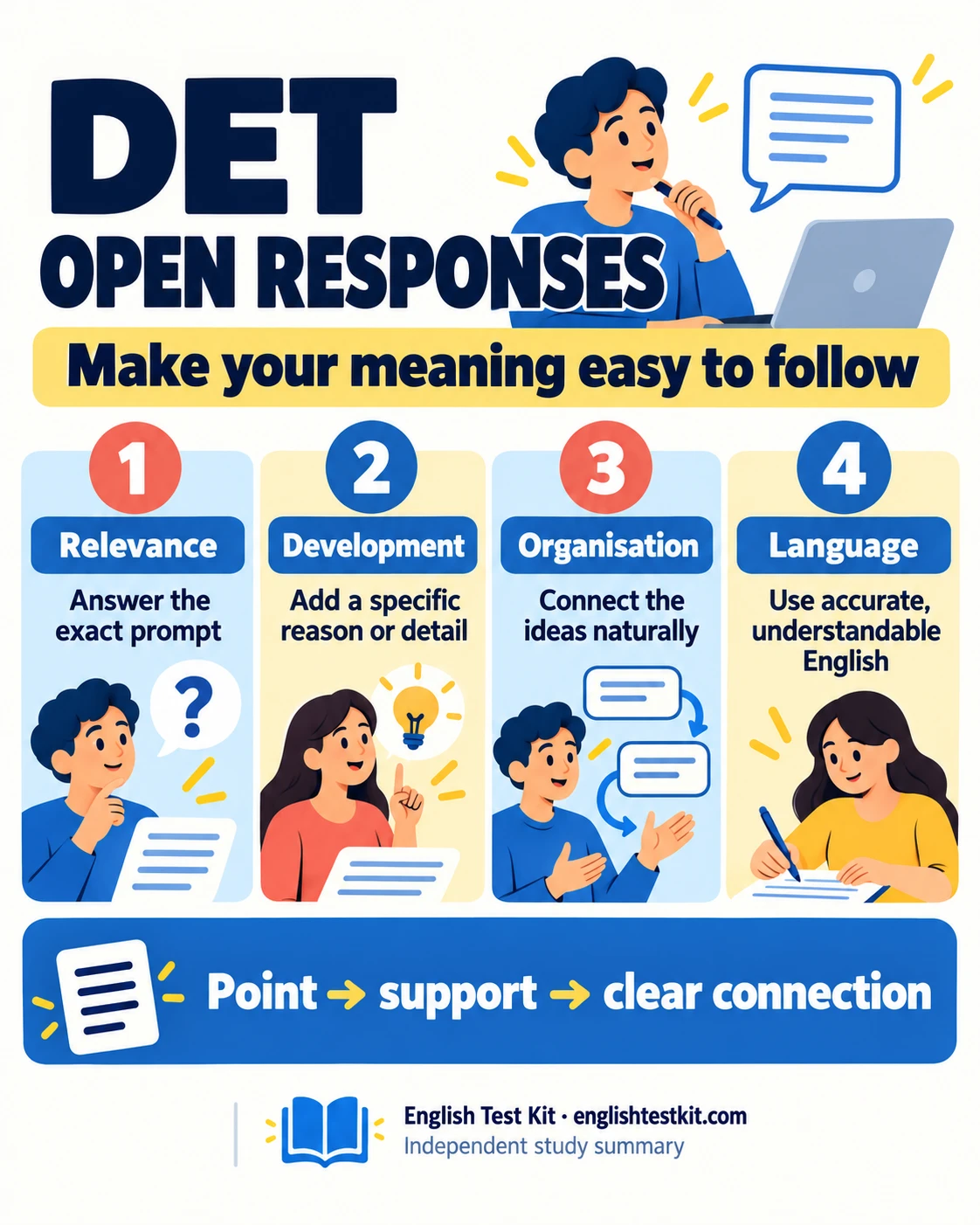
Duolingo speaking and writing tasks require a relevant, developed response to the prompt you receive. The best preparation improves how you communicate across different situations: describing a photo, explaining an opinion, extending an answer, or responding to another speaker. Learn a flexible planning method rather than a paragraph to repeat.
Communicate, do not recite
Open responses ask you to communicate an idea from a photo, a reading prompt, an interactive exchange, or a sample question. The scoring engine considers the substance and organisation of the response together with vocabulary, grammar, fluency, and pronunciation where relevant.
Response area | Current tasks |
|---|---|
Writing | Write About the Photo; Interactive Writing; Writing Sample |
Speaking | Speak About the Photo; Read, Then Speak; Interactive Speaking; Speaking Sample |
A three-part response check
Answer the prompt directly and include enough specific detail to make the idea clear.
Connect sentences with a simple structure: point, support, and a brief conclusion or consequence.
Leave a moment to check tense, agreement, word choice, and whether the recording captures your voice clearly.
Writing and speaking samples are shared with institutions and are assessed under the current task guidance. Treat them as real communication because an admissions reader may use them alongside your result.
Begin with the communication goal
Before responding, identify what the task asks you to do. Describing an image requires observable detail and useful relationships. Explaining a preference requires a choice and reasons. A follow-up question requires a response to the new information, even if you already discussed a related point.
Use a short mental plan: answer, support, and connection. For writing, that might become a clear first sentence, two developed details, and a final implication. For speaking, it might be a direct answer followed by a reason and an example. The structure should support the task rather than force every response into an essay.
Make a photo description more informative
Imagine an original practice photo showing two people repairing a bicycle outside a shop. “There are people and a bicycle. It is nice” uses words but communicates little. A more useful description is: “One person holds the bicycle upright while another adjusts the rear wheel outside a small shop. A toolbox lies beside them.”
The improvement comes from actions, positions and relationships, not rare vocabulary. Do not confidently invent the people’s jobs, location or motives. If an interpretation is useful, distinguish it from visible evidence: “They appear to be repairing the bicycle” is more cautious than claiming that a professional mechanic is completing a paid service.
Develop a reason instead of listing opinions
Consider the original practice question, “Would you rather study alone or with a group?” A list such as “Groups are useful, interesting and good” leaves the reasoning unexplained. A developed point might say: “I prefer a small group when preparing for a discussion because other students can challenge an explanation that sounds convincing only to me.”
Add a specific example, such as explaining a difficult concept to a classmate and discovering a missing step. Then connect that example to your preference. You do not need several unrelated reasons when one relevant reason can be explained clearly. Acknowledge a limitation if it helps answer the question, rather than adding a memorised counterargument.
Adapt the same idea to speech and writing
Written responses benefit from clear sentence boundaries, accurate spelling and readable paragraphing where appropriate. Spoken responses also require intelligible pronunciation, a manageable pace and complete thought groups. A sophisticated sentence loses value if you cannot finish it clearly within the task.
Practise expressing the same idea once in writing and once aloud, using fresh wording. Compare which details survive in both versions. This reveals whether the idea is understood or merely memorised. Follow the current task instructions and on-screen time; different response types should not share an invented universal length target.
Use two passes when reviewing your response
First review meaning: Did I answer the exact question? Did each detail support the answer? Did I contradict the photo, prompt or previous turn? Then review delivery and language: repeated wording, tense, agreement, unclear references, unfinished sentences and pronunciation that obscures meaning.
Select one recurring weakness for the next attempt. Replace a vague phrase with a concrete detail, or practise completing shorter sentences before increasing complexity. Current official guidance includes the speaking and writing samples among assessed responses and identifies their score contributions. Treat them with the same care as the other open responses, while remembering that institutions may also view the shared samples.
Save your one-page study summary