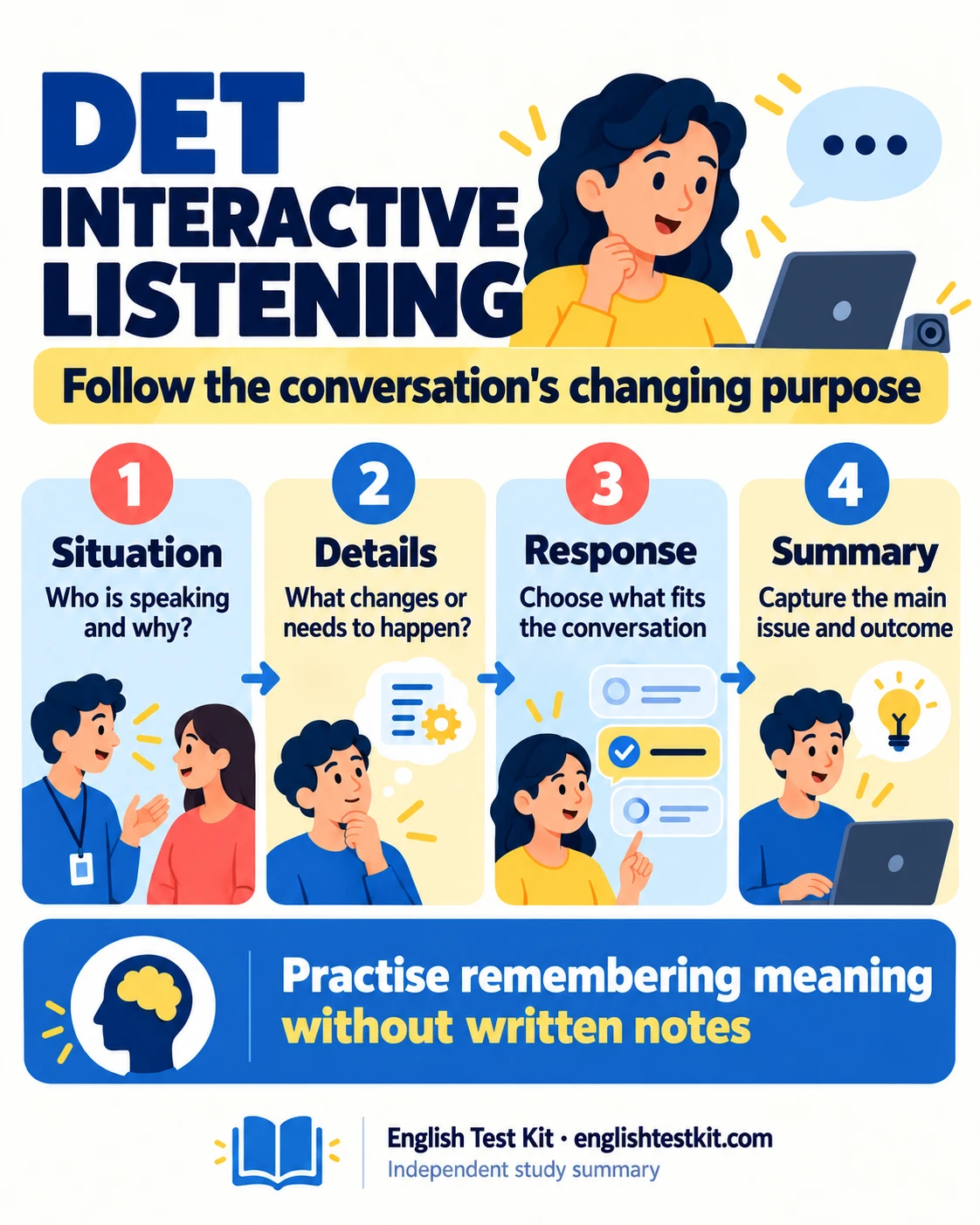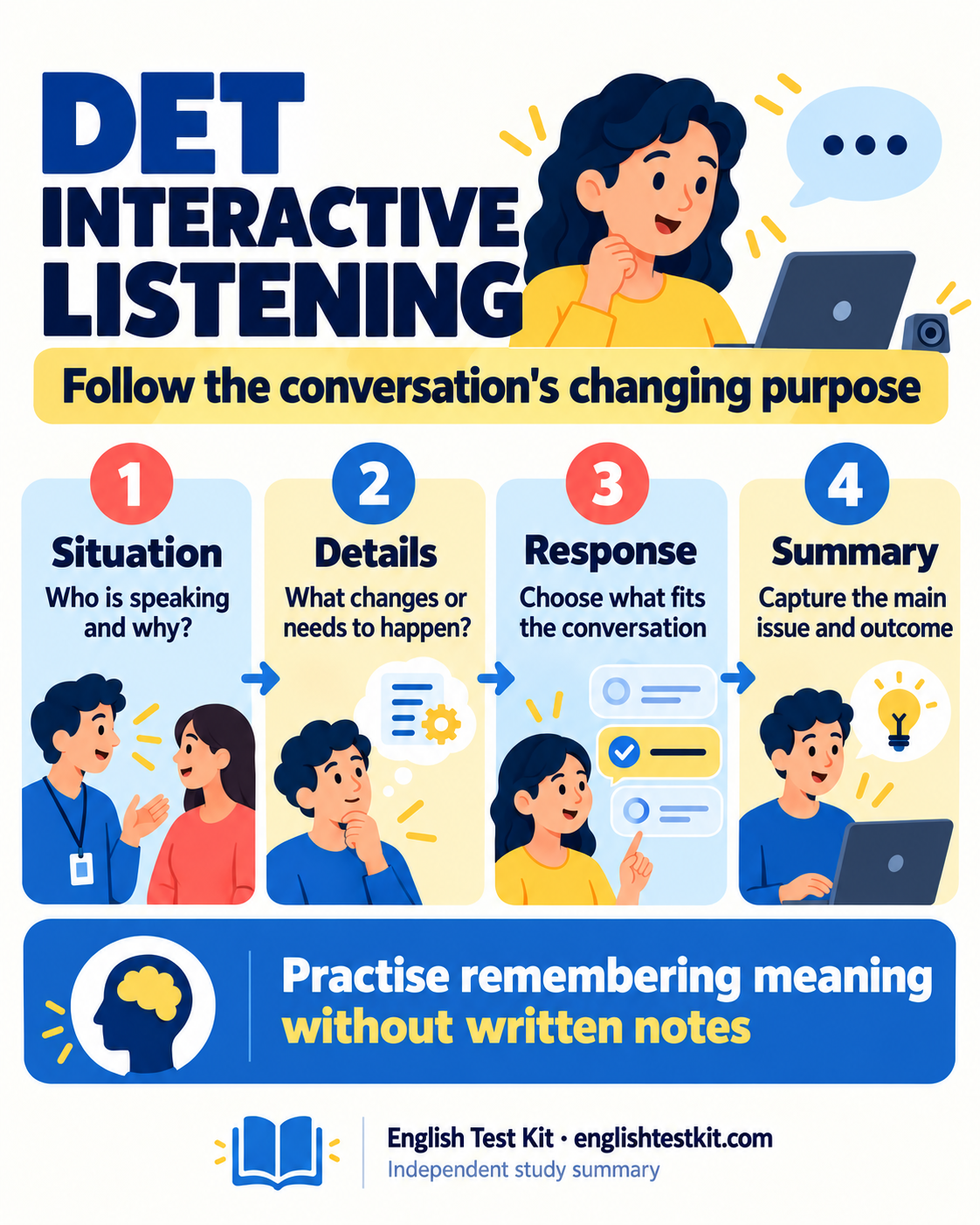
Duolingo Interactive Listening checks whether you can follow a conversation as it develops. Preparation should connect listening, choosing an appropriate response, and remembering the main outcome. A useful summary explains the situation and decision accurately; it does not reproduce every sentence or add a solution the speakers never discussed.
Listen for relationships and purpose
Interactive Listening uses a conversation or spoken situation and several linked prompts. You may need to follow the speaker’s goal, remember details, and use the conversation as evidence for a later response.
The set has connected steps
Listen and identify information needed for the next prompt.
Respond to a comprehension question or complete a detail from the audio.
Summarise the conversation in your own words when the set asks you to show the bigger picture.
Build listening control
Listen for who is speaking, why they are speaking, and what changes during the exchange.
Keep the key points in memory; the official rules do not allow notes during the certified test.
After a practice recording, give a short spoken or written summary without adding information that was not said.
Good listening is active: predict the speaker’s next point, check it against the audio, and keep the conversation’s purpose in view.
Follow the purpose before collecting details
Listen for four anchors: who is involved, what someone wants, what difficulty appears, and what happens next. These anchors give details a place in the conversation. A room number matters when the problem is finding a class; it may be secondary when the main issue is choosing a research topic.
Pay attention when a speaker corrects an earlier suggestion. Words such as “actually”, “instead” and “unfortunately” can change the plan. Remembering only the first proposal can lead to an answer that sounds plausible but contradicts the outcome. Keep the current version of the plan in mind as the exchange moves forward.
Work through an original conversation example
Here is a short teaching transcript, not an official test item or a playable listening exercise: a student wants to borrow a recorder for a field project on Friday. The equipment officer says the recorders are booked that morning, but one becomes available after lunch. The student agrees to collect it at two and return it on Monday.
The purpose is borrowing equipment, the obstacle is Friday-morning availability, and the outcome is an afternoon collection with a Monday return. “The student cannot borrow a recorder” would be wrong because it ignores the later agreement. “The officer will deliver the recorder” adds an action that the transcript does not support.
For listening practice, use an actual recording first. Read a transcript afterwards to diagnose what you missed; reading this example alone does not test your ability to understand speech.
Choose a response that fits the previous turn
A response should make sense in the immediate exchange and the wider situation. If the officer asks when the student needs the recorder, a relevant answer gives the required time. A grammatically correct sentence about the project topic may fail to answer that question.
Before selecting, identify whether the speaker is asking for information, offering an alternative, checking understanding, or closing the conversation. Then check the options against that function. Avoid choosing an option just because it repeats a word from the audio. Repeated vocabulary does not guarantee that the intention or timeline matches.
Turn the conversation into a concise summary
A useful practice summary of the example is: “The student asked to borrow a recorder for a Friday field project. Because the equipment was unavailable in the morning, they arranged a two o’clock collection and a Monday return.” It captures the problem and solution without inventing feelings or unnecessary background.
Build the summary from memory and use your own connected sentences. Check the people, purpose, key change and final arrangement. Follow the actual task’s time and response instructions; this teaching example does not establish an official word target.
Review comprehension and language separately
After practice, compare your summary with the recording or transcript. First mark factual omissions, reversals and unsupported details. Then review tense, reference words and sentence connections. A polished sentence cannot repair an incorrect account of the conversation.
Keep a practice error log after the exercise: for example, “I remembered the first time offered and missed the correction.” Use that finding to guide the next recording. Develop the memory routine without taking notes during certified-test practice, because the certified DET does not permit notes.
Save your one-page study summary