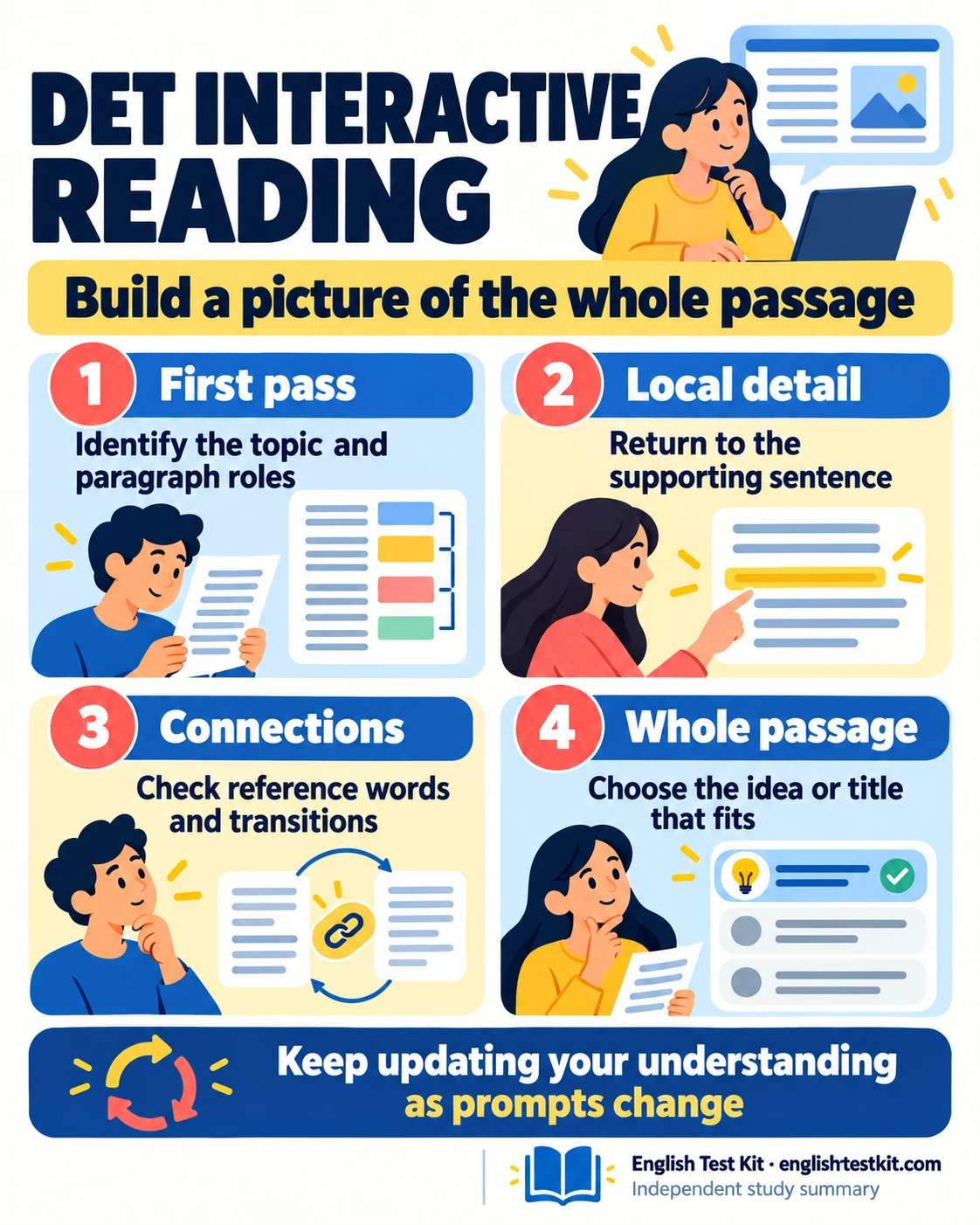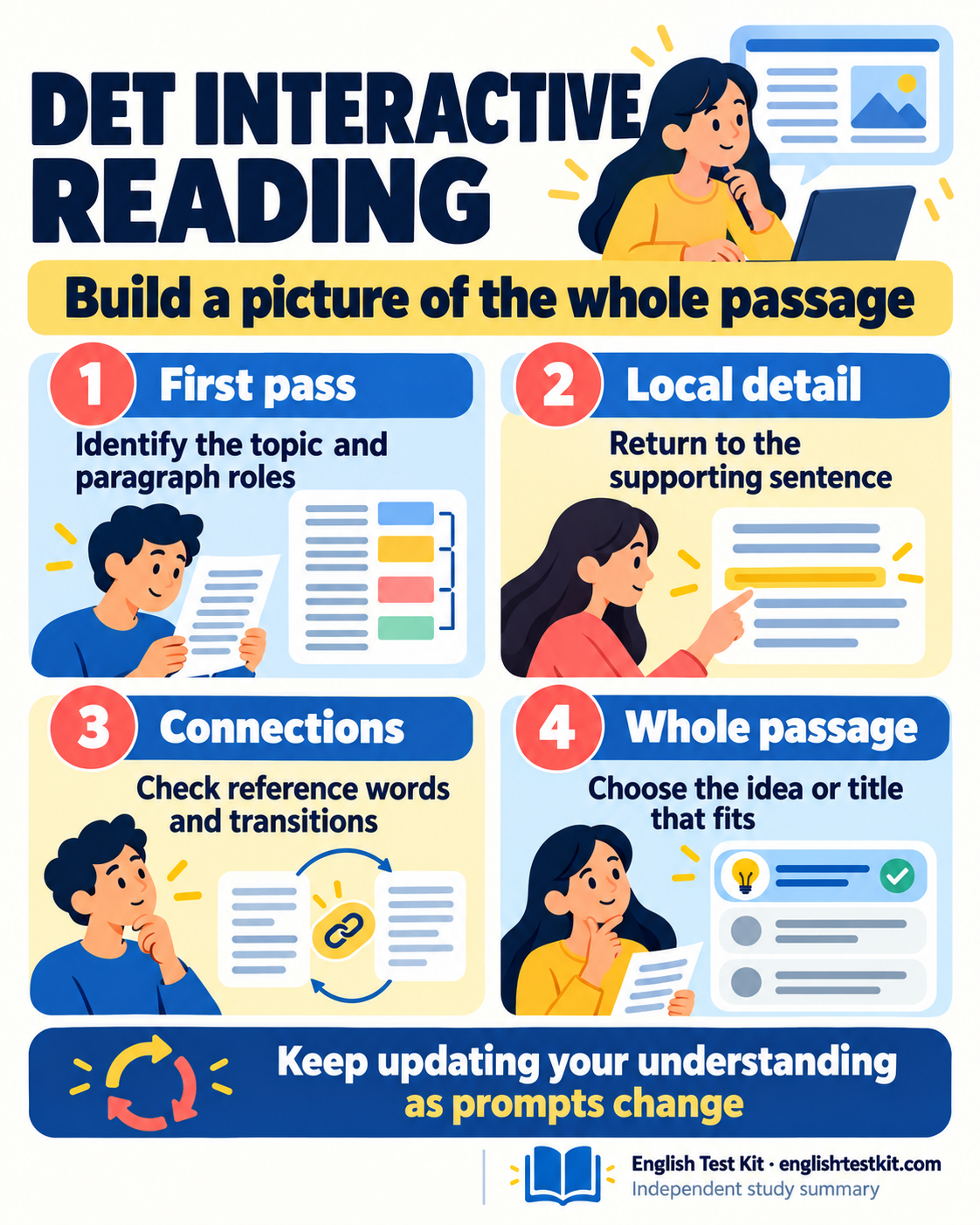
Interactive Reading requires you to maintain an understanding of a passage while the response task changes. A word gap needs local grammar and meaning, a selected text span needs precise evidence, and a title or main-idea choice needs the whole passage. Build a situation model that you update rather than treating each prompt as an unrelated puzzle.
Read for the whole passage
Interactive Reading presents a passage with a set of connected prompts. The task is more than finding one matching word: you need to keep the passage structure and key details in mind as the questions change.
What can appear
Complete Sentences and Complete the Passage: use the surrounding meaning and passage structure.
Highlight the Answer: select the passage text that answers the question.
Identify the Idea and Title the Passage: choose the central idea and an appropriate title.
A calm reading routine
Scan the passage for its topic, purpose, and paragraph roles before answering.
Return to the exact sentence or paragraph that supports each answer.
Keep an eye on the next prompt, but do not trade evidence for a quick guess.
Interactive Reading is one part of the wider adaptive test. Build stamina with unfamiliar topics and practise explaining why an answer fits the passage.
Start with the passage's shape
Identify the topic, purpose and main role of each paragraph. Is the writer introducing a problem, explaining a change, reporting a finding or qualifying a claim? You do not need to memorise every word. You need enough structure to locate evidence and understand how a new prompt connects with the text.
When a missing sentence is involved, read on both sides. A sentence about the same topic may still connect poorly if a pronoun has no clear reference or a conclusion appears before the reason supporting it. Use cohesion as well as topic vocabulary.
Work through an original miniature passage
Consider this teaching text: “A college library trialled later opening hours during the examination period. Evening attendance increased, but staffing costs also rose. The college will review both figures before deciding whether to continue the arrangement.” This is a short original demonstration, not a complete official interactive set.
If a completion asks why the arrangement began, the examination period supplies relevant context. If a question asks whether the decision is final, the passage shows that review comes first. An answer stating that permanent late opening has already been approved would overstate the evidence.
Select the evidence the question actually needs
For a practice question asking what happens before a final decision, the supporting information is the review of attendance and costs. Selecting only a phrase about increased attendance would omit part of that decision process. Match the required span or response to the complete question, not merely the most memorable detail.
Keep a distinction between what the passage says, what it implies and what it does not establish. Outside experience of libraries or colleges should not supply an answer absent from this text. Plausible background knowledge is not the same as passage evidence.
Choose an idea or title with the right scope
For the miniature passage, a title about evaluating a library-hours trial fits the whole message. “Why every library should open all night” adds a universal recommendation and a time claim not provided. “Staffing costs in one college” focuses on one detail while losing the trial and decision.
During review, explain why the best title covers the central relationship and why a distractor is too broad, too narrow or inaccurate. This habit is useful even when the exact response interface differs across task steps.
Practise a reviewable sequence
Attempt suitable connected reading material independently, then check each decision against the supporting sentence or passage structure. Classify errors as vocabulary, grammar, cohesion, missed evidence or scope. Try fresh material after learning a correction so the next success demonstrates a transferable method rather than a remembered answer. Follow the current official directions for each Interactive Reading activity and its response conditions.
Save your one-page study summary