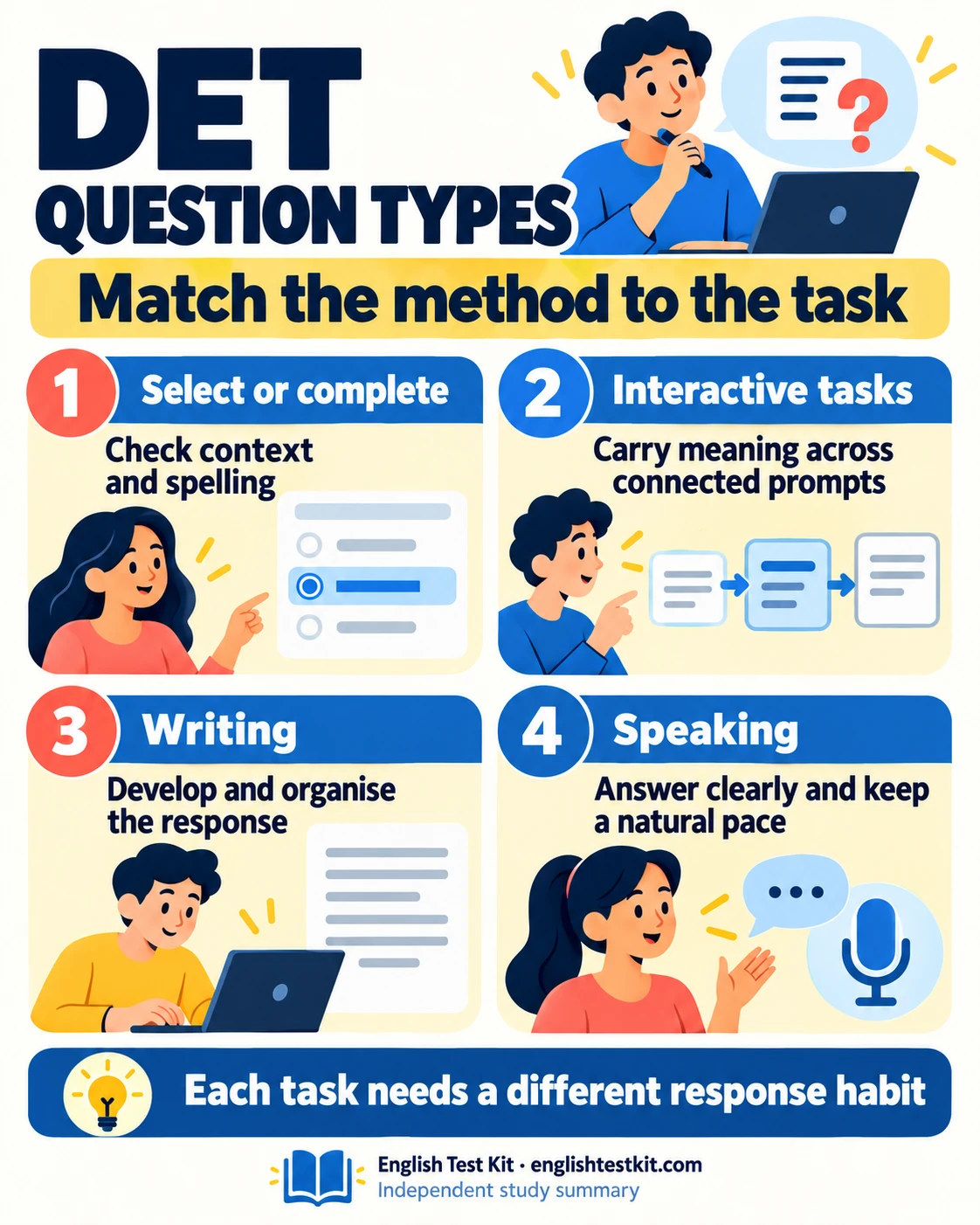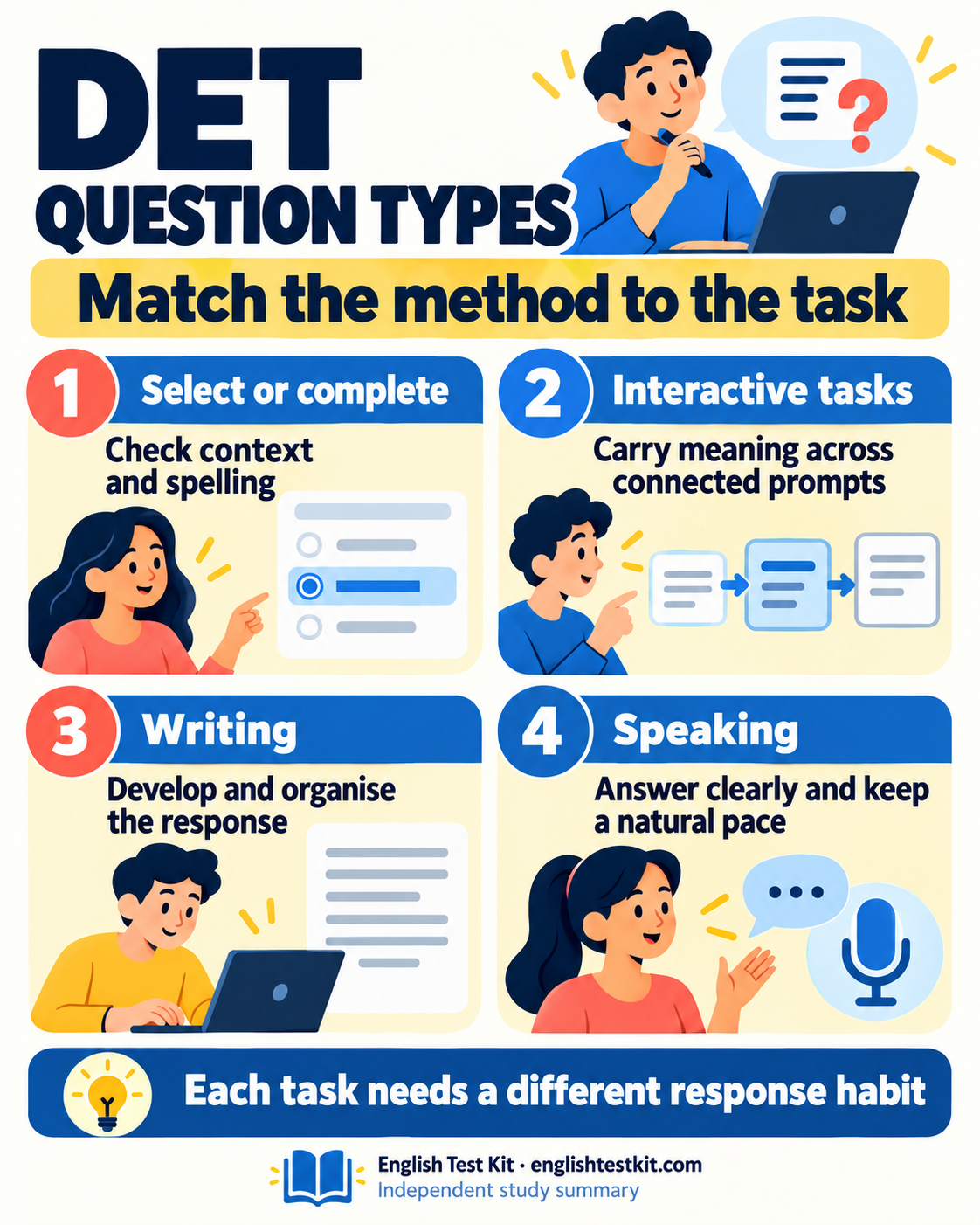
DET question names become useful when you connect them with a response habit. Selecting a word, completing a passage, typing speech and developing an opinion do not all need the same method. Group the tasks by the language work they require, then practise each family before combining them.
Two kinds of work
DET tasks broadly fall into questions with a correct answer and open responses that ask you to communicate an idea. Correct-answer tasks can award partial credit where the scoring rules allow it. Open responses are evaluated for qualities such as content, coherence, vocabulary, grammar, fluency, and pronunciation.
Task family | Examples | Useful practice |
|---|---|---|
Read or listen for an answer | Read and Select; Fill in the Blanks; Read and Complete; Listen and Type | Notice spelling, word boundaries, sentence meaning, and detail in audio. |
Interactive comprehension | Interactive Reading; Interactive Listening | Read or listen across linked prompts and carry information forward. |
Open writing | Write About the Photo; Interactive Writing; Writing Sample | Describe, explain, organise, and edit ideas within the response time. |
Open speaking | Speak About the Photo; Read, Then Speak; Interactive Speaking; Speaking Sample | Plan quickly, speak clearly, and keep the response connected to the prompt. |
Check the current format
Duolingo updates the question catalogue when it changes the test. Interactive Speaking was introduced in 2025 and replaced Listen Then Speak, while Read Aloud was removed. Use the official Test Center pages when you build a new study plan.
Practise the response action, not just the task name: select, complete, type, describe, summarise, write, or speak.
Correct-answer work: use context and accuracy
Consider this original completion example: “The library will remain open ___ the evening workshop finishes.” With suitable choices, “until” expresses the intended time relationship. A word that is generally connected with time may still fail the grammar or meaning. Read the surrounding sentence and verify the completed message.
For recognition or typing tasks, check the exact response rather than relying on a broad impression. Spelling and grammatical endings can matter when the task requires reproducing language. Use official task directions to understand the response format and current scoring rules; do not assume every question uses identical marking.
Connected comprehension: maintain a situation model
Interactive Reading and Listening contain related prompts. Keep track of the passage topic, paragraph function, participants, problem or outcome as appropriate. A later question may depend on understanding the same material from a different angle, so discarding the meaning after one answer can make the next step harder.
In an original campus-conversation demonstration, a student may ask to change a booking, learn that the first alternative is full and then choose another session. A summary should preserve the final arrangement, while a detail question may ask about the unavailable option. Those are different facts within the same situation.
Open responses: communicate a developed idea
For an original practice prompt about a useful class activity, “Group work is good” gives little explanation. A developed response could identify the activity, explain how discussing different solutions helps learning and provide a specific example. The improvement comes from a clearer, more relevant message rather than simply adding adjectives.
For photo tasks, begin with observable details before adding cautious interpretation. For interactive speaking, respond to the question in the current turn instead of delivering an answer prepared for an earlier one. For writing, leave room to check coherence, grammar and spelling within the task's conditions.
A practical task-family notebook
Create a short record for each family: input, response action, main constraint and one recurring error. A typing entry might focus on missing endings; a passage entry on unsupported inference; an open response on repeating the main point without development. Add a correction and test it on fresh material.
This is more useful than a list of task names with no observed behaviour beside them. It also makes format updates easier to handle: when an activity changes, you can learn the new action and reuse relevant underlying language skills without assuming the old task remains in the test.
Check that your materials are current
Use the provider's current task catalogue and scoring guidance. Earlier resources may describe removed activities or outdated frequencies. They can still support general English where appropriate, but they should not be presented as a complete current-format rehearsal. Keep independent practice feedback separate from a certified score and treat the shared writing and speaking samples as purposeful assessed responses.
Save your one-page study summary