

A C1 Advanced result should be read as a profile of language performance and a qualification-specific reporting outcome. The overall score is useful, but component information can reveal a weakness that matters to a recipient or to your next stage of learning. Keep the named qualification, scale and reported level together.
The score bands
The qualification is targeted at CEFR C1, but Cambridge results can report achievement at a neighbouring level as well.
C1 Advanced Cambridge English Scale reporting bands
Scale score | Grade or outcome | CEFR level |
|---|---|---|
200–210 | A | C2 |
193–199 | B | C1 |
180–192 | C | C1 |
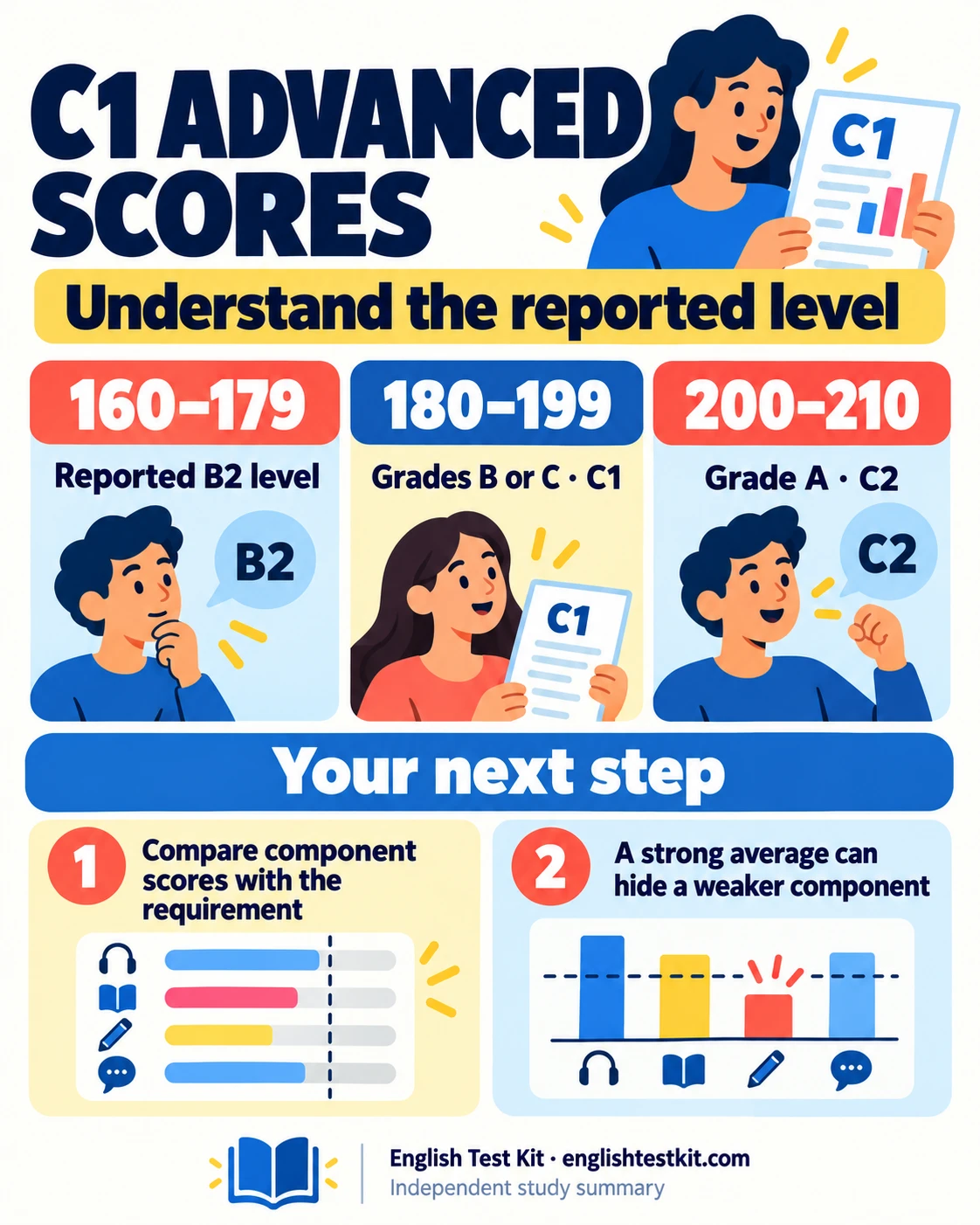
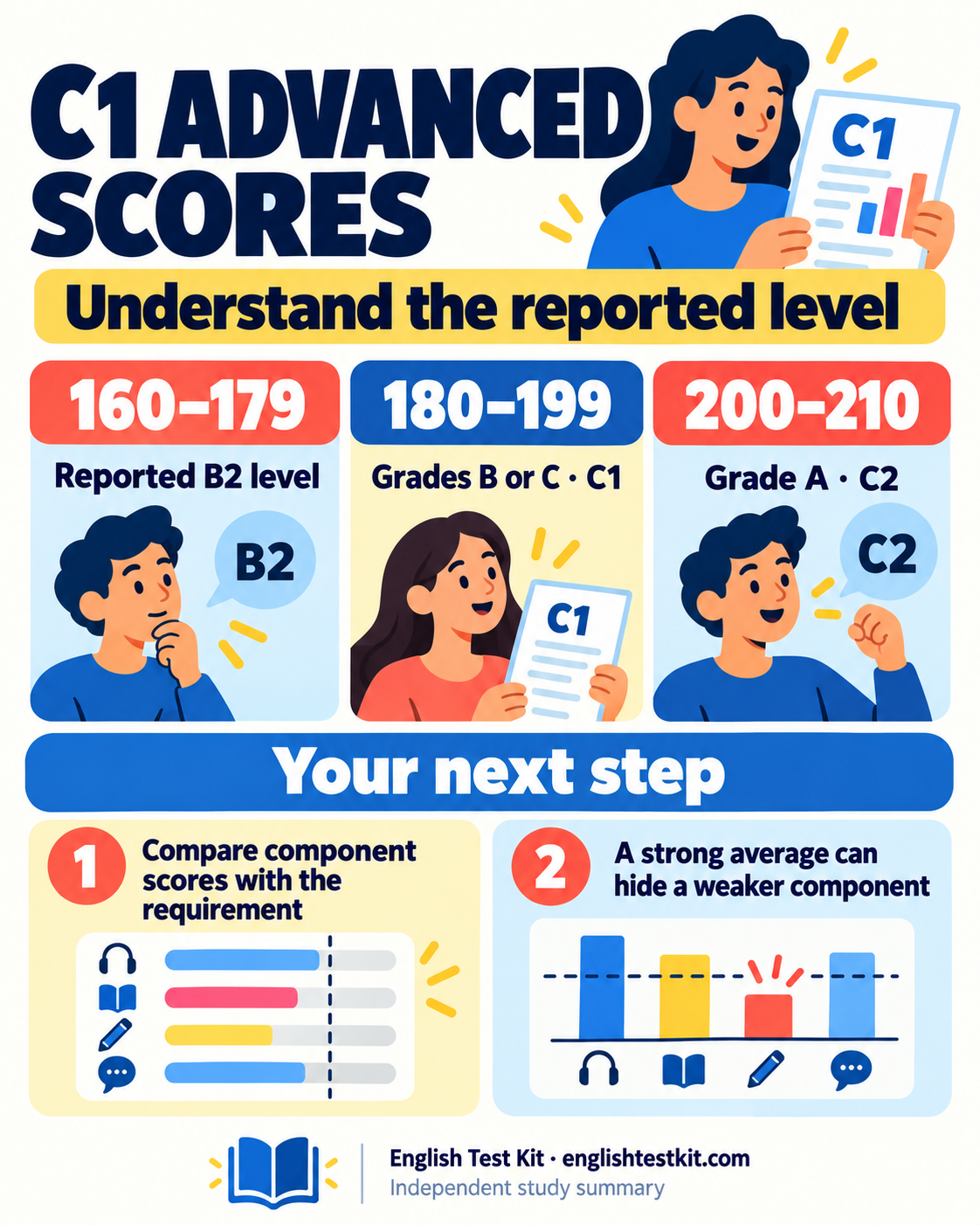
160–179 | Level reported | B2 |
142–159 | Score reported; no certificate | — |
What the result shows
The Statement of Results gives an overall Cambridge English Scale score and component information. For B2 First, C1 Advanced and C2 Proficiency, Reading, Use of English, Writing, Listening and Speaking scores contribute equally to the overall score.
Use individual component scores to understand your profile. An institution may set a minimum overall score, a minimum for one skill, or both.
A score band's Cambridge reporting outcome does not guarantee acceptance by a university, employer or other organisation. Check its current requirement.
Interpret the level, not just the letter
C1 Advanced targets C1, while Grade A reports achievement at C2. Scores in the lower certificate band can report B2; compare the reported level and individual scores with your requirement.
Scores below the certificate bands can still appear on a Statement of Results. The Cambridge results page identifies which lower scores are reported without a certificate.
Compare a fictional profile with a requirement
Suppose illustrative component scores are Reading 196, Use of English 191, Writing 183, Listening 189 and Speaking 191. Their average is 190. If a fictional recipient asks for overall 185 and Writing 185, the overall figure would satisfy one condition while Writing would fall short of the other.
The example demonstrates a comparison, not a real institution's rule or a prediction from raw practice marks. Record the accepted qualification and every named minimum from the actual recipient. An overall C1 outcome does not automatically replace an individual-score condition.
Interpret C1 and neighbouring-level outcomes
The qualification targets C1, while its published reporting bands can indicate achievement at C2 or B2 in the relevant ranges. Read the provider's outcome for the actual score rather than assuming that entering a C1 exam guarantees a C1 certificate. Equally, do not treat a high outcome from another qualification as automatically interchangeable with a requirement for this named exam.
Use the official Statement of Results and current reporting guidance. If a recipient's wording is unclear about the qualification, level or component score, ask with the exact report details. A general score chart cannot decide the recipient's policy.
Make a lower component score actionable
For Writing, compare actual responses with the task and published assessment criteria. A response may contain accurate language but fail to evaluate the supplied ideas or adapt the text to its audience. A useful correction might be to explain why one proposal is more suitable for the reader rather than adding another descriptive paragraph.
For Reading or Listening, inspect whether an error comes from missing qualification, confusing viewpoints or overlooking an implication. For Use of English, separate collocation, form and transformation meaning. For Speaking, assess development and interaction alongside language. The component number narrows the investigation, while the response evidence identifies the practice target.
Use practice conversion carefully
A raw mark from an unrelated small set is not automatically a Cambridge English Scale score. Follow the conversion guidance supplied for suitable official practice material and keep estimates separate from certified results. For productive work, use informed feedback where possible instead of assigning a precise grade from a short excerpt.
Track whether a correction improves fresh tasks over several sessions. An accurate explanation of why a distractor is wrong, or a clearer reader-focused recommendation, gives more diagnostic information than a remembered answer on a familiar paper.
Check the submission conditions
Confirm the accepted qualification, overall and component requirements, result-date policy and reporting instructions. Keep the official report and any recipient clarification. The aim is to use the score accurately for the decision you need while making the next study step specific enough to practise.
Save your one-page study summary
Continue with related guides
Sources and further information
This guide is an independent explanation. Cambridge English publishes the exam rules and is the final source for current instructions.