This surprising mammal fossil is giving scientists something to chew on
 By Emma Carter
Image information
This is a representative image for this Daily News lesson.
Intro
A small fossil from China is helping scientists trace the deep evolutionary history of mammalian behavior and anatomy.
Vocabulary
| Word | Part of speech | Meaning | Example |
|---|---|---|---|
| exceedingly adverb | adverb | Meaning: To an exceptionally high degree; extremely. | Example: The evidence is exceedingly persuasive despite the specimen’s fragmentary condition. |
| infer verb | verb | Meaning: To reach a reasoned conclusion from available evidence rather than direct observation. | Example: From the wear patterns, researchers inferred that the tool had been used repeatedly. |
| innovations noun | noun | Meaning: New methods, ideas, or features that represent significant advances. | Example: The laboratory’s methodological innovations transformed the study of ancient proteins. |
| intriguing adjective | adjective | Meaning: Stimulating curiosity because it is unusual, complex, or not fully explained. | Example: The archive contains an intriguing contradiction between official records and private correspondence. |
| spectroscopy noun | noun | Meaning: The analysis of materials by examining how they interact with electromagnetic radiation. | Example: The conservators used spectroscopy to identify traces of an earlier pigment. |
| distinguish verb | verb | Meaning: To recognize or demonstrate the difference between entities that might otherwise be confused. | Example: The revised criteria distinguish correlation from causation more rigorously. |
| anatomy noun | noun | Meaning: The physical structure of an organism or the study of that structure. | Example: The report links the creature’s unusual anatomy to its specialized habitat. |
| preservation noun | noun | Meaning: The process or condition of being kept intact, especially over an extended period. | Example: The preservation of the manuscript’s marginal notes proved unexpectedly informative. |
The story
A fossil roughly the size of a Chihuahua is offering scientists an unusually detailed glimpse of mammalian life during the middle Jurassic, about 165 million years ago. The animal, named Megacauda sungei, was preserved in a thick slab of shale discovered in the Inner Mongolia region of China, an area renowned for producing exceptional fossils.
The specimen attracted attention because both its bones and impressions of soft tissue survived. Early fossil mammals are exceedingly rare, and this degree of preservation allowed researchers to infer aspects of the animal’s behavior as well as its structure. Their analysis suggests that Megacauda could chew food, swallow it, and suckle its young—three traits associated with mammals.
Those findings push evidence for these evolutionary innovations deep into the past, at least to the middle Jurassic. Rather than revealing an animal that neatly resembles a modern species, however, the fossil presents an intriguing mixture of characteristics. Its pelvis, hind limbs, and tail resemble those of a modern platypus, while its sharp teeth suggest that it was a predator.
Researchers first noticed the specimen about a decade ago at the Paleontological Museum of Liaoning, where many fossils from the region are kept. Zhe-Xi Luo, a paleontologist at the University of Chicago, and Thomas Martin of the University of Bonn regularly visit the museum to examine new discoveries. The team has described the fossil in the journal Nature.
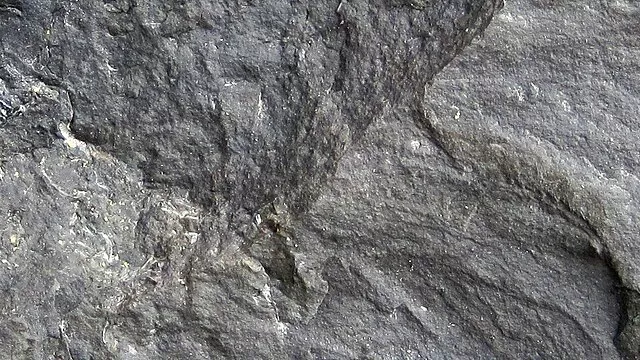
The fossil’s appearance initially made it difficult to study. Its bones are very dark, as is the surrounding rock, so ordinary photographs cannot easily distinguish the skeleton from the shale. Chang-Fu Zhou of Shandong University of Science and Technology addressed that problem with X-ray fluorescence spectroscopy, a technique that can highlight the chemical differences between materials.
The resulting image made the skeleton appear bright yellow and brought its unusual anatomy into sharper view. In that sense, the specimen is valuable for two reasons: its preservation records a combination of mammalian traits, while modern imaging methods make those traits visible. Together, the fossil and the analysis suggest that important features of mammalian biology were already present among ancient relatives long before mammals became familiar in their modern forms.
Warm-up questions
- What kinds of fossil evidence might reveal an extinct animal’s behavior rather than merely its anatomy?
- How might modern imaging technologies alter interpretations of objects that appear visually indistinct?
Comprehension questions
- Why was the Megacauda specimen unusually informative to researchers?
- Which three mammalian behaviors does the analysis attribute to Megacauda?
- How does the fossil complicate any straightforward comparison with modern mammals?
- What problem prevented ordinary photographs from clearly showing the skeleton?
- Why is the specimen valuable in two distinct respects?
Opinion questions
- Does the fossil’s hybrid anatomy make it more scientifically valuable, or merely more difficult to classify? Explain.
- Should unusually preserved specimens receive priority over more typical fossils in research funding? Why or why not?
Further discussion
- What methodological risks arise when scientists infer behavior from anatomical or preservation evidence?
- How can imaging technologies reshape the boundary between observation and interpretation in paleontology?
Writing prompt
- Write a well-structured analytical commentary explaining how preservation and imaging jointly expand what scientists can know about ancient life.