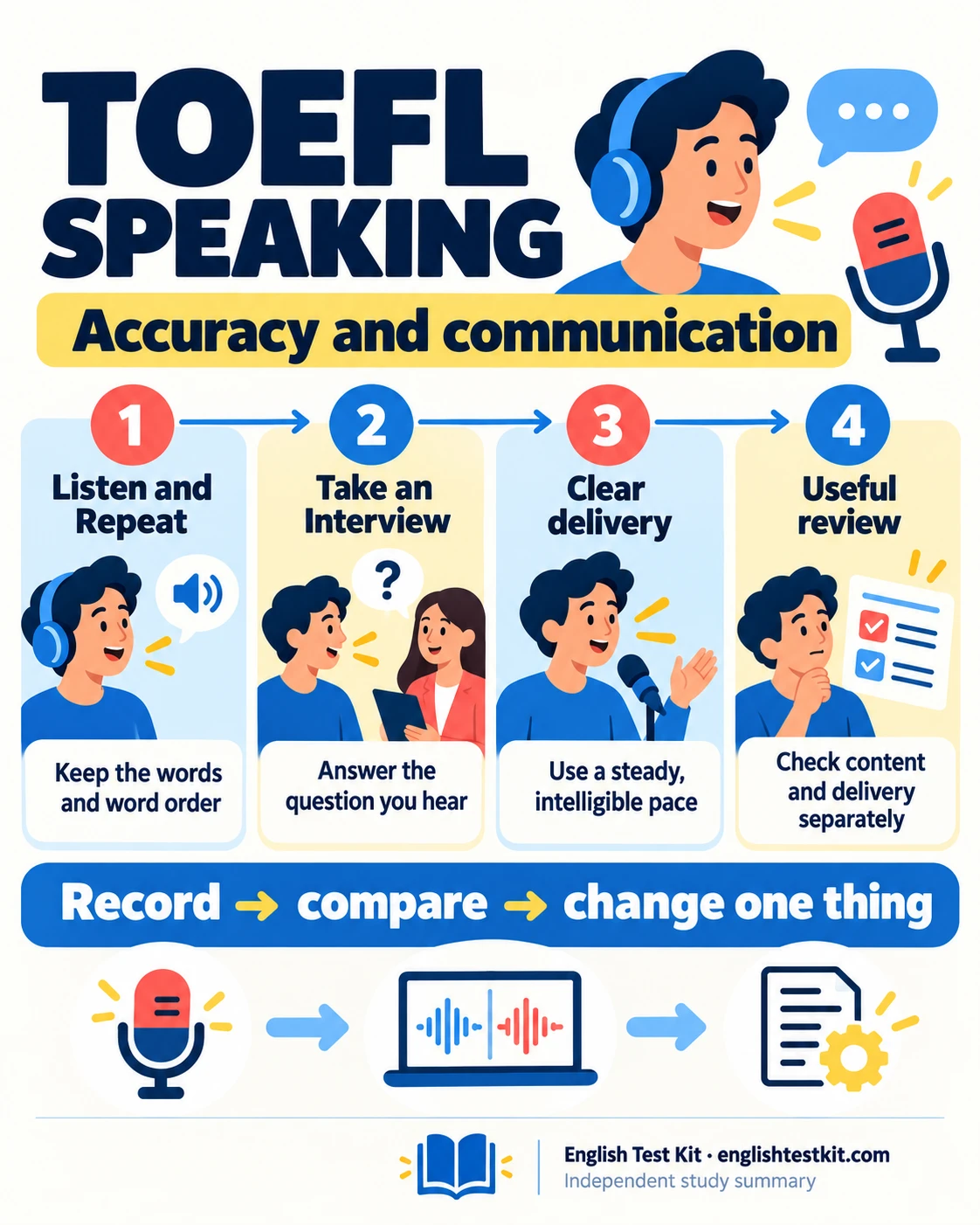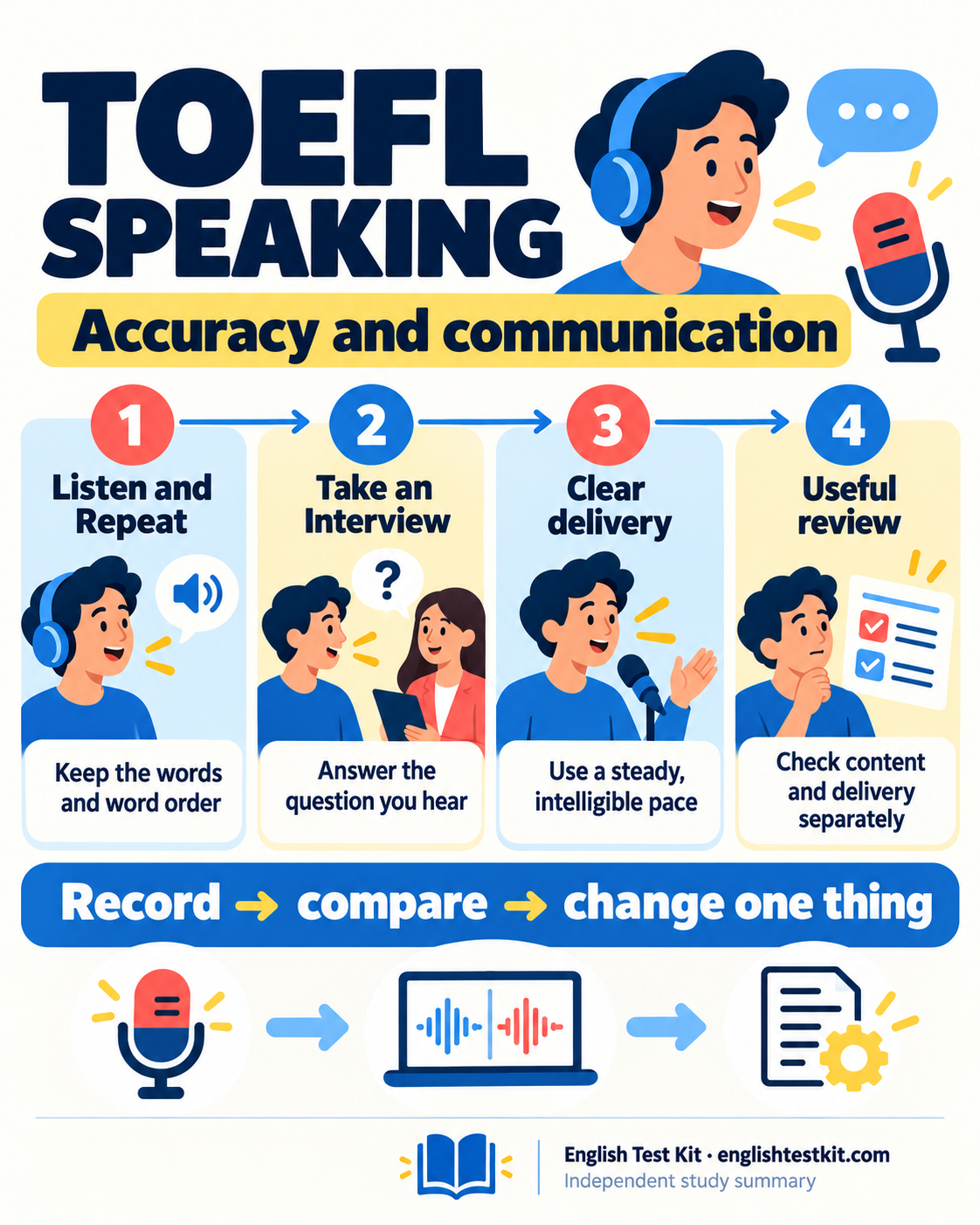
The current TOEFL Speaking tasks require two different habits: accurate reproduction in Listen and Repeat, and a relevant developed response in Take an Interview. Practise them separately before combining them. Adding your own ideas helps an interview answer, but changing the source is not the purpose of repetition.
Two tasks in the current Speaking section
The 2026 TOEFL iBT Speaking section is built around two focused tasks. In Listen and Repeat, you hear short sentences and repeat them. In Take an Interview, you answer questions in a simulated academic or campus situation. These tasks ask for both accurate speech and effective spoken communication.
The current Speaking tasks described by ETS.
Task | What you do | What to practise |
|---|---|---|
Listen and Repeat | Repeat short sentences after hearing them. | Attention to the full sentence, word endings, rhythm and intelligibility. |
Take an Interview | Answer questions about experiences and opinions. | A direct answer, natural pace, relevant detail and clear organization. |
Practise repeating what you hear
Listen for the sentence as a complete unit, including small grammatical words and endings. Repeat it at a steady pace, keeping the original meaning and word order. Recording yourself can reveal whether words disappear, endings are unclear, or your speech becomes difficult to follow when you hurry.
Practise short sentences first, then gradually add longer ones.
Focus on clear consonants and word endings instead of forcing an accent.
Review accuracy and intelligibility separately: what you said and how clearly it could be understood.
Answer an interview question with a clear shape
Start by answering the actual question. Add a reason, a detail, or a brief example to make the answer specific, then stop when the point is complete. A short pause to organize one idea is usually more effective than filling the whole response with repeated phrases. Use vocabulary you can control accurately.
Build a realistic practice loop
Use a mix of prompts about everyday campus situations, personal experiences and opinions. Record responses, listen once for whether the answer addresses the question, and listen again for pace, grammar and intelligibility. Change one thing at a time in the next attempt.
ETS gives Speaking a base estimate of about 8 minutes and 11 items; follow the current section instructions and on-screen timing. The adaptive design applies to Reading and Listening. You record responses using a microphone.
Avoid old task templates
Many older preparation materials focus on an independent opinion task and integrated tasks that combine reading and listening. ETS now lists Listen and Repeat and Take an Interview for the current Speaking section. Check the date and format of any course, practice book, or online sample before investing preparation time.
Listen and Repeat: preserve the whole sentence
Use this original practice sentence: “Please return the library books by Friday.” If the response becomes “Return library books Friday”, several useful words disappear. The general topic remains recognisable, but the language has not been reproduced accurately. Compare the small grammatical words and word order as well as the prominent nouns.
Listen in meaningful groups rather than treating every word as an isolated memory item. After a fresh recorded practice sentence, reproduce it at a controlled pace, then compare with the source. Note omissions, substitutions, endings and any pronunciation that makes the words hard to understand. Use a different sentence to check whether the correction transfers.
Reading the sentence on this page is a demonstration of what to review, not a substitute for listening practice. For a genuine first attempt, use suitable audio without seeing a transcript, then consult the text during diagnosis.
Take an Interview: answer, explain and illustrate
For the original practice question “What makes a study space useful?”, a minimal answer might be “It should be quiet.” A developed response could explain that quiet reduces interruptions, describe how a library table helps with sustained reading, and acknowledge that group work may need a different space.
The example shows a line of thought, not a script to memorise. A question about working with other students would need a different emphasis. Begin with the actual question, select an idea you can explain and add a relevant reason or example. An elaborate story that does not answer the prompt is not useful development.
Separate content from delivery in review
On the first listen to a recording, ask whether the response does the right task. For repetition, compare it with the source. For an interview answer, check relevance, specificity and connection between ideas. On a second listen, inspect pace, intelligibility, grammatical control and unnecessary restarts.
This two-pass method helps you avoid repairing pronunciation in an answer that still misses the question, or rewriting good content when the main problem is unclear delivery. Choose one adjustment for the next attempt, such as finishing word endings or giving an example instead of repeating the same opinion.
Build flexible practice
Alternate shorter and longer repetition sentences with fresh interview prompts about experiences, preferences and campus situations. Keep the first response independent, then use replay and feedback for learning. Gradually rehearse the current task conditions and response windows using official familiarisation material. Reliable performance across unfamiliar prompts is stronger evidence of readiness than the best recording of an answer you have rehearsed many times.
Save your one-page study summary