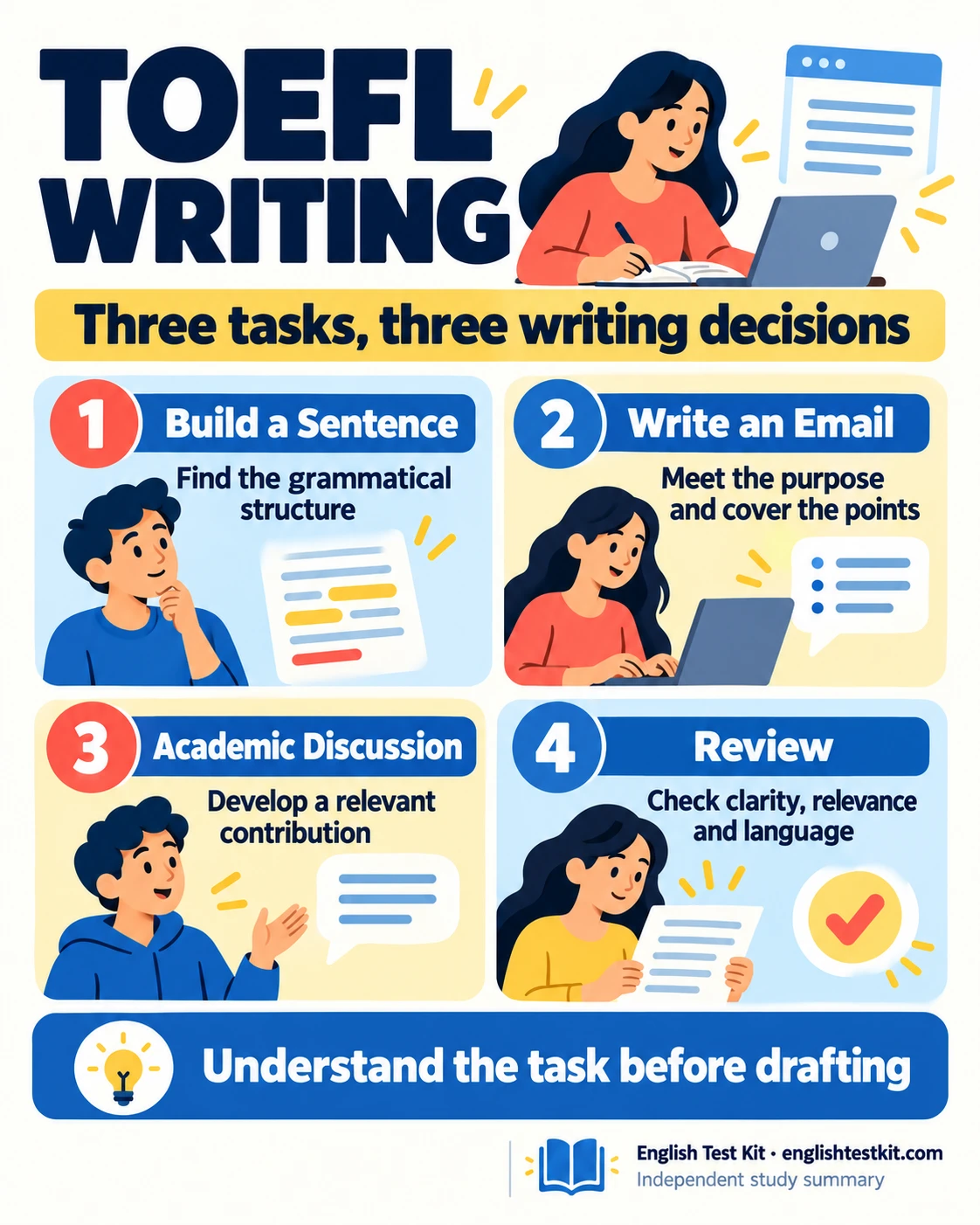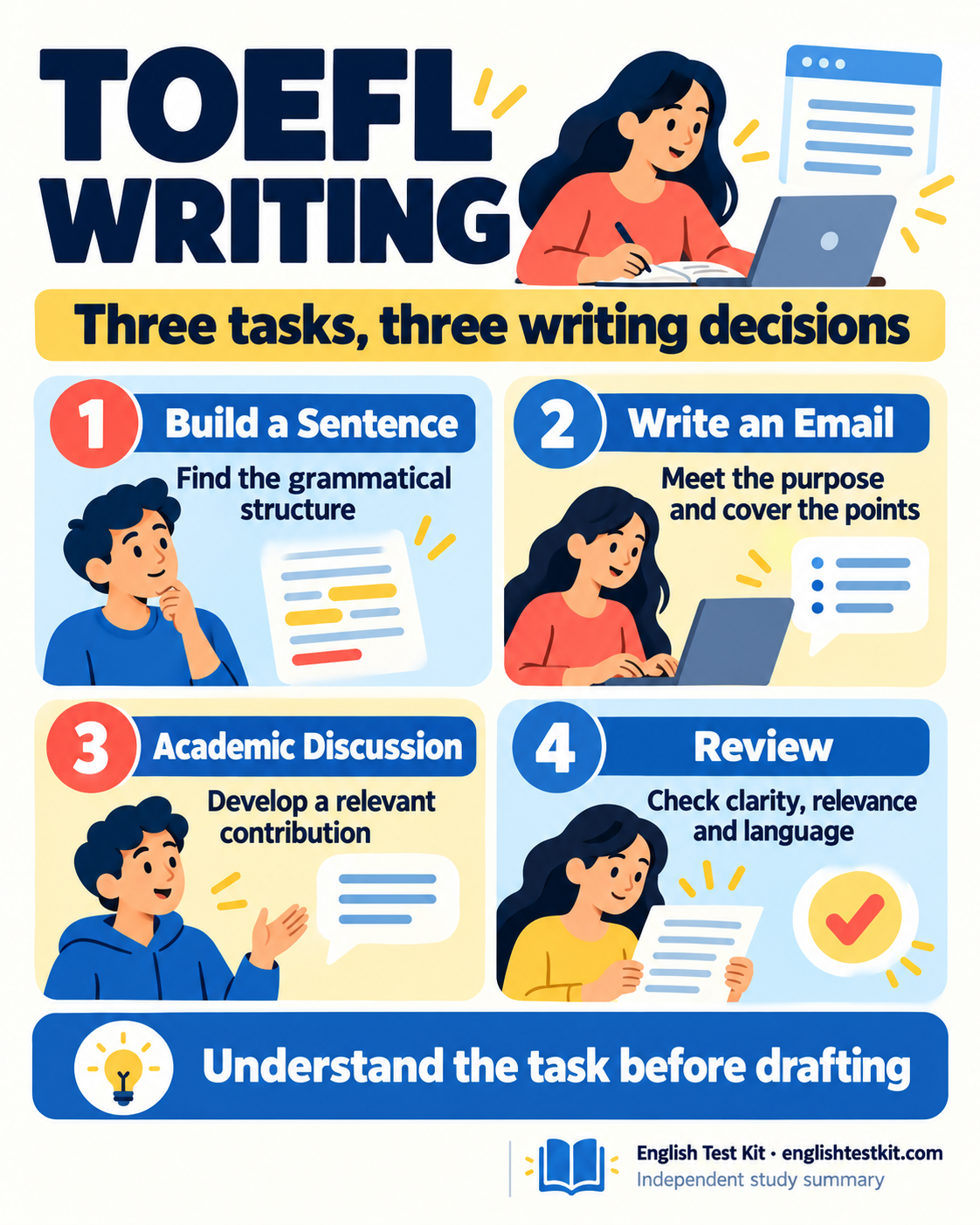
Current TOEFL Writing combines sentence-level control with two purposeful writing tasks. Preparation should include recognising grammatical relationships, meeting a reader's needs and developing a relevant contribution. A fluent response still needs to answer the specific prompt in the required form.
Three tasks, three kinds of writing
The current TOEFL iBT Writing section asks you to use English for both sentence-level accuracy and practical communication. ETS lists three task types. You arrange language into a grammatical sentence, write an email for a situation, and contribute to a classroom-style academic discussion.
The three current TOEFL iBT Writing task types described by ETS.
Task | What you do | A useful practice focus |
|---|---|---|
Build a Sentence | Arrange words or phrases to form a complete sentence or question. | Word order, clause structure and punctuation. |
Write an Email | Write to someone in an academic or social situation. | Purpose, audience, clear requests or information, and tone. |
Write for an Academic Discussion | Add a supported view to an online class discussion. | A direct claim, relevant support and a clear response to the topic. |
Practise the sentence task for accuracy
For Build a Sentence, learn to recognize the structure that the meaning requires. Find the subject and main verb, check where modifiers belong, and verify that the finished sentence is complete. When a sentence is wrong, identify the pattern that caused the problem instead of only memorizing the corrected answer.
Practise statements and questions, including clauses joined with connectors.
Check agreement, tense, articles and prepositions after arranging the words.
Read the finished sentence once for meaning and once for grammar.
Make an email easy to act on
An email prompt gives you a situation and a reason to write. Before drafting, identify the recipient, your purpose, and any points the prompt asks you to cover. Put the main request or message early, answer every part, and use a tone that suits the relationship. Leave a moment to check clarity and basic conventions.
Contribute a focused academic discussion response
For the discussion task, state your position clearly, then explain it with a reason or example. Keep each sentence connected to your main point. If the prompt presents other viewpoints, show that you understood the issue before adding your own contribution. Clear development is more useful than complicated vocabulary that obscures your meaning.
ETS describes the current section as three tasks, with a base estimate of about 23 minutes and 12 items. Follow the time and instructions shown for your section. The current multistage adaptive design applies to Reading and Listening.
Prepare with the current format
Older TOEFL materials may describe an integrated writing task based on a reading passage and lecture. That is not one of the three task types listed on ETS’s current Writing page. Use up-to-date material for task names and directions, then practise the underlying English skills regularly.
Build a Sentence: identify the grammatical relationship
Consider these original practice fragments: “the students”, “asked”, “whether”, “the lab” and “was open”. A coherent arrangement is “The students asked whether the lab was open.” The embedded question uses statement order after “whether”; “whether was the lab open” would not fit that structure.
Look for the subject and main verb, then identify how the remaining words form a clause, question or modifier. After arranging the sentence, read it once for meaning and again for grammar. When an answer fails, name the pattern—such as embedded-question order—so you can practise a fresh example rather than memorise one sequence of fragments.
Write an Email: make the required action clear
Imagine an original campus situation: you need laboratory access for a project, the online booking page is unavailable, and you must ask a staff member how to reserve a slot. A useful plan includes the reason for writing, the technical problem, the requested help and any relevant availability permitted by the prompt.
“I cannot use the website. Please reply” leaves the recipient to infer too much. A clearer practice message explains the project purpose, identifies the unavailable booking page and asks how to reserve an appropriate slot. The improvement is task coverage and an actionable request, not simply adding a longer greeting.
Check every point in the prompt before polishing language. A polite email that omits the main request can be less effective than a straightforward one that supplies what the reader needs. Choose a tone suited to the relationship and avoid filling the response with memorised formal expressions.
Academic Discussion: contribute rather than repeat
For an original practice topic, imagine a class discussing whether a campus café should open later. One student values access for evening learners; another raises staffing costs. A developed contribution could support a limited trial, explain how it would measure demand and acknowledge the cost concern. It adds a reasoned proposal while responding to the issue already being discussed.
A response that merely repeats both classmates' views has little independent development. Choose a position, explain why it is reasonable and support it with a specific illustration or consequence. You do not need to agree with every previous comment, but your contribution should make sense in the discussion.
Revise in a useful order
First check relevance and completeness: have you answered the actual question and covered the requested points? Next check organisation: does each sentence support the purpose, and are relationships clear? Finally inspect grammar, vocabulary, spelling and punctuation. This order avoids spending the final moments improving a sentence in an answer that still misses a required idea.
Practise parts of the process as well as complete timed responses. Build several sentences of the same grammatical pattern, plan different emails or develop one discussion paragraph. Then combine those skills under the current task conditions. The examples here demonstrate independent teaching methods; they are not official prompts or scored responses.
Save your one-page study summary