TOEFL's current score scale is easier to use when you keep the overall band and four section results together. The overall calculation summarises a profile; it does not remove a weaker skill or establish whether a recipient's requirement is met. Read the official report first, then compare it with the exact conditions of your application.
Four section scores and an overall score
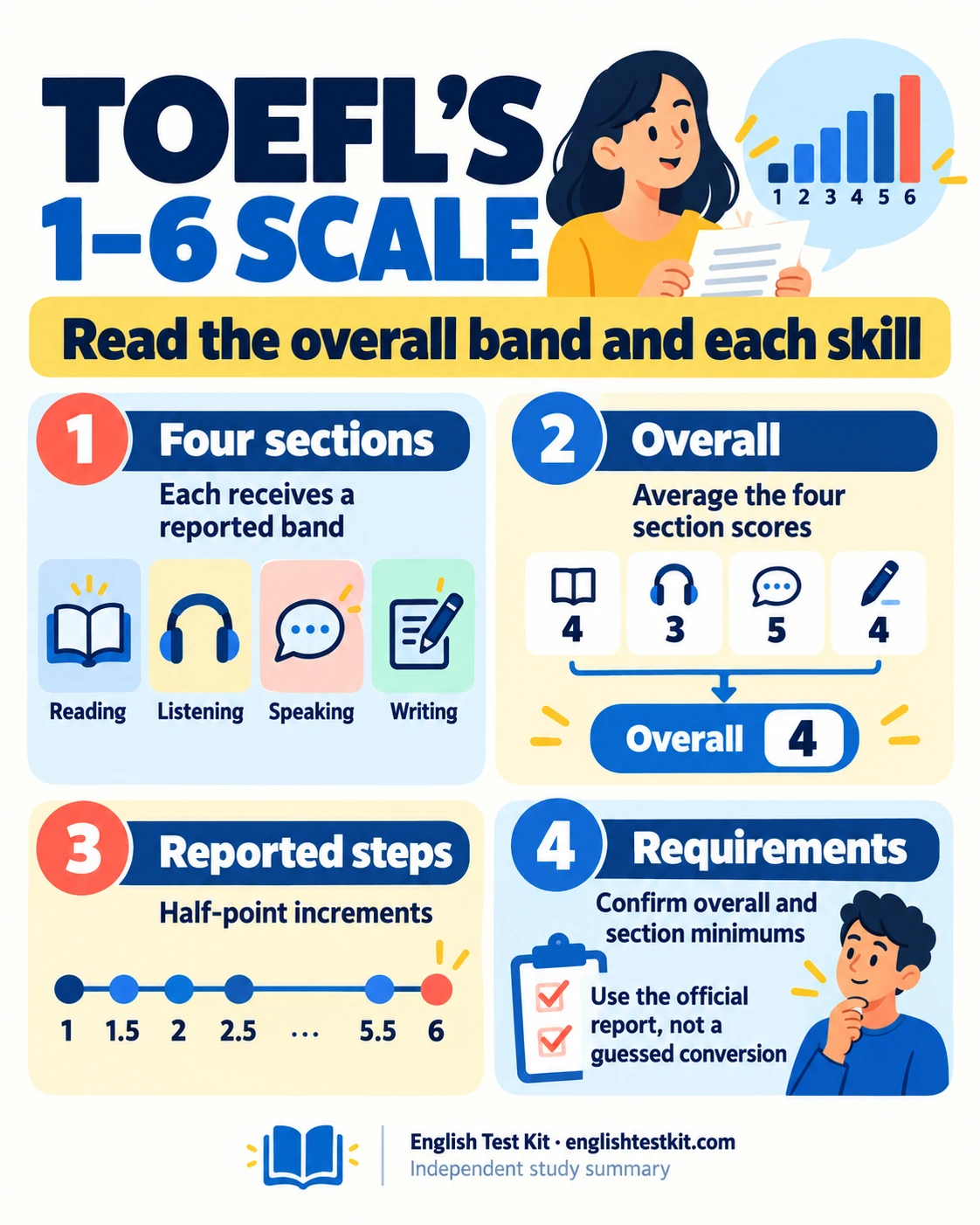
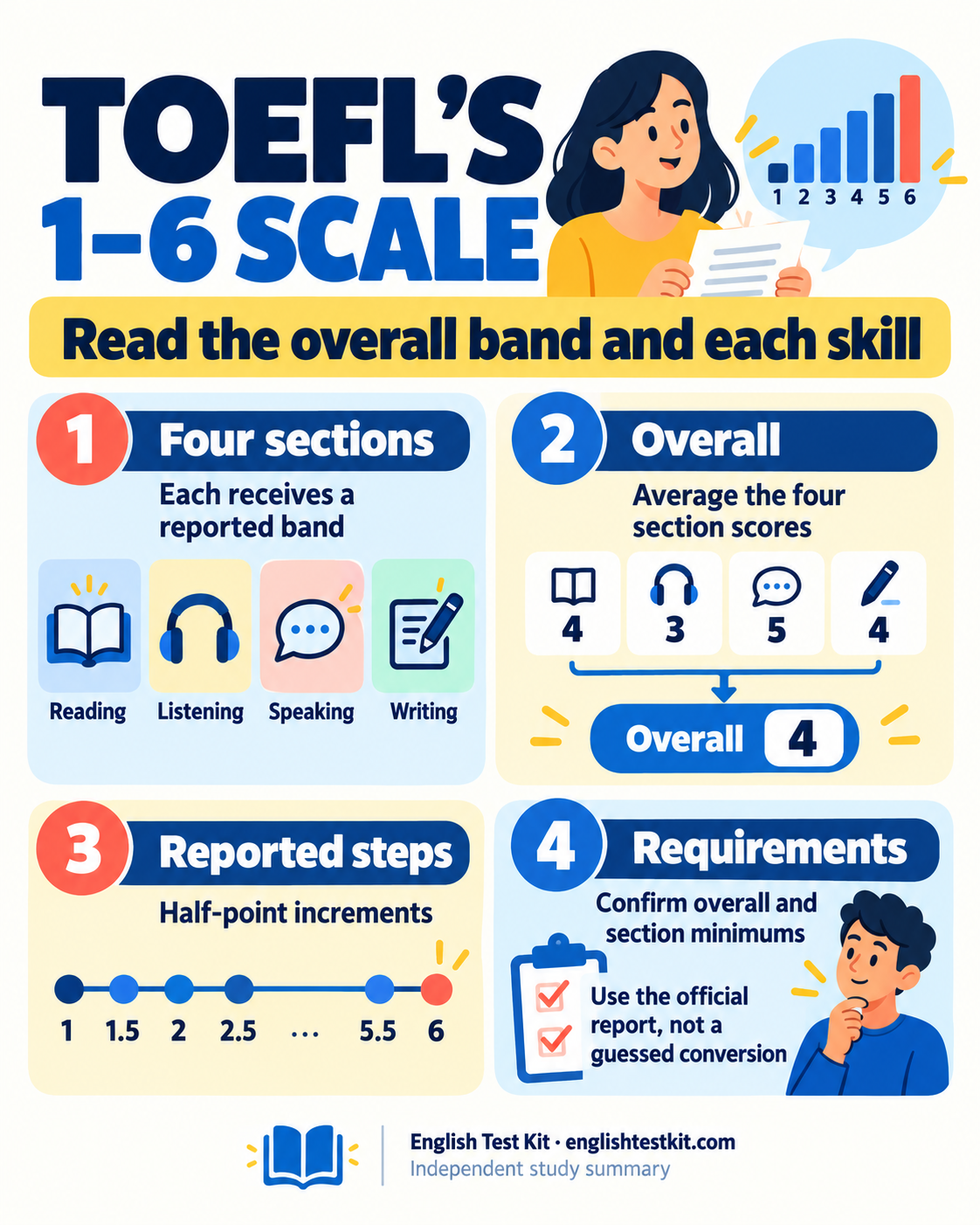
For tests taken on or after January 21, 2026, TOEFL iBT score reports use a 1–6 scale in half-point increments. You receive a score for Reading, Listening, Writing and Speaking, plus an overall score. ETS says the overall score is the average of the four section scores rounded to the nearest half band.
Illustrations of the overall score calculation; actual section scores come from the official report.
Section scores | Average | Reported overall |
|---|---|---|
4.5, 5, 5, 5.5 | 5.0 | 5.0 |
4, 4.5, 5, 5 | 4.625 | 4.5 |
5, 5, 5.5, 5.5 | 5.25 | 5.5 |
How to read the scale
ETS maps the bands to the Common European Framework of Reference for Languages (CEFR). Its current score report includes a CEFR level as well as the TOEFL scale results. Read the section scores alongside the overall result: the average cannot show every skill’s strengths and gaps.
ETS’s published CEFR alignment for the 1–6 scale; confirm requirements with your receiving institution.
CEFR level | TOEFL band(s) |
|---|---|
C2 | 6 |
C1 | 5–5.5 |
B2 | 4–4.5 |
B1 | 3–3.5 |
A2 | 2–2.5 |
A1 | 1–1.5 |
A half band is a valid reported increment; scores do not move in tenths.
The overall score is an average of section scores, rounded to a half band—not a separate fifth section.
Institutions set their own score requirements; ETS does not set a universal pass mark.
Use the official score report and ETS guidance rather than a third-party conversion calculator.
Why requirements may still look different
Universities and programs update admission pages on their own schedules. Some may list a requirement on the former 0–120 scale while others may have moved to the 1–6 scale. During the transition period, ETS says the report includes a CEFR level, the new section and overall bands, and a comparable overall 0–120 score. Check the exact requirement and any section minimum directly with the receiving institution.
This guide explains the scale; it does not convert or predict an individual test result. Your official ETS report is the authoritative record.
Use scores to make a next-step plan
Compare each section with the requirement for your intended program, then identify the weakest task types within that skill. A target should reflect the school’s stated minimums, your application timeline and the time you can devote to practice—not a generic claim that one score is “good” for every applicant.
Work through an overall-band example
Consider fictional section scores of Reading 5.0, Listening 5.0, Writing 4.5 and Speaking 5.5. The sum is 20, and dividing by four gives 5.0. No further movement is needed to report the overall band in this example. The Writing band remains 4.5 even though the overall result is higher.
For a second illustration, Reading 5.0, Listening 5.0, Writing 5.5 and Speaking 5.5 total 21. The average is 5.25, which is reported as 5.5 under the official half-band rounding rule. Use reported section values and the provider's rule; do not create decimal section scores that the report does not give.
Compare every condition separately
Imagine a fictional programme requiring overall 5.0 and Writing 5.0. The first example satisfies the overall condition but not the Writing condition. A different programme could use different thresholds, so the same profile could lead to a different decision. These scenarios illustrate how to read requirements, not real admission policies.
Record the accepted score scale, overall minimum, individual-section minimums, test setting and result-date policy. During the transition between report formats, a recipient may still display older terminology. Ask how it wants the official current report interpreted instead of assuming that an unofficial conversion answers the question.
Use CEFR alignment appropriately
The provider's CEFR mapping describes broad proficiency alignment. It does not mean that every learner with the same overall band has identical strengths, nor that every institution accepts the same level for every purpose. Read the section profile and any additional recipient conditions alongside the alignment information.
For study planning, ask what the lower section score represents in actual work. A Writing issue could involve task coverage, organisation or language accuracy; a Listening issue could involve recognising speech or following an implication. The score identifies a broad area to investigate, while reviewed task responses provide the more specific learning target.
Keep practice estimates separate
A short task set can be useful for diagnosing errors without predicting a certified band. Material difficulty, task coverage and scoring procedures matter. Use suitable official practice and informed feedback where available, then look for consistent improvement across fresh tasks. Avoid treating one unusually strong attempt or a simple percentage as the official result you will receive.
Finally, keep the test date with the report and use the provider's current reporting guidance. The official record and the recipient's requirement are the two documents that settle the administrative comparison.
Save your one-page study summary